

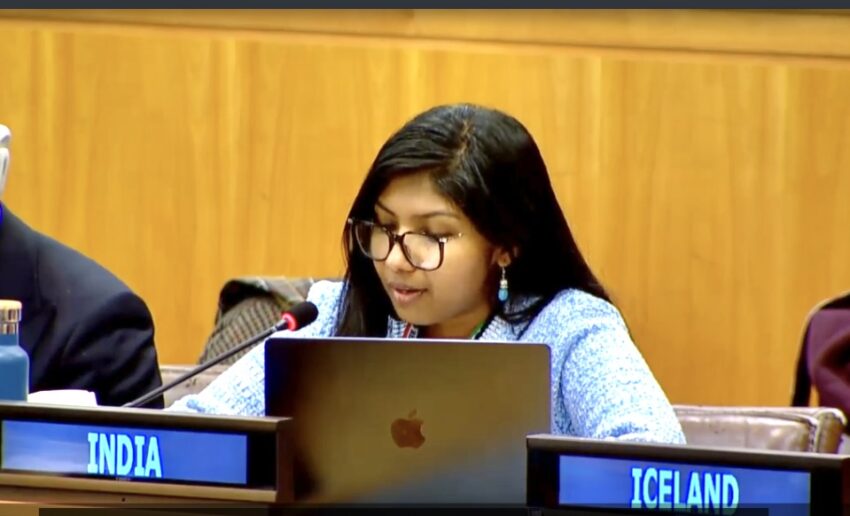
United Nations — India delivered a firm rebuke at the United Nations today, warning member states against weaponizing the principle of self-determination to promote separatism within established democracies.

Addressing the Third Committee, 49th plenary, UN General Assembly, on “Universal Realization of the Right of Peoples to Self-Determination” November 19, 2026, India’s diplomat, Bhavika Mangalanandan, reaffirmed India’s historical commitment to anti-colonialism while drawing a strict legal boundary around how the UN Charter’s core tenets should be applied in the modern era.
“The right to self-determination cannot be abused, to encourage secession and undermine pluralistic and democratic states,” India stated, emphasizing that the concept must be viewed strictly through a historical lens.
Drawing on its own legacy as a former colony that stood at the forefront of the global decolonization movement, India stressed that the international community has long held a clear consensus on the issue – that self-determination applies exclusively to colonized peoples, non-self-governing territories, and trust colonies under foreign domination, not to component groups within independent, sovereign nations.
ADVERTISEMENT

“The UN has established that the principle of self-determination is a vehicle for decolonization, not a justification for secession or undermining territorial integrity of any member state,” India noted.
In a pointed critique aimed at geopolitical rivals, India condemned ongoing efforts within UN forums to distort foundational international law. Calling such maneuvers “unacceptable,” India accused unnamed actors of attempting to “reinvent some of the basic principles of the charter… and to apply them selectively for narrow or domestic political ends.”
Concluding her remarks, Mangalanandan asserted that once a nation achieves independence, the spirit of self-determination is no longer an external right to break away, but an internal process preserved “through the regular exercise of democratic choice.”
India’s stance was shared by Spain by placing territorial integrity against self-determination. Spain strongly maintained that Under UN Resolution 1514, the right to self-determination cannot be used to justify colonial situations that violate a state’s territorial integrity, nor can an administering power claim the colonial link is severed through misinterpreting this principle.
Both India and Spain were responding to a draft resolution presented by Pakistan and its co-sponsors.