

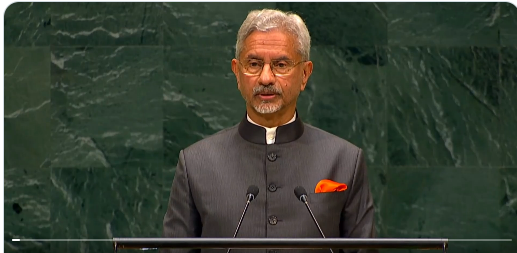
New York [US], September 27, 2026: India’s External Affairs Minister S Jaishankar on Saturday, September 26, called out Pakistan for terrorist activities within and outside its borders; raised concern over the fate of Indian and other seafarers safety and security, and highlighted every nation’s right to shape its on AI ecosystem through development of its own models and deployment strategies in line with national goals and priorities.

Addressing the 81st United Nations General Assembly (UNGA), Jaishankar launched a sharp critique against nations attempting to distort global realities and justify safe havens for extremists, in an oblique reference to Pakistan whose Prime Minister Shehbaz Sharif had addressed the UNGA on Friday, the day before Jaishankar addressed the international body..
“Yesterday, a serial practitioner of terrorism misrepresented facts before this assembly. Arguments were invoked to normalise terrorism and claim immunity from its consequences. That will not stand. Our right to defend ourselves against terrorism will be exercised. Friendship and goodwill cannot coexist with terrorism, and understandings premised on that will naturally be called into question. It is for the perpetrator of terrorism to mend its ways…”
He stressed that the international community must dismantle state-backed syndicates without exception. Highlighting the institutional dangers posed by state actors, he emphasized, “A persistent threat to peace has been the scourge of terrorism. That this could be state-sponsored, with cross-border purpose, makes it a direct affront to the global order. Governments indulging in such practices must be held accountable. There must be no dilution in our zero-tolerance approach towards terrorism. Its financial aspects, in particular, should be exposed and should be countered…”
ADVERTISEMENT

Jaishankar went on to raise concerns over attacks on commercial shipping and seafarers in various maritime regions, including the Gulf, Red Sea and Black Sea. Calling it “completely unacceptable” Jaishankar noted that Indian seafarers, along with others from different countries, had lost their lives in such attacks.
He said India has joined Liberia and 23 other partners in an initiative aimed at building global public opinion against such attacks.
“We must ensure that the safety and security of shipping and seafarers is never compromised. Scrupulously observing international law is an integral element of that endeavour,” the External Affairs Minister added.
On the fast-advancing global AI scenario, Jaishankar stressed the priorities and needs of regions and nations, adding that India views AI as an important part of its partnership agenda with the Global South.
He said Artificial Intelligence (AI) is a transformational driver for human empowerment, economic prosperity and solving population problems, while stressing the need for technology democratization and cultural understanding.
“An issue central to current global conversations, is that of AI. India hosted the AI Impact Summit this February, gathering together the best minds on that subject. We view AI as a transformational driver, for human empowerment, economic prosperity and population-scale problem solving,” he said.
“We believe in the right of each nation, to shape its eco-system, with the development of its own models, and deployment strategies, consistent with its national goals and priorities. AI will be very much part of our partnership agenda, with the Global South,” Jaishankar added.
Jaishankar further highlighted the importance of mutual respect as technology becomes more accessible, saying that consideration for the interests and viewpoints of others strengthens prospects for peace.
He also emphasized the role of culture and heritage in promoting international understanding in a globalized world, stating that economic and political rebalancing is already underway and cultural rebalancing must now be advanced.
“As technology is democratized, this process is greatly facilitated, by an ethos of mutual respect. Indeed, care and consideration for the interests, and viewpoints of others, reinforces even the prospects of peace,” he said.
“In a globalized world, we must continuously and vigorously, promote international understanding. Economic rebalancing is well underway; the political one is also visible, and the third facet – cultural rebalancing – must now be taken forward,” he said.
He highlighted the challenges faced by the Global South.
“The predicament of the Global South, is particularly acute. It faces a 4F crisis – of the security of food, fuel, fertilizer and finance. The combined impact of a Super El Nino, compounding fertilizer shortages and now impediments to grain movements, all these are cause for alarm. Moreover, SDG (Sustainable Development Goals) progress is under increasing pressure. The Global South’s right to industrialize is also undermined by non-market practices and market denial. The march of technology, that was meant to instill hope, has now become a source of anxiety. Misuse of AI is sharpening bias, and diluting mutual respect. These directions bode ill for the aims and objectives of the United Nations,” he said.