

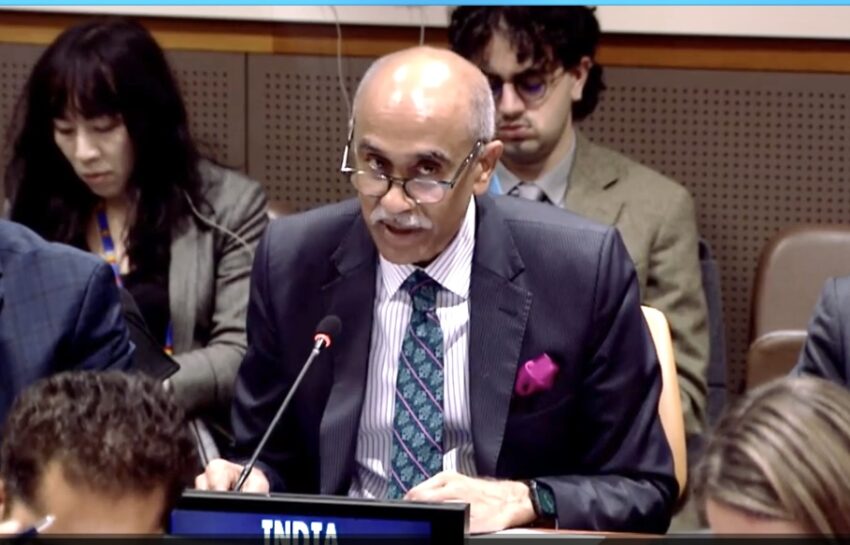
United Nations — India called for stronger international efforts to prevent armed groups and terrorist networks from exploiting natural resources, while warning that supply-chain rules should not create undue barriers for developing countries.

Addressing the informal meeting of UN Security Council on “Arria Formula on Natural Resources and Conflict”, convened by Liberia on November 18, India’s Permanent Representative to the UN, Parvathaneni Harish, outlined a seven-point framework, stating that natural resources must act as engines of development and prosperity rather than drivers of conflict. He emphasized the need for respect for national sovereignty, national ownership, and voluntary international cooperation, and highlighted India’s commitment to curbing the illicit trade of conflict diamonds in its capacity as the 2026 Chair of the Kimberley Process.
Conflict diamonds, often called blood diamonds, fueled devastating civil wars during the1990s and early 2000s, in Angola, Sierra Leone, Liberia, and the Democratic Republic of the Congo, resulting in millions of deaths and widespread human rights abuses. Because rough diamonds are tiny, lightweight, easily concealed, and hold immense value, they became an ideal currency for warlords and insurgent groups.
While large-scale civil wars funded by diamonds have declined, illicit trading persists on a smaller scale—funding armed groups in regions like the Central African Republic or being used to bypass international sanctions.
ADVERTISEMENT

Kimberley Process Certification Scheme is an international, multi-stakeholder certification scheme established to stop this trade by tracking rough diamonds from the mine to the export market. Established in 2003 through a UN mandate, the Kimberley Process is a joint initiative involving governments, the international diamond industry, and civil society organizations. Today, it has 60 participants representing 86 countries, with the European Union counting as a single participant, covering 99.8% of the global production of rough diamonds.
Harish said India, the world’s largest importer of rough diamonds, valued at $10.48 billion, and a leading exporter of polished stones, valued at $12.16 billion, would work to strengthen the Kimberley Process and make it more effective and inclusive in curbing the trade in conflict diamonds.
Describing the Kimberley Process as an “instructive example” of tri-sector collaboration among governments, industry, and civil society, Harish argued that international resource governance succeeds best when it remains “voluntary, consensus-based, and nationally led in an environment of friendship and goodwill”. He urged member states to rely on existing, proven frameworks rather than drafting redundant global mandates.
While stressing the need to prevent armed rebels and terrorist networks from exploiting mineral wealth, Harish warned against measures that penalize legitimate commerce in the Global South. Acknowledging the importance of supply-chain transparency and due diligence, Harish cautioned that such “standards should not become compliance burdens or disguised barriers to trade for developing countries,” calling instead for technology partnerships, local value addition, and capacity-building.
The discussion turned to the Indus Waters Treaty after Pakistan’s delegation raised India’s suspension of the agreement. Harish said he had not intended to raise bilateral issues but responded to what he described as Pakistan using the forum to “peddle its propaganda.”
Turning his focus to Pakistan’s domestic governance, Harish accused the Pakistani military of exploiting the nation’s natural resources for self-interest. He pointed directly to a September 2025 incident in which Pakistan Army Chief Field Marshal Asim Munir presented a wooden box of mineral stones to foreign leaders.
Harish linked the military’s involvement in resource extraction to internal political instability, specifically citing the dismissal of a provincial government and the imposition of a state of emergency.