

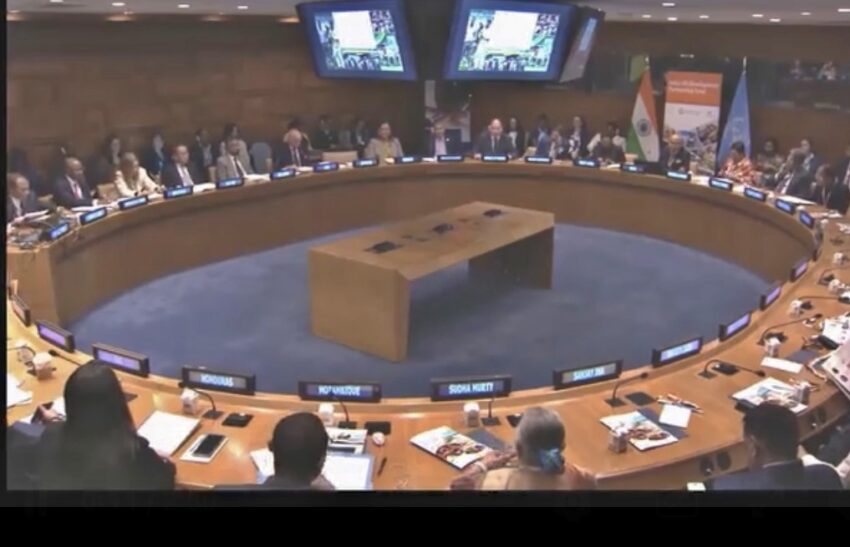

United Nations – Amid rising global economic uncertainties and escalating climate pressures, global leaders, high-ranking diplomats, and a visiting parliamentary delegation from India converged at the UN Headquarters on October 22, 2026, for the 9th annual event of the India-UN Development Partnership Fund.
Under the guiding theme “South-Led Solutions, Shared Results,” the high-level gathering served as a comprehensive review of nearly a decade of demand-driven South-South cooperation, while formally releasing the 2026 India-UN Development Partnership Fund Year-End Review Report to map out an ambitious future focused on artificial intelligence, digital innovation, and sustainable growth across the Global South.
Opening the proceedings, P. Harish, Permanent Representative of India to the UN, emphasized that development cooperation is a driving force deeply rooted in India’s civilizational philosophy.
“Our approach to development cooperation is rooted in our civilizational ethos of Vasudhaiva Kutumbakam, that the whole world is one family. We believe that progress becomes more enduring when we share our experiences amongst friends and partners in the Global South, strengthen each other’s capabilities, and advance together,” he said.
ADVERTISEMENT

Recalling the 2017 inception of the fund backed by an initial $150 million commitment from the Government of India, Harish highlighted how the initiative rigorously prioritizes host-country leadership and unconditional support.
Echoing this vision, the leader of the Indian parliamentary delegation, Member of Parliament Sangeetakumari Singh Deo, reiterated international development cooperation as a central pillar of India’s foreign policy framework.
She further detailed how India’s multilateral engagements are augmented by robust bilateral tools, pointing to the Indian Technical and Economic Cooperation(ITEC) program which has trained thousands of civil servants and judicial officers since 2014, alongside broader financial architectures including rupee-denominated lines of credit and debt restructuring support for nations navigating severe economic distress.
She also cited new lines of credit with Angola, Mongolia, Maldives, and Mauritius, including a rupee-denominated line of credit to the Maldives. She described India’s completion of debt restructuring with Sri Lanka as support for the country’s recovery from its economic crisis, thus extending the Fund to include financial, technical and institutional cooperation.
Operating as a cornerstone for grassroots empowerment and climate resilience, the Fund currently maintains a sweeping portfolio spanning 94 projects across 64 member states, managed in cooperation with 14 UN entities, with a concentrated focus on Least Developed Countries (LDCs), Landlocked Developing Countries (LLDC), and Small Island Developing States (SIDS) to systematically advance the 2030 Sustainable Development Goals.
The practical reality of this solidarity was vividly reinforced by UNDP Associate Director Haoliang Xu, who detailed the operational scope, noting that the UNDP has implemented 40 of these projects, delivering over $31 million to accelerate SDG achievement.
Both Indian representatives and event proceedings placed strong emphasis on the indispensable role played by UN partners, extending explicit gratitude to the United Nations Office for South-South Cooperation (UNOSS) for providing seamless secretarial services, as well as to the United Nations Development Program (UNDP), the Pan American Health Organization (PAHO), and other participating entities.
Dr. Jarbas Barbosa da Silva Jr., Director of PAHO, praised the fund’s deep trust in local leadership, sharing how projects are strengthening everyday public health infrastructure.
Permanent representatives and delegates from partner countries shared how the fund directly addresses local vulnerabilities, featuring interventions from Tuvalu, St. Lucia, Timor-Leste, Cuba, Moldova, the Federated States of Micronesia, the Commonwealth of Dominica, Sri Lanka, Lao PDR, Tanzania, Mozambique, Kiribati, Venezuela, Senegal, and Morocco.
Concluding the remarks, Dima Al-Khatib, Director of UNOSSC, emphasized the fund’s growing integration into global policy discussions and pointed toward future collaborations in artificial intelligence, digital innovation, and knowledge-sharing via the South-South Galaxy+ platform.
The 2026 Year-End Review Report released at the event underlined this expansion, highlighting that largest investments are directed toward SDG 3 for Good Health and Well-being, SDG 4 for Quality Education, and SDG 1 and SDG 6 addressing No Poverty and Clean Water and Sanitation.