

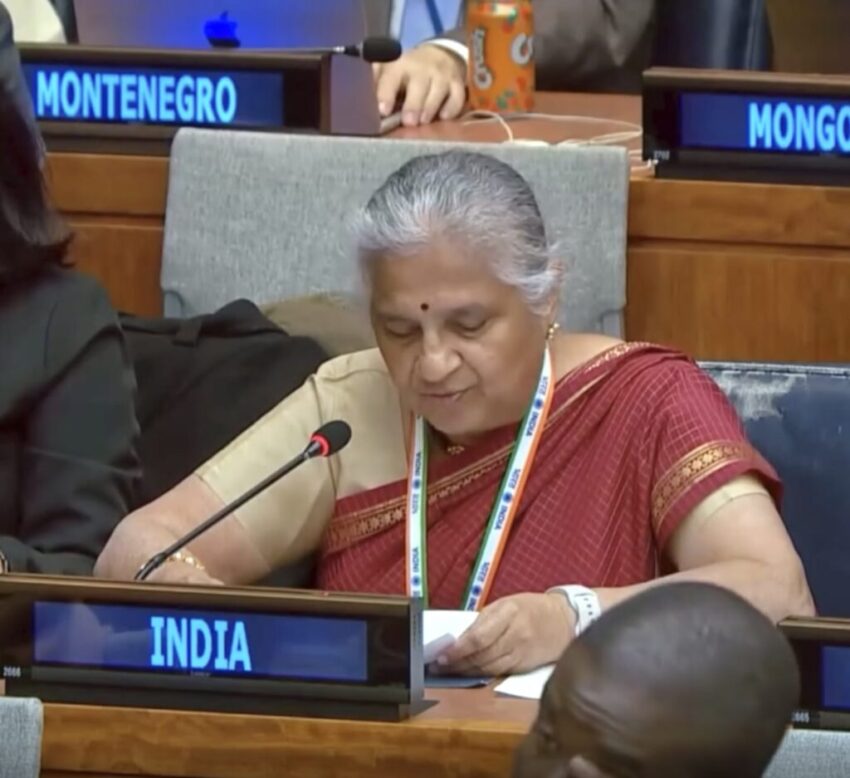
United Nations – That outer space must remain a sanctuary for international cooperation rather than a stage for conflict, was India’s resolute message to the First Committee of United Nations General Assembly.

Speaking before the committee on October 20, 2026, Member of Parliament, Sudha Murthy anchored India’s vision in a global ethos, declaring, “India believes that outer space belongs to all of us. We are one earth, one family with one future. It is our view that our outer space should remain relevant for cooperation, not conflict.”
Championing a Legally Binding Treaty
Addressing the shifting geopolitical and technological realities of the world, Murthy highlighted the rise of new actors and the growing prevalence of dual-use space technologies. While acknowledging differing international approaches to preventing an arms race in outer space (PAROS), she firmly reiterated India’s core stance that voluntary steps are not enough.
ADVERTISEMENT

Referring to the legally binding draft treaty on prevention of the placement of weapons in outer space as an important legally binding instrument Murthy stated, “India reiterates its preferences for a legally binding instrument on one that is universally acceptable, where verifiable and multilaterally negotiated at the Conference on Disarmament,” adding that India views the draft treaty as a constructive foundation for ongoing discussions.
While welcoming transparency and confidence-building measures (TCBMs) as valuable tools, she drew a clear line on their limitations, noting that they “can complement, but not substitute a legally binding instrument.”
The draft Treaty on the Prevention of the Placement of Weapons in Outer Space, the Threat or Use of Force against Outer Space Objects (PPWT) which was formally negotiated and tabled by China and Russia within the Geneva-based Conference on Disarmament, has historically been backed by countries including various members of the BRICS grouping such as India and other developing nations who view a formal treaty as crucial to preventing space militarization.
Despite being repeatedly brought up in the UNGA First Committee and the Conference on Disarmament, the draft treaty has faced a longstanding diplomatic stalemate, with the US and several of its allies strongly opposing the PPWT text. Their primary objections are that the treaty lacks effective verification mechanisms, does not address ground-based anti-satellite (ASAT) missiles which can shoot down satellites from Earth without being “placed” in space, and fails to account for terrestrial counter-space capabilities.
Hence the emphasis by India and other countries supporting the draft on the need for a text that is both universally acceptable and strictly verifiable.
Comprehensive Security and Avoiding Fragmentation
Murthy also cautioned against a fragmented approach to space governance. She stressed that threats to safety, security, and sustainability, alongside risks of misunderstanding and the ambiguous threshold for the use of force, must be evaluated holistically.
“A selective focus on some threats over others would be counterproductive,” she warned, pointing to the inherent challenges of verifying space behavior and managing data access. She urged the international community to respect existing institutional mandates, avoiding policy overlaps and the creation of multiple competing standards.
Safeguarding Scientific Progress
Highlighting the need for international regulatory frameworks to safeguard global scientific development, Murthy emphasized that regulatory outcomes “must not discourage the exchange of scientific and technological research for peaceful, legitimate purposes.”
Concluding her address, Murthy reaffirmed India’s proactive commitment to global space governance: “India stands ready to help strengthen the international legal framework governing outer space and to ensure its peaceful use while enhancing safety, security and sustainability.”