

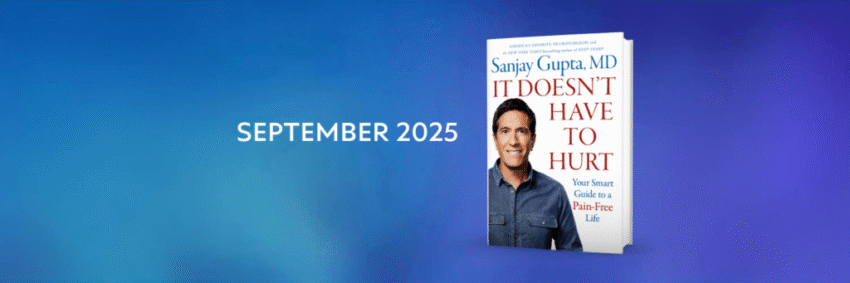

Sanjay Gupta has spent much of his career treating people in pain. But the neurosurgeon and CNN medical journalist recently witnessed firsthand how it can upend your own life: His mother broke her back, and he became her caregiver. The experience taught him that pain hijacks your entire identity, and it hijacks the identity of the whole family. Pain, he saw, can create a sense of powerlessness compounded by the medical community, which often struggles to understand and treat chronic pain. But Gupta also knew that it didn’t have to be this way.
About 20 percent of the American population lives with chronic pain – more than 50 million people. But so much of the conversation around chronic pain has centered on opioids and addiction, Gupta said. In his book, “It Doesn’t Have to Hurt,” Gupta explores what the latest science tells us on how to help relieve pain. He emphasizes that pain begins in the brain and that we should pay attention to our bodies.
Gupta, a staff neurosurgeon at Emory Clinic in Atlanta, came to appreciate that pain was unlike any other experience or symptom. It’s a uniquely personal experience, and maybe – he told me – that was the entire point behind why it is so notoriously difficult to understand and treat. I spoke to Gupta about our brain’s endogenous opioid system, which produces natural painkillers such as endorphins; how foam rolling can actually relieve and prevent pain, and why the placebo effect can be a good thing.
This conversation has been edited for length and clarity.
ADVERTISEMENT

Q: One of the trickiest conversations I have with my patients with chronic pain is when they’ve been told by 10 doctors that their pain is “all in your head.” And there’s this tension between not wanting anyone to feel like they’re making this up – which is not at all true – but also recognizing that all pain starts and ends in the brain.
A: Totally. To best prevent and have the best chance of treating chronic pain, you have to treat the brain first. An acute pain experience can turn into a chronic pain experience if you let that loop of pain cycle over and over again. But if the brain decides the pain doesn’t exist, it doesn’t exist. And I realize that’s a provocative thing to say within the pain world.
Q: What role does the brain play in pain perception?
A: It’s like scrolling a social media feed – you’re scrolling, scrolling, and then something really incendiary pops up. You have to decide: Is this real? Is this fake? Your brain is doing that constantly. And if you’re in a very inflamed state – because of your mood, whether you exercised, what else is happening in your life – everything’s going to hurt. But I could bang your thumb with a hammer on a Tuesday and you would have one sort of pain experience – and I could do the same thing to you on a Wednesday and it could be a totally different pain. It’s kind of awesome to see that variability within a human, let alone … like all the seven, 8 billion other humans on the planet.
Q: It’s difficult to not have a so-called objective measure of pain that captures that well. If a patient comes in and says, “My pain is 10 out of 10,” and they look fine – they’re eating, they’re not crying – a lot of doctors might say, “Go home. I think you’re OK,” right? That’s very hard for patients to navigate.
A: I think the patient has to be the North Star. You have to trust the patient. There’s some people who believe we shouldn’t even try to objectify and measure pain because it is such a personal experience. You can measure cholesterol or the size of a tumor. Pain is a biopsychosocial phenomenon that defies a lot of those measurements. But it’s an opportunity. Chronic pain never occurs in isolation. It always comes with baggage attached. And you have to address the baggage as much as the pain.
Q: Is it possible to tap into the brain’s own endogenous opioid system for better pain relief?
A: Yes. So when you give an opioid pill, you’re going to get a certain half-life, you’re going to get side effects. With your own endogenous opioid system, it turns on and off on a dime without any of that. It’s really wondrous what the body can do. I went through an experiment myself when I was working on the book around what’s known as the MORE therapy: the mindfulness-oriented recovery enhancement therapy. What struck me about the data that’s now coming out of the University of California at San Diego is that when people with chronic pain start meditating in that program, they may have no pain. A meditation session has the capacity to give the same pain-relief as five milligrams of oxycodone.
Q: Most people who end up living with chronic pain cannot identify one clear-cut event that started it – like a fall or car accident. Only about a third of people have that inciting event. That means most people have no idea what caused it.
A: I talk to a lot of gastroenterologists like you who deal with this specifically. IBS often doesn’t have any clear-cut sort of cause. One of the things gastroenterologists really emphasized to me was that a lot of patients worry that something toxic is happening inside their body. “I have this pain, and it means that something bad has happened.”
Q: Right, like eating – or this food – must be harming me because I’m hurting.
A: Exactly. And they told me they often find that when you explain to people that this was not harming you – that there wasn’t this toxic force inside their body, that this was a gut-brain axis phenomenon – it actually relieved a lot of anxiety. Same thing with fibromyalgia.
Q: You say foam rolling can help prevent pain. It wasn’t something that had really crossed my mind that way before.
A: I’m kind of like you. I didn’t have a lot of knowledge of foam rolling, but as I talked to so many different people for the book, it kept coming up over and over again. As we get older, the myofascia – which is basically this thick envelope of tissue that surrounds all your organs and all your muscles – it gets stiff. Two things result. One is that you could have pain just from that. You feel achy as the myofascia becomes increasingly stiff. But also, if you do have an injury, your muscles will tend to swell. And if they’re swelling against a really stiff myofascia, that is more painful. So simply foam rolling on some regular basis can go a long way. But it can be a little bit painful to foam roll.
Q: Yes. I discovered this. I thought, “This cannot be right.”
A: Well, usually it’s most painful in people who’ve not done it before, but once you start to do it regularly, you’re just basically loosening up this connective tissue that I think a lot of people ignore. We focus a lot on muscles. We may strengthen tendons even. Obviously, bone health is really important, but the myofascia is a neglected part of our body’s interconnected system. And it’s highly innervated, which is why it hurts a little bit when you’re foam rolling.
Q: Do you foam roll before you exercise? Or should we do it whether we’re exercising or not?
A: I do it every day. I have it in my closet when I’m getting ready in the morning, it only takes a few minutes for me. Sitting at my desk right now, I have no aches and pains.
Q: What about tools like acupuncture? Despite the fairly good data, there’s still a vocal group of people who say, “No, it’s a placebo.”
A: Absolutely. Look, expectations and experience are inextricably linked. If you expect something to hurt, it will hurt. And if you don’t think it’s going to hurt, you can do almost anything to the human body – within reason – and it won’t hurt. I think it is fair to say, just as a broad statement, that our endogenous opioid system is the placebo effect.
Q: I’ve heard that it can be harnessed through something as simple as looking at photos of your partner or connecting to them in some way. When we just say “try holding the hands of someone you love” – that can sound a little woo-woo to people. But when you think about these tools in terms of what that’s doing neurochemically, it’s incredibly powerful and the studies really back that up.
A: It’s funny that you use the term woo-woo, because I think that’s always in the chat. I mean, I’m a neurosurgeon, you’re a gastroenterologist, and we’re sitting here having this conversation about things that have classically fallen into that woo-woo bucket, you know? But I do think that the endogenous opioid system is at the heart of all of this and it’s a beautiful thing to consider. That it’s within all of us. And if I am diving into things that are traditionally thought of as woo-woo as a Western-trained neuroscientist, then hopefully that leaves an impact on people – that, “Hey, this guy is looking at this with an open mind and trying to explain not just the what, but the why behind it.”