

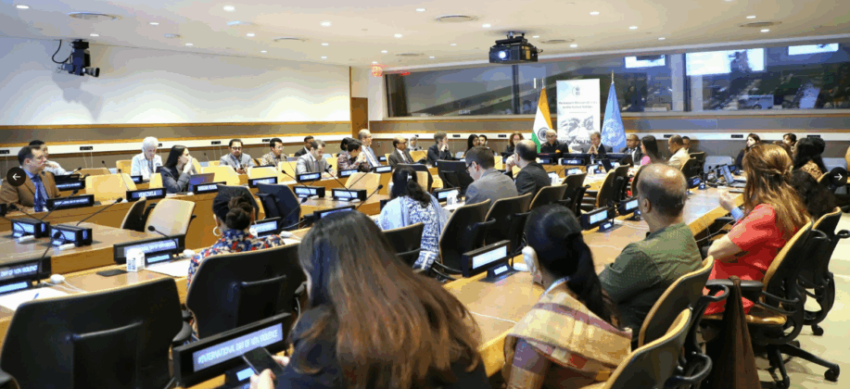

United Nations – Non-violence is an active, practical commitment rather than a passive concept, and adherence to Ahimsa serves as solutions to modern global turmoil, said India’s Permanent Representative to the UN, P. Harish, in his address at the special event, “Gandhian Values and the UN Charter” held to celebrate Mahatma Gandhi’s birthday October 2, 2026, as the International Day of Non-Violence.
“Gandhian principles are not relics of the past, but practical tools for our turbulent present, reminding us that courage and selflessness remain our greatest shields against conflict,” Harish said.
Harish was speaking at the special commemorative event organized by the Permanent Mission of India.
Earlier, while paying homage at the bust of Mahatma Gandhi on the north lawns of the UN headquarters, Harish had shared the famous statement of Gandhi, “There is no way to peace, because peace is the way” , stating how it captured the UN spirit of peace, dialog, development, non-violence and multilateralism.
ADVERTISEMENT

A special high level Commemorative Discussion on “Gandhian Values and the UN Charter” was part of the celebration emphasizing dialogue, human rights education, peace, and the timeless global relevance of Ahimsa (non-violence) in addressing contemporary conflicts. The discussion focused on Gandhian values providing practical guidance for inclusive development, climate concerns, and peaceful coexistence.
Speaking about the core principles of Gandhian philosophy, Harish highlighted Gandhi’s deep environmental consciousness, quoting Gandhi: “the Earth provides enough for every person’s need but not every person’s greed.” Harish said this philosophy remains highly relevant to the UN’s Sustainable Development goals, urging a shift toward sustainable living and responsible planet stewardship.
Gandhi envisioned an open society where cultural influences from all lands are welcome without people losing their own footing, providing crucial guidance for respecting diversity and coexisting peacefully in multicultural nations while preserving distinct cultural identities, Harish said.
UN Secretary-General, António Guterres, emphasized the relevance of Mahatma Gandhi’s philosophies in today’s fractured global climate in his message. “In this time of rising division, tension and conflict, Gandhi’s lessons speak to us with renewed urgency,” he said. Guterres noted that Gandhi provided an enduring blueprint for achieving deep, structural change without abandoning the principles of peace.
Referring to the Gandhian philosophy of rejecting the cycle of retaliation, Guterres stressed that humanity must lean on dialogue and non-violent tools to build bridges.
Calling attention to contemporary global suffering, poverty and inequality, Guterres urged the international community to anchor themselves in empathy, dignity and genuine diplomatic dialog.
UN leadership reflected on the enduring relevance of Gandhi’s philosophy to counter modern poverty, inequalities, and global strife. Diplomats noted how it was of utmost importance to uphold the foundational pillars of global peace, including international law, human rights, and the UN Charter.
The Discussion stressed that systemic issues like poverty, rising socioeconomic inequality, and climate change actively undermine global stability, and drive a wedge between populations, fueling mistrust. They spoke about the urgent need to address inequality and climate chaos, following Gandhian principles.
The day was observed universally across the globe. It was celebrated in Washington, D.C., Atlanta, and Dallas in the US; in South Africa; in Spain, Belgium, the Netherlands, and Switzerland; and Southeast & Central Asian countries including Thailand and Kazakhstan; and Latin American Nations such as Brazil.