

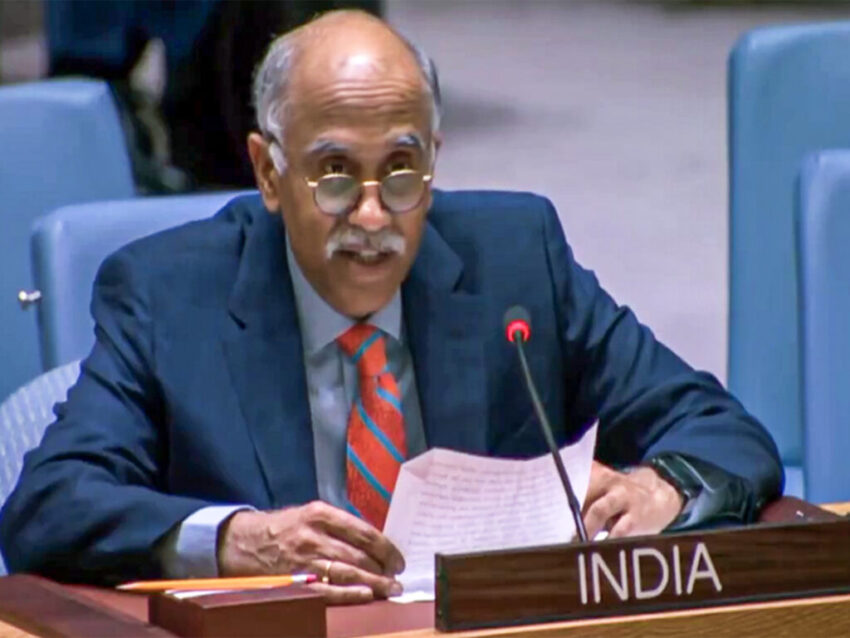

UNITED NATIONS — Warning that the “weaponisation” and disruption of global supply lines are plunging the Global South into severe food emergencies, India has issued a powerful call to action at the UN Security Council, demanding that early-warning mechanisms look beyond ground-level chaos to explicitly shield critical supply chains.
India strongly advocated for a major shift toward decentralized agricultural systems, increased reliance on climate-adaptive crops like millets, and strict protections for commercial sea lanes to stop localized regional conflicts from driving worldwide starvation.
During an open debate on conflict-induced food insecurity convened by Denmark, India insisted that UN response frameworks, particularly under Security Council Resolution 2417, must evolve. India argued that identifying worsening humanitarian conditions on the ground is no longer enough to avert widespread disaster.
Instead, India proposed that the United Nations must proactively track and report on vulnerabilities across global trade sectors.
ADVERTISEMENT

“Early warning should… include timely assessments of disruptions to critical supply chains, including food, fertiliser, fuel and humanitarian logistics,” said India’s Permanent Representative to the UN, P. Harish, emphasizing that these evaluations must be conducted by technical agencies and remain “objective, evidence-based and free from politicisation.”
Harish detailed how failures in energy markets, maritime logistics, and the fertilizer trade disproportionately penalize import-dependent, developing countries. Echoing the Secretary-General’s call to ensure unhindered commercial and humanitarian transit, India targeted the vulnerability of specific global trade paths.
Just a day before India’s statement, UN Secretary-General António Guterres, had presented his grim assessment, speaking against the compounding effects of ongoing geopolitical violence on the global food supply. Guterres urged the Security Council to act immediately, cautioning that “the best protection against food insecurity is peace” and calling for absolute safeguards across global borders and seas to protect vulnerable agricultural networks.
Presenting India’s statement, Harish urged the international community to collectively step up and safeguard critical lanes.
“Disruptions to commercial shipping during conflicts can have cascading effects far beyond the immediate region, disproportionately affecting food-importing developing countries and humanitarian operations,” he said.
A core point of India’s recommendations was developing a shift in the global community’s primary focus towards supporting small and marginal producers across the Global South, instead of centralized production models, which leave global markets deeply vulnerable to “geopolitical disruptions, economic coercion and weaponisation.”
Cautioning against over-reliance on centralized agricultural models, India also called for diversifying the global food away from over-reliance on a few dominant staple crops. “We must also encourage climate resilient crops such as millets rather than limit conceptions of food security to the biggest staple, grain crops such as rice, wheat and corn,” India argued, pointing to its own success during the International Year of Millets and its domestic PM-KISAN initiative as blueprints for robust, national self-reliance.
While Guterres urged the Council to deploy every tool at its disposal to break the conflict-hunger cycle, India reminded member states that long-term resilience is ultimately a domestic obligation supported by targeted multilateral assistance.
India concluded that the Security Council should focus heavily on its core mandate of facilitating peace and humanitarian access. Meanwhile, the long-term, structural fight against global hunger must remain driven by national ownership and spearheaded by specialized bodies like the UN General Assembly, ECOSOC, and international food agencies.