

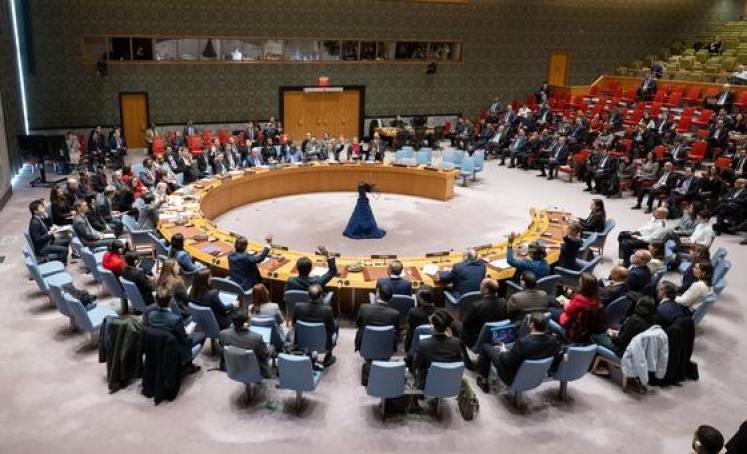

United Nations — In a stern address to the UN Security Council, India called for greater clarity in defining international conflicts, cautioning against political maneuvering that mischaracterizes acts of armed aggression as simple disputes.
Calling out global inaction, India’s Permanent Representative to the UN, P. Harish, told the UN Security Council that international peace remains out of reach not due to a lack of rules, but because member states lack the collective political will to enforce them.
Harish was speaking during the UN Security Council High-Level Open Debate on “Strengthening the Mechanisms for Peaceful Settlement of Disputes”.
The debate was a one year Follow-up to Security Council Resolution 2788 (2025) originally authored by Pakistan, which requested the Secretary-General to present concrete recommendations on strengthening Chapter VI tools for conflict prevention and peaceful settlement. Briefed by UN Secretary-General António Guterres, the discussion featured contributions from over 80 UN Member States.
Need for Redefining Aggression
A key focus of India’s statement was the critical distinction between routine diplomatic disputes and severe violations of state sovereignty. India warned against confusing standard disputes with the illegal use of armed force, such as military aggression or unlawful occupation, which directly threaten a nation’s territorial integrity.
ADVERTISEMENT

Establishing clear definitions, India argued, is essential to determining whether conflict resolution tools under Chapter VI or enforcement actions under Chapter VII should be applied.
Rejecting Identity-Based Division in Diplomacy
Addressing the framework for conflict resolution, India urged the Security Council to pursue inclusive, open, and pragmatic problem-solving efforts.
“Linking such issues to race, ethnicity, faith, religion, and other identity markers not only reflects a divisive approach but is also symbolic of the absence of engagement in good faith,” Harish highlighted.
Adapting to Modern Realities
An important point raised by India was in regard to the redundancy of the age-old UN mechanisms to deal with conflicts of today’s world.
Calling on the UNSC to account for evolving global realities when reviewing decades-old conflicts, India outlined fundamental operational differences between Chapters VI and VII of the UN Charter.
India pointed out that Chapter VII is designed for firm, concrete action against immediate threats, breaches of peace, and acts of aggression. Chapter VI provides flexible tools to handle situation-based risks to peace.
India noted that Chapter VI interventions carry no “perpetual validity” and must be subject to periodic review to reflect changing geopolitical realities rather than remaining frozen in time.
Demand for Sunset Clauses and Mandate Accountability
India called for stricter, collective reviews of UNSC mandates under the UN80 framework. Highlighting the strain on the UN’s constrained finances, India strongly criticized the practice of allowing outdated, irrelevant mandates to continue in perpetuity.
India insisted that the continuation of any mandate must be guided strictly by its relevance and utility, rather than being sustained for narrow political reasons. India called for the mandatory inclusion of “sunset clauses” to ensure missions are closed when they are no longer effective.
Empowering True Regional Organizations
Finally, India addressed the role of external organizations in global conflict resolution. Established regional organizations were praised by India for playing an enabling role, possessing the necessary geographic ties and domain expertise to successfully complement UN functions.
At the same time, India drew a sharp distinction against “cross-regional groups”. India argued that these disconnected groupings lack the critical regional knowledge required to genuinely resolve complex disputes and should not be treated with the same diplomatic weight.
Responding to Pakistan
Criticizing Pakistan for using the international platform to advance a divisive agenda and mislead the global community, India delivered a stern critique of Pakistan for bringing up the Kashmir issue once again in a serious forum.
Furthering its rebuke, India also directed a sharp critique toward the broader international community and the UN, pointing out that authoritarian practices and human rights failures in Pakistan frequently evade the meaningful global scrutiny typically applied to other sovereign nations.
Reaffirming that the Union Territory of Jammu and Kashmir remains an integral and inalienable part of India, Harish pointed out that the sole unresolved matter regarding the region involves Pakistan’s illegal occupation and aggression toward sovereign Indian Territory.
India strongly urged Pakistan to focus on resolving its escalating internal crises. Highlighting severe human rights violations in Pakistan-occupied Jammu and Kashmir (PoJK), India detailed decades of state-sponsored suppression, and severe curbs on fundamental human rights.
Concluding Remarks
At the end, India reaffirmed its position as a founding member of the UN, and concluded by reiterating its commitment to the UN Charter and international law, stating its readiness to work alongside member states to uphold global peace and security.