

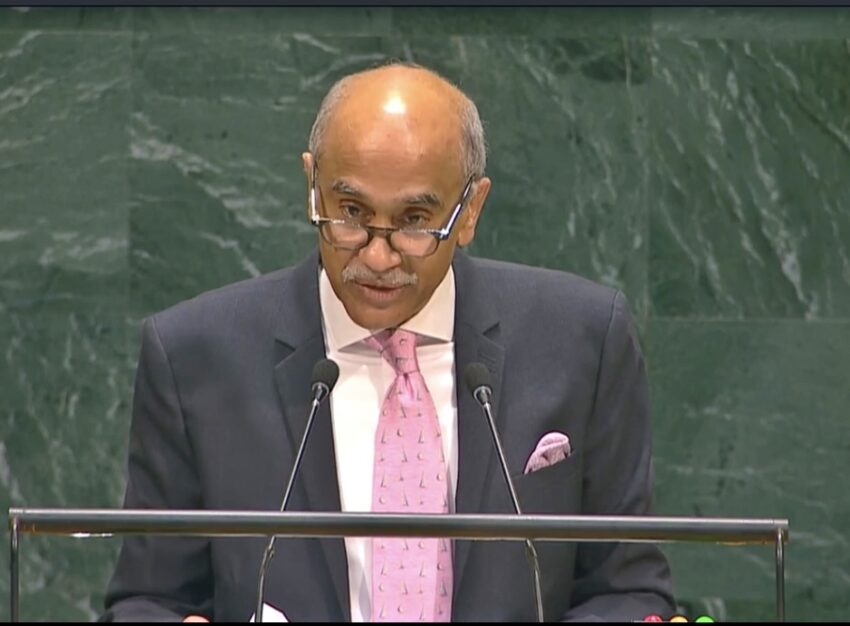
United Nations – At the UNGA Intergovernmental Negotiations (IGN) Plenary Cluster Debate on the Question of the Veto, India delivered a strong call for a comprehensive overhaul of the UN Security Council, criticizing the veto as a tool of narrow political expediency and rejecting “piecemeal” fixes.

Still from webtv.un.org
“…the questions of credibility, legitimacy and efficacy that hang over the Security Council will not be answered by managing the veto alone,” said India’s Permanent Representative to the UN, Parvathaneni Harish, as he delivered India’s statement and logical arguments on the current status of the Veto power, asking for properly written drafts instead of empty verbal discussions.
India urged the IGN to shift immediately to text-based negotiations with clearly defined timelines and milestones. Harish emphasized that updating the 2015 framework document is the most democratic, time-tested path to realizing meaningful reform.
Veto requires conscientious execution, Harish stated, identifying it as a privilege with global obligations to maintain international peace and security rather than to serve narrow geopolitical interests. Harish pointed to disguised and hidden vetoes, existing within the UNSC as subterranean blocking mechanisms. He noted that procedural consensus rules in subsidiary bodies are frequently used as a “disguised de facto veto” to stall progress and block democratic transparency.
ADVERTISEMENT

Expressing India’s frustration, Harish noted deadlocked reforms. He said that 17 years after the inception of the IGN, there are still no concrete outcomes to show precisely because these hidden vetoes are weaponized to entrench the status quo.
Aligning with Africa, Harish stated India’s principled position on fairness, asking for equal rights for Permanent Members. “We reiterate that as long as a veto exists, it must be held by all permanent members of a reformed council,” Harish said. “Fairness and justice demand that all permanent members enjoy the same rights and responsibilities,” Harish stated.
Pointing to the failure of incomplete, piecemeal approaches, India critiqued the 2022 Veto Initiative which mandated a General Assembly debate whenever a veto is cast. Statistically, the initiative failed to act as a deterrent, Harish pointed out. The veto was used 18 times between April 2022 and 2024, compared to only four times in the two years prior, Harish said.
Describing the Veto as part of interconnected clusters, India argued that addressing the veto cannot be isolated. “Limiting the veto cannot be separated from the questions of categories of membership, regional representation, size and working methods,” Harish emphasized. Addressing the veto in isolation fails to alter the actual decision-making imbalance of the current P5, he added.
Other member states and cross-regional coalitions presented widely divergent views. While General Assembly leadership criticized internal debates upon use of veto, states and coalitions expressed opinions in favor of internal IGN consensus building, total abolition, outright suppression of existing veto, or a gradual removal, including an enhanced representation proposed by China.