

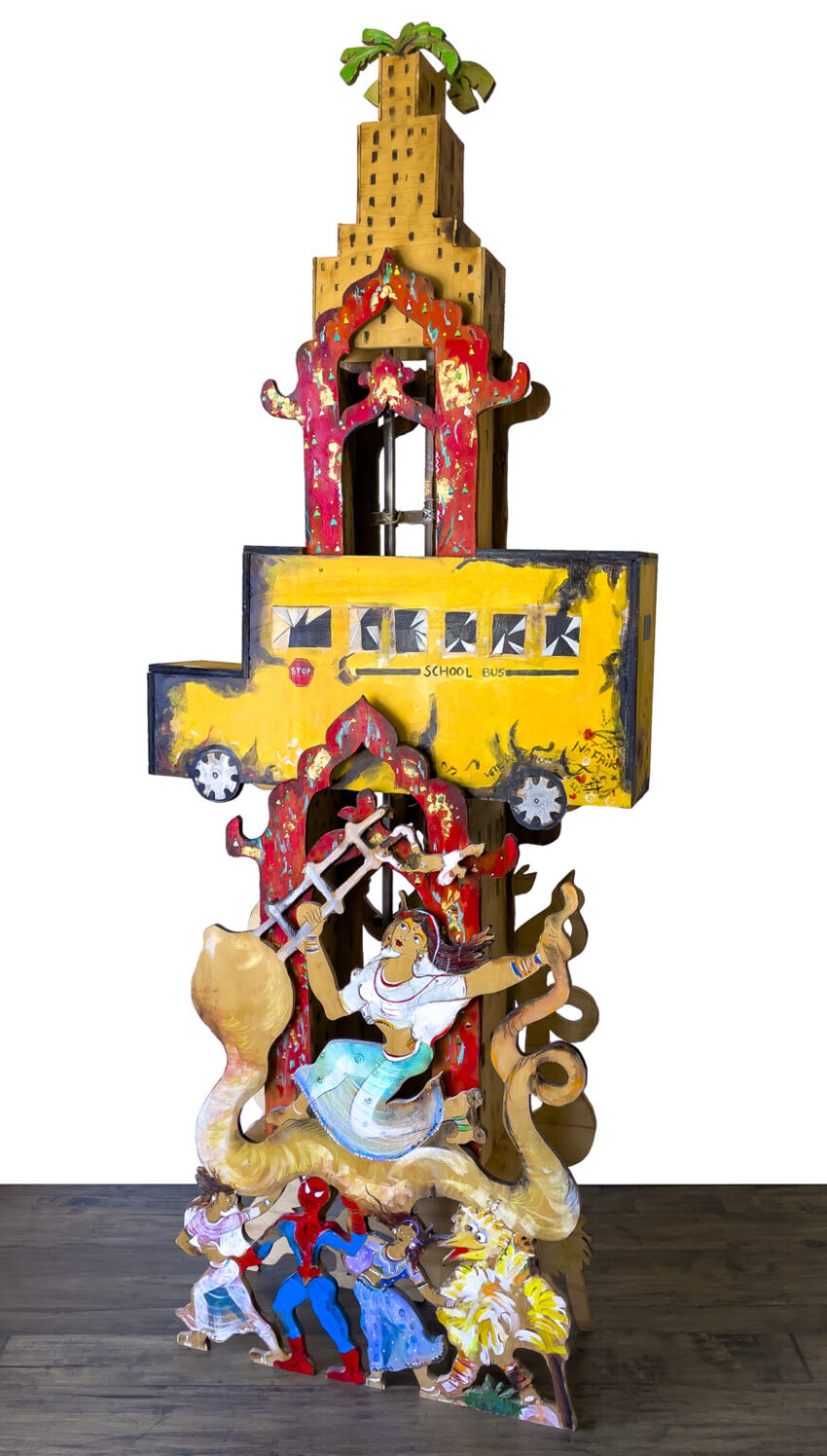
Just as Indian culture offers diverse spiritual paths tailored to an individual’s personality, the work of Contemporary Artist Ela Shah provides multiple paths of interpretation. A single sculpture can be experienced as a playful visual narrative, a sharp cultural satire, or a deep philosophical exploration of modern faith and survival. It meets every viewer exactly where they are, showing that everything in our interconnected world is part of the larger picture.
The act of darshan, or “seeing god” has always been central to Hindu worship. This intimate exchange between deity and devotee takes place both in the temple and in the home. For Hindus, as well as followers of many other religions, home shrines are an integral part of family life and culture.
Metropolitan Museum of Art spotlights Indian Devotional Prints
In the mid-19th century, new technologies were introduced that permitted mass production of vibrant prints. When applied to religious icons, these affordable prints proved immensely popular throughout India. Even the humblest home could now display a colorful print of their chosen god. At the same time as the country was experiencing the first stirrings of the Independence movement, these prints became a powerful means of expressing Indian religious identity.
ADVERTISEMENT

Now, New York City’s Metropolitan Museum of Art has mounted a new exhibit – Household Gods: Hindu Devotional Prints, 1860–1930. This first-ever exhibit features more than 100 images that spotlight the artistry inherent in these elaborate and colorful prints.
“What really makes these prints so fabulous” said the New York Times in their enthusiastic review “is their sheer aesthetic abundance — their density of color, composition, iconography and ornament…”
Contemporary Artist Ela Shah on memories, art and culture
Ela Shah is a contemporary artist of rare talent. Regardless of the media she works in and the materials she chooses to express herself, Shah’s work always reflects her deep spirituality. While some may want to characterize her work as being “Hindu” she frequently incorporates imagery from other spiritual traditions, reflecting her deep belief in the universality of experience and faith.
Following her visit to the Met, we spoke with her about what makes her work so recognizable and what inspires her work.

Power of Myth.
Paint on burnt wood
First, what were your impressions of the exhibit?
“The exhibit reminded me of my childhood. They were the first images we were exposed to. I saw them in most everyone’s home…they were on posters and calendars…. I copied them because I could see how gods could look.”
Can you remember growing up and your own home shrine?
“My mother worshiped Krishna and she had a small shrine in our house. Every morning I smelled incense. I heard her ringing tiny bells to wake Krishna up, and she’d decorate the shrine with fresh flowers…Her shrine and the rituals are among my very first memories.”
Was your early work focused on religious subjects?
“No. My early training was very Western. I studied portrait, landscape and the Old Masters. I also copied the gods and goddesses from posters and did miniature painting…When I came to America, I studied for my master’s at Montclair State University and I worked with new materials…wood, clay and bronze.”
What motivated you to work with other materials?
“We moved from India to Montclair and it was a time of personal conflict. I was able to find release and expression in my art. When I was working in clay I was thinking ‘this material is like our bodies and our bodies can perish. When I worked with bronze, I thought of it as something within us, our soul that can never be destroyed, a philosophy I learned from Gita the Indian epic of Mahabharata…’ Working in bronze was especially powerful because it’s like the soul; nothing can crush it.”

Your art is complex and detailed. In what ways do you see that reflecting your Indian culture and religion?
“You’re right, my art is very complex. Hinduism is very complex! It makes you think about different things. In Hinduism there are so many different paths to reach ultimate reality…you choose the path according to your personality, capability and preference.
My sister used to say that when we see a mango tree, we see the whole blossom. Westerners just see the seed…”
Why do you think Indian art is so distinctive to a western eye?
“I think much of Western art historically leaned toward a singular linear perspective. Traditional Indian art is holistic, maximalist, and multi-layered…A single temple carving can contain hundreds of unique figures, reflecting our view that we live in an interconnected universe where everything is divine… Our art provides multiple layers of meaning—allowing a single work to be experienced as a simple story, a visual marvel, or a deep philosophical truth.”
Your tower sculptures are especially impressive and immediately catch the viewer’s eye. Tell me about them.
“All my tower sculptures are structures of faith…They’re not Hindu. They’re tall like churches and have arches like mosques…they’re reflective of all religions and I hope everybody can relate to them. But I do often include specific gods and goddesses for what they symbolize. Courage, women’s issues, strength…I incorporate those into my work.”
How would you sum up the message of your work?
“Most of my work seeks to convey empathy and a sense of oneness with others who also experience the ebb and flow of pleasure and pain, ultimately aiming to find bliss…. Viewers are invited to reflect on existence’s complexities and their own quest for inner peace.”