

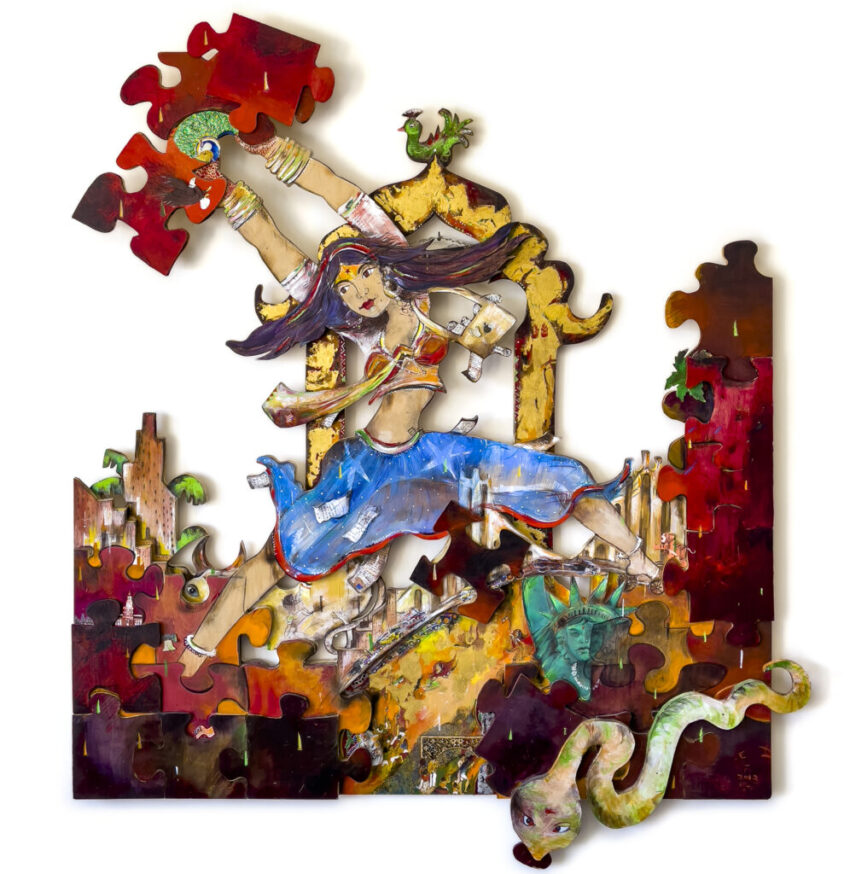
Ela Shah is an award-winning Indian American contemporary artist whose work has been featured in museums and galleries in India, Europe and throughout the US. A native of Bombay, she, her physician husband and children moved to the US and settled in New Jersey nearly 50 years ago. Last year she established the Ela and Dr. Bipin Shah Family Foundation, a passion project designed to honor the caring compassionate legacy of her late husband as well as her own artistic legacy. Writer Sandy Levine spoke with Ela about the motivation behind establishing the foundation as well as her current projects.
Sandy Levine: Tell us about your late husband Bipin and how this foundation honors his legacy.
Ela Shah: “Bipin was a physician and dedicated his life to helping his patients and serving his community. After medical school we lived in a small village in India (Cambay) where he was the only doctor. We saw poverty firsthand, the lack of basic supplies and widespread hunger. Throughout his life, Bipin continued to support the hospital in Cambay and to help the people it served… The foundation will continue his legacy by helping widows and children in need, whether orphaned, hungry, or facing physical hardship around the world.”
SL: The foundation is unique in that it has a dual mission: charity and art. How do they fit together?
ADVERTISEMENT

ES: “The overarching goal of the foundation is to uplift future generations. Charity of course plays a role, but art can too. Art can bring people together, encourage understanding, and open conversations about identity, migration, struggle, and belonging. Art can offer its own kind of healing, helping people process feelings and rediscover meaning.”
SL: Was there an “ah ha!” moment when you realized you could create a single foundation to honor both Bipin and your legacies?
ES: “In 2025, I went to a show at of Amy Sherald’s work* at the Whitney Museum in New York. I was struck by all the children of color connecting to the artwork, finding reflections of their own culture, and feeling pride…Seeing the children helped me realize that I could create a single foundation that could honor Bipin’s life of compassion and my own belief in the healing power of art.”

SL: You’ve often said your body of work is a visual autobiography.** Can you explain?
ES: “My art is a story of resilience, how difficult experiences can still lead to strength, healing, and hope. After arriving in America, I was overwhelmed with physical and emotional burdens. I felt the sting of culture shock deeply. Every day there was something to remind me that I was different; the way I wore my hair, what I packed in my children’s lunch box, the clothes I wore. It was one of the most difficult periods of my life…My way of moving forward was to bring art back into my life…(and) since I am a visual artist, I express many of these ideas through images and sculpture rather than words alone. If my journey can help even a few people overcome challenges in their own lives, then the work has meaning beyond art itself.”
SL: It seems that contemporary Indian art is under-represented in museums and galleries. Do you have a sense of why?
ES: “I think more traditional Indian arts get the attention. I see parents encouraging their children to learn Indian dance and music and they gain an appreciation for Indian visual arts in their homes and temples. But contemporary Indian art doesn’t have a home… There’s no one museum that’s devoted to our work. My vision is that one day there will be a museum of contemporary Indian diaspora art, and most artists in our community feel the same way… While I may not live to see it realized, I can at least be part of the effort to make it happen.”

SL: Can you talk a little more about that vision?
ES: “Beyond showcasing the visual arts, I also hope to encourage cultural dialogue, so younger generations can better understand and relate to both their own culture and others. In the same way communities create temples, music programs, and cultural centers, I believe there can also be museums and spaces dedicated to art, culture, classes, conversations, and creative exchange.”
SL: In addition to growing the foundation, what are you doing to expand awareness of contemporary Indian art?
ES: “We’re looking for galleries where we can showcase the work of Indian artists as well as my own. I’m also reaching out to the community of artists I’ve met throughout my career. There’s a group of Southeast Asian artists*** in the New York/New Jersey area that I’ve been speaking with and hope to collaborate with.”
SL: And finally, how can individuals support the work of the Dr. Bipin and Ela Shah Foundation?
ES: “We’re building a website specifically for the foundation, but in the meantime, you can visit my website: www.elashah.com”
*Artist Amy Sherald created the official portrait of Michelle Obama.
**Ela’s journey from Bombay to New Jersey is explored in her book ”ela: Breaking Boundaries” and in the award-winning documentary of the same name.
***The South Asian Artist Association of America