

As an American-Born [very] Confused Desi in his mid-40’s, my knowledge of Indian rituals and culture is embarrassingly limited. It’s the sum of the little I remember from Sunday school, staying at a temple summer sleep-away camp during high school and now from sheepishly scraping what I can from AI.

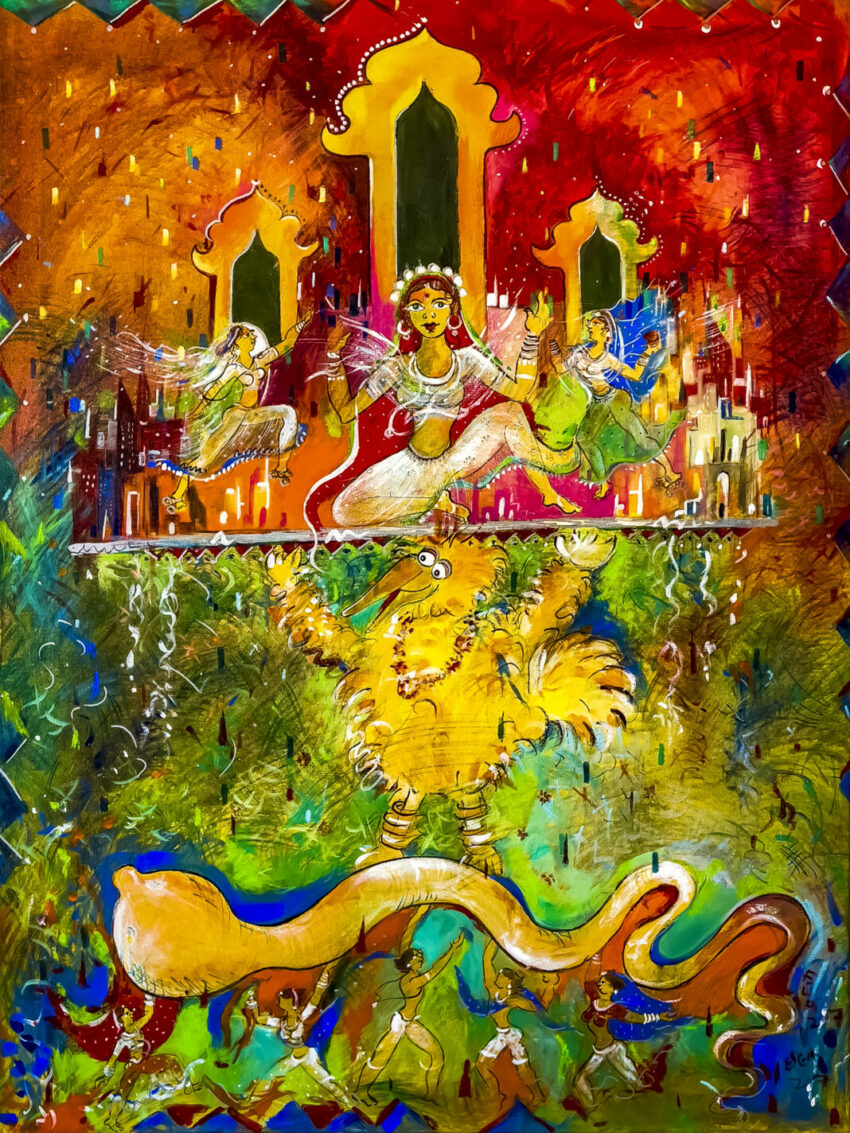
Acrylic, silkscreen on canvas
48” x 36”. PHOTOS: Provided
When the calendar signals the nine-day festival of Navrati each Fall, I usually find out by a bombardment of texts from family members containing religious images and blessings. Normally we will attend at least one garba dance event at a local high school, but more of the celebration tends to happen around Diwali, which comes after the end of Navratri and is infinitely more popularized. I don’t blame my lack of knowledge on my Indian-born parents (who can also be confused about the significance of certain rituals), but I think each generation can do a better job of explaining the reasons behind our cultural ceremonies to the next. (Just for the record, my wife, sister and most of my cousins are as clueless as I am.)
From what I understand, Navrati is a nine-night festival celebrating the Goddess Durga and her victory of good over evil. It’s a time to honor the divine feminine. Her nine female avatars reflect a host of powerful attributes including purity, inner strength, leadership, bravery, determination, protection, justice, wisdom, creativity and compassion. Tragically, there’s a disconnect between worshipping the divine female like Durga, and the real-world lack of gender equality, safety and social respect given to women in India and around the world.
Learning through Art
ADVERTISEMENT

One effective and powerful way for me to understand a religious or cultural event is through art. Just consider the impact of Da Vinci’s “Last Supper” in transmitting a pivotal story of Catholicism. Not as well know, but no less effective in sharing our cultural heritage, is the work of the talented contemporary artist Ela Shah. Her work is infinitely more appealing and memorable than Sunday school lectures. It’s not only colorful, artistically sophisticated and beautifully rendered, but it sparks conversation and learning.
Shah reinforces the most positive attributes of Durga’s avatars while “bringing them down to earth” by making them relatable in human form. More so, she brings them to America with Western influences reflecting her own journey from Bombay to the NJ/NY area. Here’s just a sample.

Mixed media on wood
62”x19”x1”
In “On Go” you first notice a woman with multiple arms, a direct reference to the traditional depictions of the multi-armed Durga. However, when looking deeper, you notice that instead of carrying Durga’s array of weapons, she’s carrying various modern-day tools and items, such as a spoon, brush, food and children’s clothing. To me, this represents the strength and reality of a modern-day woman who must constantly multi-task to balance her professional work and family life. She is simultaneously skating down a slope and climbing up an incline, perhaps representing the ups and downs of her daily battles. Despite how much she has going on, she makes it look easy while exuding beauty and thoughtfulness.

“Hang in There” spotlights a woman wearing a hybrid outfit featuring more Americanized colors and a Wonder Woman-like superhero top. She has only four arms this time, but she is managing to carry the weight of an ancient Indian structure on her head while skating on one foot through New York City. Is this heroine attempting to hang on to her roots in India while navigating her new world in a busy city? Does the ladder vs. tennis racket represent a work hard, play hard dynamic?
The vibrance and energy of Navratri is evident in “Yatra.” At the base is what looks like traditional Indian men and women representing traditions and rituals. Above their heads, they are carrying a snake-like spirit emerging from a lamp, upon which a version of Big Bird (a popular character used in many of Shah’s paintings) is standing. The main heroine balances on his head while her friends on each side celebrate her. With the beautiful mix of colors, the confetti-like spots and the feeling of movement, this painting truly evokes the spirit of Navratri.
Art can be a powerful vehicle for opening minds and understanding the intentions behind beloved rituals. Ela Shah’s work bridges the gap from reverence for feminine divinity to admiration for real, modern women juggling, climbing, skating, dancing and thriving on earth. The original intentions of Navratri may have been for people to not only honor Durga’s triumph over evil, but also to honor and celebrate the triumph of all the powerful women around us. Now with all of that said, I need to remember to tell my kids what I learned Navratri is all about before I become my parents…
Note: I’m proud to have recently joined the Board of her new non-profit foundation, the Ela and Dr. Bipin Shah Family Foundation, which is focused on bringing higher visibility of contemporary South Asian artists like her in America while supporting philanthropy for struggling widows and children.