

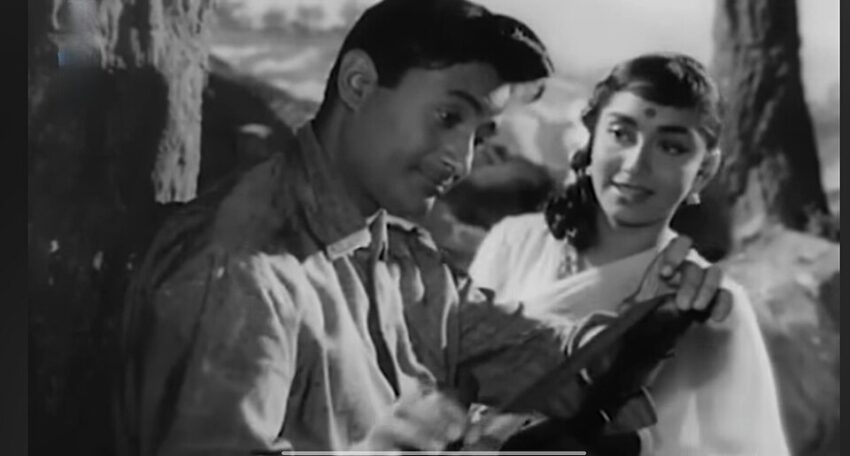

He would have been 103. Dev Anand, on September 26. If he was here – in this twenty first century when the world has changed and when cinema has shifted from an integrated whole to a done-in-parts-sometimes-with-AI fragments joined together.
But then, classics always remain, even after centuries. No one can disregard Shakespeare. No one can disregard Guru Dutt. And no one can disregard Dev Anand. Even today.
While some would write him off as a film hero of the old times, with precise mannerisms, Dev Anand’s tremendous contribution to the spirit and mental makeup of the urban youth in the newly independent India needs more than fleeting attention.

Dev Anand’s filmography reveals a deeply empathetic actor. Holding a Bachelor’s degree in English Literature from Lahore College, he excelled at navigating the complex emotional landscapes of a rapidly changing India, capturing both its optimistic dreams and its dark, gritty underbellies.
ADVERTISEMENT

In the 1950s, as a newly independent India witnessed a massive migratory shift from rural landscapes to bustling cities, Dev Anand became the definitive screen avatar of the displaced urban youth. He dressed in Western outfits, and spoke rapidly without a local accent, even in Hindi.
Unlike the tragic, brooding figures or the idealized rural heroes of his contemporaries, his characters belonged entirely to the asphalt and neon lights of the metropolis. Unlike the traditional romantic leads of his era, Dev Anand rarely played a passive “rich heir” or zamindar’s son who simply loitered around a mansion.

He was the pioneer of the working-class urban hero in Bollywood. His characters were almost always working professionals, self-employed hustlers, or ambitious lower-middle-class men navigating the daily grind of city life.
In seminal noir classics like Baazi (1951), Taxi Driver (1954), and Kala Bazar (1960), he embodied the struggles of the marginalized city dweller. These characters, whether a desperate gambler, a cynical cabbie, or a black-marketer, reflected the survival instincts of a youth caught between traditional morality and the harsh economic realities of urban life.
He brought an effortless, bohemian cool to these roles, making the disenfranchised youth feel seen, understood, and ultimately, humanized.
What set Dev Anand apart in these urban narratives was his ability to infuse morally ambiguous characters with profound emotional vulnerability. He rarely played saints; instead, he played deeply flawed men driven to the edge by circumstance.

His emotional range shone brightest when his characters faced intense internal conflicts. Baazi (1951), Taxi Driver (1954), Kala Bazar (1960), Bambai Ka Babu (1960), Guide (1965) were films where he perfectly captured the anxiety of a man compromising his ideals for survival, showcasing the heavy guilt that hid beneath a charming exterior.
Behind the fast-talking façade of the characters lay an aching loneliness, a yearning for genuine human connection amidst the cold, unforgiving machinery of the big city, and Dev Anand conveyed this beautifully. Many a tears were shed with him and for him in Fantoosh when he sang ‘Dukhi Man Mere”.

Even when backed into a corner, his characters exhibited a resilient optimism, a refusal to let the city crush their spirit, encapsulating Dev Anand’s definitive ‘Urban Optimist’ archetype, which he pioneered in his 1950s Bombay noir and crime thrillers such as C.I.D., Kala Bazar and more.
This duality of the characters he portrayed and the manner in which he portrayed them struck home with the young audiences who could identify with him, feeling he was one of them.
As India industrialized, the youth aspired to modern, respectable careers. Dev Anand stepped into these specialized professions, using them as backdrops to examine the emotional and psychological fracturing of the educated middle class.
By grounding his characters in distinct urban professions such as the architect in Tere Ghar Ke Samne, the doctor in Tere Mere Sapne, the journalist in Solva Saal, and the white-collar accountant in Munimji , he gave a realistic face to the aspirations and emotional tribulations of the post-independence urban youth.
Good looking, well dressed and young, Dev Anand also became master of nuanced romance and melancholy in the 1960s. His portrayal of the urban youth evolved to encompass deeper psychological and romantic complexities. Teen Devian (1965) portrayed this softer anti-hero who dated three women simultaneously. Instead of relying on melodramatic clichés, Anand’s romantic on-screen relationships during that era felt modern, progressive and respectful.
His performance in Guide (1965) marked the absolute zenith of this evolution. As Raju, he portrayed a man traversing the entire spectrum of human emotion, from a charming romantic and a materialistic urban smooth-talker to a deeply conflicted lover and, ultimately, a flawed man seeking spiritual absolution.
He represented a youth that viewed love not just as a familial duty, but as a deeply personal, emotional, and sometimes painful choice. The melancholy in his romantic setbacks was never passive. It was filled with a restless, poetic energy that defined the aspirations and heartbreaks of a generation. Through this unique blend of style, grit, and raw emotional vulnerability, Dev Anand didn’t just play roles: he mirrored the soul of modernizing India.
Dev Anand gave some soulful performances too, while he famously captured the kinetic energy of the modern Indian metropolis. His most impactful roles focused heavily on internal conflict, psychological fragility, and moral compromise.
Dev Anand’s true brilliance lay in portraying characters whose slick, confident exteriors masked an aching vulnerability. He was the master of “urban melancholy,” playing men who were not inherently evil but were pushed into moral ambiguity by the unforgiving machinery of the big city.
In Kala Bazar (1960), where he plays an opportunistic black-marketer, beneath whose suave charm, Anand exposes a raw, shifting conscience. The emotional weight of the character hinges on his sudden, agonizing awakening to his own degradation when he falls in love with a progressive woman. The transition from cocky defiance to deep remorse showcases Anand’s ability to portray the intense guilt plaguing a displaced youth trying to reconcile survival with integrity.
In Baazi (1951), his portrayal of a desperate gambler is laced with a palpable anxiety. He doesn’t play the criminal with hardened malice; instead, his expressive eyes convey the sheer terror and loneliness of an urban youth backed into a corner, gambling not for greed, but to save his family.
The absolute peak of Dev Anand’s emotional range occurred when he stripped away his professional armor entirely to examine identity and existential dread. In Hum Dono, playing a double role as two military officers, he masterfully portrays the psychological trauma of war and the agonizing burden of stolen identity. His performance as Captain Anand, forced to comfort a dying comrade’s family while pretending to be him, is a master class in suppressed grief and emotional claustrophobia.
This culminated in Guide, where his character, Raju, transitions from a smooth-talking local professional into a fragmented, broken man who loses his wealth, his love, and his freedom. In the final act, mistaken for a spiritual saint during a catastrophic drought, Anand achieves an acting zenith. His performance ceases to be about urban style; it becomes a raw, agonizing exploration of a flawed man’s superego battling his own ego.
Through all this, Anand’s younger brother Vijay (Goldie) Anand took his natural style and channeled it into complex, emotionally heavy spaces. Vijay Anand possessed an ahead-of-time understanding of film grammar, camera movement, and character psychology. He transformed the breezy star Dev Anand into a serious dramatic actor, pioneering sophisticated framing of internal guilt and identity crises in character portrayals. S.D. Burman created urban soundscapes with modern instruments like guitar and violin for these revelations.
Working in perfect unison, the two Anands and Burman made sure that Dev Anand’s characters were never one –dimensional. Vijay Anand gave the urban youth a sharp, psychological mirror to look into. S.D. Burman gave him a voice to sing his sorrows.
Through such specific, deeply humanized professional and emotional arcs, Dev Anand didn’t just entertain post-independence India: he profoundly validated the internal struggles of its evolving youth. Together, the three created an immortal template of modern Indian masculinity. Dev Anand remains that master template in most memories!