

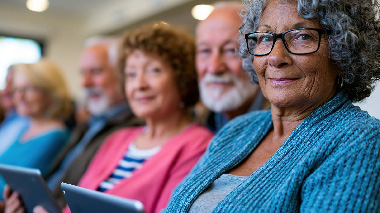
United Nations – The International Day of Older Persons was celebrated October 1, 2026, by the UN and its various agencies, alongside global partners, with a call for major systemic shifts.

Established in 1990 by the United Nations General Assembly (Resolution 45/106), and first observed on October 1, 1991, the day recognizes the contributions of older people and addresses issues that affect their lives and well-beings.
The official 2026 theme was “The Age of Longevity: Rethinking Systems for Longer Lives” which focuses on the global trend of increased life expectancy. It serves as a call to action for governments, the private sector, and civil society to build healthier, more equitable, and financially secure environments so that added years of life translate into added years of dignity and contribution.
In a special message on the occasion, praising older adults as foundational pillars of society and “leaders and caregivers”, UN Secretary-General António Guterres, advocated strongly for intergenerational solidarity, highlighting the vital roles that older adults play in families, communities, and global economies, while pushing governments to adapt systems to growing aging populations.
ADVERTISEMENT


Photo by Amer Kapetanovic/UNFPA Bosnia and Herzegovina.
He described longer life expectancy as “one of the great achievements of our time, a sign of improved health and stronger social protections,” noting that the population of people aged 60 and over is projected to surge from 1.2 billion to 2.1 billion by 2050, making up roughly 20% of the global population.
Guterres stressed that growing older still exposes too many people to insecurity, economic vulnerability, and discrimination. He called on governments to enact effective policies across employment, pensions, housing, healthcare, and lifelong learning so older adults can remain active and independent.
Celebrations of the Day by UN Agencies
The World Health Organization (WHO) hosted a special dialogue and webinar for staff and partners. Falling at the midpoint of the UN Decade of Healthy Ageing (2021–2030), the sessions focused on translating added years of life into health, dignity, and contribution.
A specialized event took place at the Palais des Nations in Geneva titled “Older Persons at the Centre: Towards a Legally Binding Instrument,” bringing global aging experts together to discuss brain health, quality of life, and human rights protections.
A high-level official UN commemoration event is scheduled for October 8, 2026, at the UN Headquarters ECOSOC Chamber in New York, sponsored by the Permanent Mission of Argentina and organized by UN DESA and the NGO Committee on Ageing, to further explore structural shifts required for the age of longevity.
A major push for the 2026 theme is being led directly by the UN Human Rights Office (OHCHR) through their global #OldEnoughTo campaign challenging systemic ageism in everyday rules.
Regional hybrid forums such as those at UN Vienna on October 5, centered on intergenerational dialogues to bridge social and emotional divides isolating older persons.

UNGA Policy Frameworks on Aging
At the UNGA High-Level Week September 18 to 28, 2026, there were discussions surrounding demographic shifts, universal health coverage, and equality at the events on longevity and aging and policy outcomes.
Establishing a mandate for accelerated national investment
The primary policy was an urgent global directive to increase domestic funding and to shift from passive policy-writing to fast, sustained infrastructure investments.
Shifting Systems from Treatment to Prevention
A major dialog between health ministers and global leaders from 15 countries suggested the policy to commit to move national health systems toward predictive and preventive health technologies that intercept illnesses earlier in life.
Codifying Whole-of-Government Longevity Frameworks
Rather than treating aging as an isolated social welfare or healthcare issue, upcoming mandatory policy implementation frameworks (including the upcoming UN convening on October 8, 2026) included a unified approach for member states to link age-inclusive labor markets, lifelong social safety networks, and integrated, community-level care systems.
How are Countries implementing policies to celebrate the Day
Across the globe, the day served as a call to action for governments to reform health, social support, and care infrastructure to adequately match the reality that people are living longer than ever before. National and global actions are focusing on expanding national long-term care policies.
Countries are auditing internal rules to identify and eliminate arbitrary age limits or cut-offs built into employment, medical procedures, digital services, and financial systems that implicitly exclude active older adults.
Country governments and regional bodies are modernizing their infrastructure across health, finance, labor, and digital spaces to treat longer lifespans as a “longevity dividend.”
South and South East Asian countries including India, Sri Lanka, Bhutan, Thailand and Timor-Leste have established formal, integrated long-term care programs which focus on decentralized, person-centered care that integrates social services directly with localized health facilities.

In Bangladesh, the government has structured multifaceted welfare programs that heavily expand old-age financial allowances and primary healthcare networks.
Governments are overhauling social safety nets and financial protections, modernizing pension systems to match current demographic realities.
In Kenya and other countries, ongoing legal frameworks are being utilized to push beyond basic welfare checks toward state-guaranteed right to reasonable care, assistance, and continued economic participation.
Local and municipal governments are working alongside the WHO Global Network for Age-Friendly Cities and Communities by adapting “Age-Friendly” infrastructure and urban environments through remodeling physical spaces. Cities are adapting public transit systems, housing regulations, and community spaces to ensure older adults can move around safely, avoid isolation, and remain independent.