


The first thing you need to know about laab, sometimes spelled larb, is how to say it. “It’s pronounced laab, like you’re saying ‘ahhh!’ at the dentist’s office,” said chef Arnold Myint, co-owner of International Market in Nashville and author, along with Kat Thompson, of the cookbook “Family Thai.” Thanks to that evocative description, I’ll never pronounce it incorrectly again.
The second thing you need to know about laab is that it’s considered one of four main categories of salad in Thai cuisine.
– Yum is defined by its sour (from limes) and spicy (from Thai chiles) profile.
– Thum, which means “pound,” is a sour vegetable or fruit-based salad. (The green papaya-based som thum, or som tum, is well known in this category).
ADVERTISEMENT

– Plah is a protein-heavy salad characterized by its sweet, thick chile-based dressing.
– Laab is a commonly meat-centric salad with a light, bright dressing and lots of crunch.
The last thing you need to know about laab is that it generally doesn’t involve a ton of ingredients or take much time to put together – just 30 minutes in this case. Despite that, it’s a dish that tastes like so much more than the sum of its parts.
In this pork laab recipe, inspired by Myint’s takes on laab, you’ll start by making khao khua, or toasted rice powder. “This is the main component of laab that sets it apart,” Myint, a 2024 James Beard Foundation semifinalist for best chef: Southeast and former “Top Chef” competitor, said. “It’s part of its identity and flavor profile.”
To make it, you’ll simply toast raw rice in a skillet on the stovetop until it browns, then grind it into a fine powder with a mortar and pestle or dedicated spice grinder. Myint calls for sticky or jasmine rice in his recipe, but any uncooked white rice grains will work. You can also buy khao khua at Asian markets, but it’s so easy and fast to make at home. “It’s a fun technique that contributes flavor and texture, nuttiness and smokiness,” Myint said. “It makes a textural difference when it hits the dressing and re-expands.”
I hadn’t noticed this transformation when I ate laab at Thai restaurants, but it was apparent when I made it at home. The toasted rice powder actually changes each bite of the salad. First, it’s crunchy, but over the next few minutes it binds with the liquid and fat in the dish, softens, and thickens the sauce.
Traditional laab moo recipes call for poaching ground or minced pork before mixing it with the pungent dressing. But I loved how in “Family Thai” Myint turned his laab into meatballs, called laab tod. “Frying laab … adds a new and crunchy dimension,” he wrote. So, in this variation, you’ll pan-sear the pork, allowing it to brown and turn a bit crisp before cooking it through.
While that’s happening, stir together a dressing of lime juice, fresh herbs, fish sauce, sugar, garlic, shallot, lemongrass and Thai chile. While lemongrass isn’t a classic element in laab, Myint included it in both of the laab recipes in his book, the aforementioned laab tod and a vegetarian mushroom laab.
“It’s a flourish of mine,” he said. “It’s not traditional. It’s something I started to add to cut the gaminess of the meat a little,” Myint, who moonlights as drag queen Suzy Wong, said. “Lemongrass has that citrus element in it, and we’re celebrating that essence in laab. When you bite into a bit of lemongrass it’s not bitter, it’s a little floral, it kind of mists in your mouth, the scent and flavor opening up like a pheromone.”
I was sold.

Myint’s recipes rely on some of his own sauces, seasonings and pickles. These are well worth making if you buy the cookbook – and may even become your own pantry staples – but for this recipe, an introduction to laab, I skipped the extras so you could make and taste laab as soon as possible.
Just before serving, with crunchy cabbage leaves and the toasted rice powder, stir the dressing into the still-warm pork. As you take a bite, close your eyes to best appreciate the way the flavors dance around your taste buds, the way the smells creep into your nostrils, the way the textures change as you chew each mouthful.
Laab will always be one of my favorite dishes. Once you’ve tasted it, it’s easy to see why. There’s a lot to love about laab.
– – –
Laab Moo (Pork Laab)
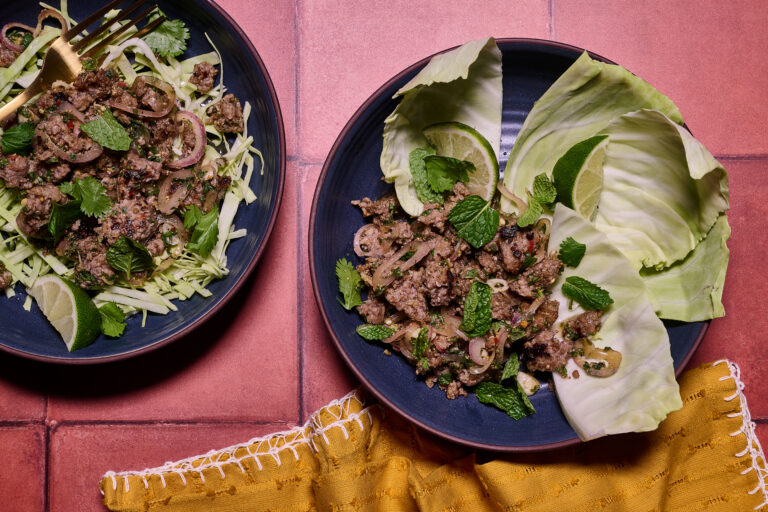
Pork laab, sometimes spelled larb, is a meaty Thai salad flavored with fish sauce, lime juice, raw shallot or onion, and herbs. This version is inspired by the elements Nashville-based chef Arnold Myint says are essential to the classic dish, including cilantro, mint, lemongrass and khao khua, ground toasted rice you can make at home to add a nutty, almost smoky note. Short-grain sticky rice is typically used, but jasmine works well, too. Most pork laab recipes call for poaching the meat, but here you will fry it so it has some crispy bits. Serve with quartered cabbage leaves to make wraps at the table, or thinly slice the cabbage for more of a plated salad.
4 servings (makes about 3 cups)
Total time: 30 mins
Storage: Refrigerate for up to 4 days.
INGREDIENTS
1 tablespoon uncooked jasmine rice or sticky rice
1 pound ground pork, preferably 85 percent lean
1/4 cup fresh lime juice (from 2 to 3 limes), plus more as needed
1/4 cup chopped fresh cilantro leaves and tender stems, plus more for serving
1/4 cup chopped fresh mint leaves, plus more for serving
1 tablespoon fish sauce, plus more as needed
1 tablespoon granulated sugar
2 garlic cloves, thinly sliced
1 large shallot, thinly sliced
1 stalk lemongrass, dry outer peel removed, tender core thinly sliced (optional)
1 fresh bird’s eye chile, finely chopped
1/2 small head green cabbage (1 pound total), cut into wedges and separated into individual leaves, or thinly sliced
STEPS
In a medium (10-inch) cast-iron skillet over medium heat, toast the rice, stirring occasionally, until it turns golden-to-dark-brown all over, about 5 minutes. Transfer the rice to a mortar and pestle, or a dedicated spice grinder, and grind until the rice turns to a fine powder.
Return the skillet to medium-high heat and add the pork. Cook, breaking the meat into big chunks with a spatula or wooden spoon, until deeply browned on one side, 5 to 6 minutes. Break the pork into smaller pieces and cook, stirring frequently, until cooked through, another 5 minutes.
While the pork is cooking, in a small bowl, stir together the lime juice, cilantro, mint, fish sauce, sugar, garlic, shallot, lemongrass, if using, and chile. Taste, and season with more lime juice or fish sauce, if desired. You should have about 1/2 cup of the dressing.
When the pork is cooked through, transfer it to a serving dish and toss with the dressing and toasted rice powder. Garnish with more cilantro and mint, and serve, family-style, with the cabbage leaves for making wraps. If using thinly sliced cabbage, divide it among shallow bowls. Top each with about 3/4 cup of the laab, garnish with more cilantro and mint, and serve warm.
Substitutions: Jasmine rice >> other white rice. Instead of making the ground toasted rice >> use store-bought khao khua, which can be found at Asian markets or online. Ground pork >> ground chicken, turkey, beef or a plant-based substitute. Cilantro >> Thai basil, basil or more mint. Mint >> basil or more cilantro. Shallot >> red onion. Dislike heat? >> Reduce or omit the chile. Fish sauce >> soy sauce, tamari or liquid aminos. Green cabbage >> red cabbage, romaine lettuce or other crunchy lettuce leaves.
Nutrition | Per serving (3/4 cup): 320 calories, 17g carbohydrates, 77mg cholesterol, 18g fat, 3g fiber, 23g protein, 6g saturated fat, 454mg sodium, 8g sugar
This analysis is an estimate based on available ingredients and this preparation. It should not substitute for a dietitian’s or nutritionist’s advice.
Inspired by recipes in “Family Thai” by Arnold Myint and Kat Thompson (Abrams, 2025).