

On his first day in office last year, President Trump signed Executive Order 14,160. That Order attempted to end birthright citizenship for children born in the United States to parents without permanent immigration status. Today, the Supreme Court will hear oral arguments in a case challenging the constitutionality of that order. And Cato has filed an amicus brief in support of the Order’s challengers, explaining how and why the Order contravenes the Fourteenth Amendment. The Court should affirm the lower court’s holding that the Order is unconstitutional.
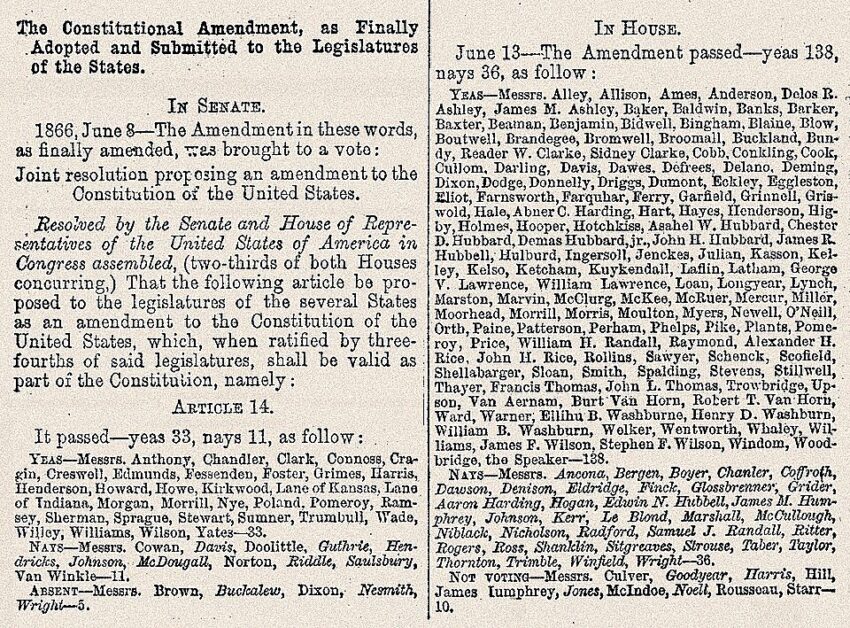
The Fourteenth Amendment commands, “All persons born or naturalized in the United States, and subject to the jurisdiction thereof, are citizens of the United States and of the State wherein they reside.” The key debate in this case hinges on the meaning of the middle portion of that sentence: “subject to the jurisdiction thereof.”

The government argues that the phrase “subject to the jurisdiction thereof” in the Fourteenth Amendment requires that newborn children be subject to America’s political jurisdiction, not just regulatory jurisdiction. Political jurisdiction, in the government’s view, demands allegiance to the United States—and therefore domicile—for citizenship. The government argues that children of parents without permanent immigration status cannot be domiciled in the United States, so they are not born citizens.
But as our brief explains, this argument does not comport with the original public meaning of the Fourteenth Amendment. Contemporaneous definitions, writings of the time, and court precedent show that “subject to the jurisdiction thereof” only required that children be born under the United States’ authority (that is, be bound to follow US law). Because children of parents without permanent immigration status are under the authority of the United States and born in the United States, the Fourteenth Amendment grants them citizenship.
ADVERTISEMENT

The ordinary public meaning of the text is corroborated by the Fourteenth Amendment’s purpose. In the past, the Court improperly limited this purpose in the Slaughter-House Cases (1873) and excluded those the Fourteenth Amendment meant to protect. We argue that this Court should avoid making that mistake again and affirm the broad purpose of the Fourteenth Amendment: to protect “all persons.” And the set of “all persons” includes the children of parents without permanent immigration status.
Our brief concludes with a rebuttal of another amicus brief in this case. Professor Ilan Wurman’s amicus brief provides an account of the common law of birthright citizenship and a purported application of originalism that pays insufficient attention to the Constitution’s original public meaning. We argue that a more faithful deployment of originalism cannot support Professor Wurman’s conclusions.
In the end, the Fourteenth Amendment guarantees citizenship to nearly all persons born in the United States, with exceptions far narrower than the Executive Order’s scope. The president cannot ignore, rewrite, or abandon that promise by executive order. The Supreme Court should affirm the judgment below and issue a judgment that respects the right of birthright citizenship that the Fourteenth Amendment guaranteed.