

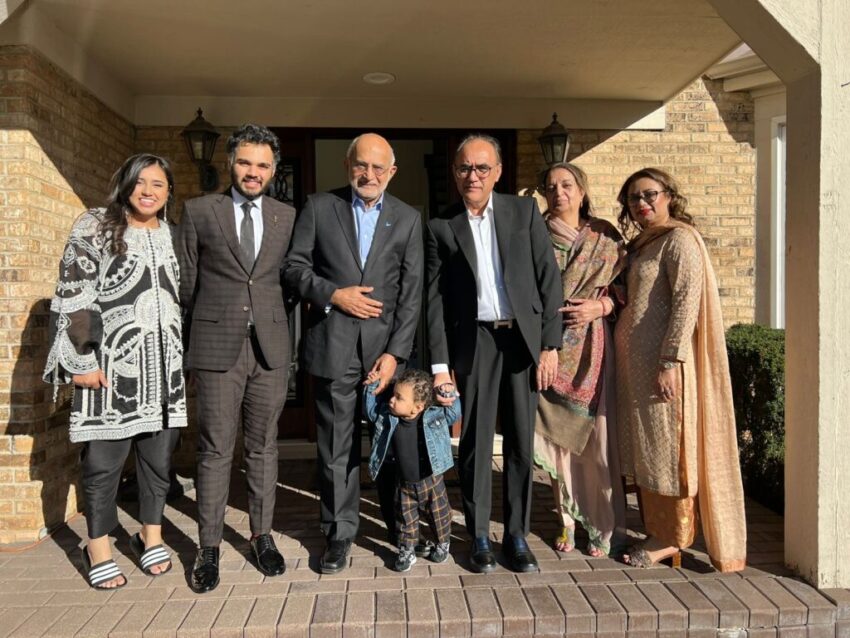

Brendan Liaw was kind of joking when he agreed he was a professional stay-at-home son during his appearance on “Jeopardy!” in May.
He had just earned a master’s degree in political science from the University of British Columbia and had recently sent off a raft of applications to law school. But he was between jobs. And he did live with his parents.
“I figured, why not have some fun with it?” he said. “Better to be a ‘stay-at-home son’ than ‘unemployed’ or ‘schmuck’ or ‘lazy guy.’”
He certainly wasn’t expecting to set off a media moment of stories and think pieces on so-called “trad sons” – adult men who embrace the lifestyle of living with their parents.
ADVERTISEMENT

“I’m sort of the origin of all this discourse,” Liaw, 28, said. He was speaking from an apartment in Vancouver, British Columbia, where he had recently finished his first semester in law school and his first stint living outside his family’s home, with a roommate.
Liaw was tickled by the sudden interest. He describes himself as a guy who is happy to be self-deprecating to get a laugh. “Most people know that it’s a bit,” he said. “I’m not actually endorsing doing nothing.”
After his “Jeopardy!” appearance – during which he won almost $60,000 across four games – several media outlets, including Vanity Fair, People and the Wall Street Journal published stories about a rise in “trad sons” or “hub-sons.”
This is during a time of acute anxiety and curiosity about young men in America. Much ink has been spilled about their loneliness, their jawlines, their physical fitness and about being “performative males.” The prolific podcaster Scott Galloway’s book “Notes on Being a Man” jumped to No. 1 on the New York Times advice bestseller list when it was published in November and sparked fresh discussion about the “masculinity crisis.” (On “Today,” Savannah Guthrie asked Galloway why “this particular cohort – young men – have fallen so far so fast” as an infographic citing Galloway’s book noted that one in five 30-year-old men still live at home).
A Pew Research Center analysis from April bears those statistics out. According to the report, 18 percent of adults ages 25-34 lived with their parents in 2023. That was a dip from a peak of 20 percent during covid restrictions, but more than twice the lowest rate (8 percent in 1970).
The reality has a bit more nuance. While young men were more likely to live at home (20 percent), 15 percent of young women hadn’t left the nest either. And White men were less likely to live at home than men of color.
This wasn’t a surprise to Che Durena, a comedian from New York City, who said the media interest in stay-at-home sons was missing some crucial cultural context. “That’s just called being Italian or Filipino or Indian,” he said in an Instagram video he uploaded last year with the caption “Cultural appropriation”
“A big part of American culture is the individualism, which is great because you get self-starters, entrepreneurship,” said Durena, 33, from his home in New York City. Durena knows this well. He moved out at age 18 to pursue his career in comedy.
But he also has many friends who stuck around the family home until much later in life. “One of my friends who does comedy – he’s Filipino and he left home at, like, 35,” he said. “And his parents beg him to come back.”
Mark Taylor, 39, agrees. He left a comment on Durena’s video that read, “I’m Filipino and black. And I can confirm that no lies were told in this statement.”
Taylor, who installs gutters for a living, was born in the Philippines and moved to California at age 13. He moved out of his family home at 16 but came back home at age 19. He’s lived independently for many years, but he says that there was no stigma in his family about adults staying – or returning – home.
Taylor is from Vallejo, California, which has a large immigrant population (27.1 percent of the population was born outside the United States, compared with a national average closer to 14 percent) and Asian community (about 28,000 people in a town of 123,000). Vallejo is also tied for the city with the highest rate of adults living with their parents in the U.S. According to the Pew analysis, 33 percent of people ages 25-34 in Vallejo live with their parents.
“My mother always had an extra room in case any one of us wanted to move back in,” he said. His older brother did just that a few years ago following a divorce. His mother was happy to have him. “There was never some rule that we had to move out when we were 18,” Taylor added.
Social distancing in the pandemic inspired Abdullah Abbasi, 24, to start selling “Stay at Home Sons” merchandise with two of his friends during the summer of 2020.
Abbasi said he hoped his first summer after college would be like a coming-of-age movie. Instead, he was spending most of his time in his parents’ basement in Barrington, Illinois, playing “PGA Tour” on PlayStation.
“If you look at it from Hollywood terms, I was like that loser kid that lives with his mom,” Abbasi said. “But we didn’t necessarily feel like losers. We still felt very happy and very content.”
Driven by boredom and a shared interest in clothes, he and his pals started making and selling “Stay at Home Sons” T-shirts. “Doing Nothing Is Hard” read the back of one hoodie.
“My mom initially took it as a jab,” Abbasi said. As a stay-at-home mother, she thought they might be making fun of her. She came around quickly to the joke and was particularly excited when the T-shirts began getting media attention, sending the articles to her friends and family.
“This might be more like a South Asian community thing, but they love to be able to brag about their kids,” Abbasi said.
The articles didn’t lead to a significant boom in sales – “Maybe a couple orders” in Abassi’s estimation – but they helped legitimize him in his father’s eyes.
“I think it actually helped my dad be like, ‘If these kids are ending up in articles, maybe he can do marketing,’” Abassi, who works for his father’s psychiatric telehealth practice, said. When we spoke, he was with his family in Islamabad, Pakistan, where part of his father’s practice operates.
“Our situation – it’s kind of like a support network, where we help and they help,” Abassi said. “I think it’s a very Eastern thing where, like, what my father did is something I’ll do.”
His two older sisters have also followed in their father’s footsteps, having earned medical degrees in Pakistan. They both have families of their own, something Abassi is also planning.
Abassi has never had a girlfriend and said that dating isn’t really part of his family’s culture. He’s had mixed feelings on being single, but has recently embraced it. “I’ve really leaned back from [dating] in the last couple of years, a little bit out of respect for myself, a little out of respect for the wife I don’t have.”
Luke Parkhurst, 34, has been single since he sold his house in Houston, quit his job and moved back in with his mother in Las Vegas. He said he was making as much as six figures selling solar power door-to-door, but he had been struggling with addiction to drugs and alcohol.
“Spiritually, mentally, physically, I was dwindling,” Parkhurst said. “I gained a lot of weight. My relationship with my family, my Lord and savior, my friends, my siblings, myself, was all just going out the window.”
Last year, he called his mom and said he wanted to come home. “Luckily, I have such a cool mom, she just said, ‘Okay, cool.’”
Things haven’t always been cool between them. “Me and my mom have been distant in the past,” Parkhurst said. His mother is Mormon and had a hard time when, he said, he veered from her religious values. They’ve gotten closer since he moved back in. “I think it’s been a good healing, bonding experience for me and my mom,” he said.
Parkhurst has fully and vocally embraced his new lifestyle. “I can look someone in the eyes and say, ‘Hell, yeah, I’m a stay-at-home son,’” he said. “You work for a living? That sucks.”
Last year, he started documenting his daily life with a tongue-in-cheek TikTok account. That led to a flurry of media coverage, which made him a bit of a poster boy for what some outlets have called the “trad son” movement. In a New York Post story, his mother called him her “hub-son.” It was accompanied with campy photos of him cleaning her pool and cooking her steak while wearing a cherry-patterned apron.
The photos were posed, but the food was real. He says he cooks his mom steak five times a week, buying the ingredients with her Costco membership and credit card.
The broad smile he wears in the photos is also real. “I’m happier than I’ve ever been,” he said.
He knows that his life isn’t for everyone. “Different strokes for different folks,” he said. “‘Not everyone orders the Number 1 at McDonald’s’ is what I always say.”
Eventually, though, he does hope to find a wife and fulfill what he calls a traditional role of husband as provider and protector.
How does he plan to find a wife without a job?
“If I need to take a girl out on a date, I’ll steal my mom’s credit card for the night,” he said with a smile. Also: “Don’t frickin’ worry unless it’s your wife that’s trying to go out with me,” he said.