

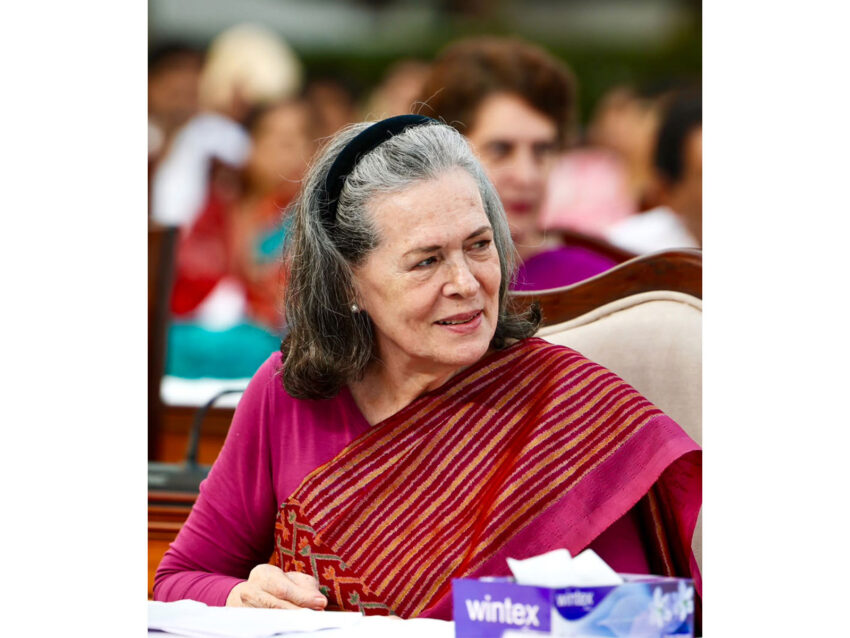
New Delhi [India], November 10 (ANI): Senior Congress leader Sonia Gandhi, in her recently published memoir titled ‘Belonging: A Journey of Love’, wrote about her impression of the 13th President of India and veteran party leader, the late Pranab Mukherjee. She revealed that Pranab Mukherjee left Congress in 1984 after Rajiv Gandhi was chosen as the Prime Minister, but returned to the party’s fold in 1989.
She recalls Mukherjee as an exceptionally knowledgeable and experienced political colleague, while also revealing his unfulfilled ambition to become the Prime Minister. The memoir also mentioned times when Mukherjee lost his temper, “becoming almost purple in the face”.
“Pranab Mukherjee was celebrated for his encyclopaedic mind. Any question on the Congress Party’s long history would find in him a ready answer, and he was equally scholarly on world history, world affairs, and philosophical questions, but at times short-tempered to the point of becoming almost purple in the face,” Gandhi wrote.
“He, too, had left the party in 1984 and formed his own after Rajiv was chosen as prime minister, feeling he’d been sidestepped. He returned in 1989, but that aspiration he never lost,” she added.
Gandhi said that Mukherjee’s aspiration to become the PM was never “lost”. She added that the former President of India always felt that he was the natural candidate for Prime Ministership due to his seniority and experience.
“Over the years he held virtually all the important portfolios in previous Congress governments, but deep down he felt his seniority and experience made him a natural candidate for the prime ministership,” Sonia said.
In her memoir, Gandhi offered a sweeping criticism of the Bharatiya Janata Party’s (BJP) political and ideological approach while also touching upon the functioning of constitutional institutions, the mainstream media, central investigative agencies, electoral processes, welfare schemes and the treatment of religious and political minorities.
Gandhi accused the ruling BJP of “systematically dismantling” India’s democratic institutions, suppressing dissent and centralising political and economic power. She also alleged that the Rashtriya Swayamsevak Sangh (RSS) has “brought most educational institutions under its ideological control”. (ANI)