

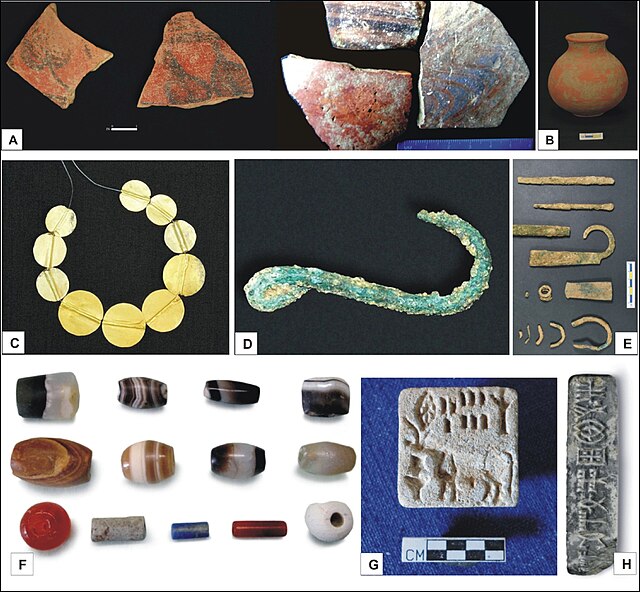

At its peak, the ancient Indus River Valley civilization featured gridded streets, multistory brick homes, flush toilets and bustling shops. Its people traded gold, precious stones and items such as bronze carts along the region’s waterways. Others carved detailed human figurines and molded clay toys. They grew wheat, barley and cotton, and crafted tools to bring water for crops from nearby rivers.
The valley, largely located in modern-day Pakistan and northwest India, hosted one of the most advanced societies at the time, along with Mesopotamia and ancient Egypt. And then – with little signs of fighting or power struggles – it mysteriously disappeared.
Today’s scientists have been trying to explain the puzzling downfall of Harappa, one of the valley’s largest cities, by looking at the environmental conditions. In a study published Thursday (November 27, 2025) in the journal Communications Earth & Environment, an international team used paleoclimate data and computer models to re-create the climate during the civilization’s existence between 3000 and 1000 B.C. They found four intense droughts reduced rainfall and dried up waterways and soils, which probably caused Harappan residents to relocate frequently.

“The most surprising finding is that the Harappan decline was driven not by a single catastrophic event, but by repeated, long, and intensifying river droughts lasting centuries,” said Hiren Solanki, lead author at the Indian Institute of Technology at Gandhinagar, India.
ADVERTISEMENT

Of course, the droughts alone wouldn’t be the sole reason for the downfall, said co-author Balaji Rajagopalan, who researches hydrology at the University of Colorado at Boulder. But he said if there is less food and a weak governance structure, for instance, then severe successive droughts can push a society “more and more toward decline and dispersement.”
Even so, the civilization lasted a very long time despite the persistent drought conditions – providing a lesson on adaptation relevant to communities facing difficult environmental conditions today, the researchers said.
“The Harappans switched crops, diversified their trade, and relocated settlements to make them more resilient to climate change,” Solanki said. “This underscores the importance of proactive planning, diversified water sources, and resilient agricultural systems in the warming world.”
Over about 2,000 years, Harappan settlements became more concentrated at sites closer to water – first around tributaries, and then further west in clusters near the Indus River.

To understand the broader context of these moves, the team simulated the climate conditions at the time. They combined the model results with environmental clues, including stalactites and stalagmites in two Indian caves and water level records of five Indian lakes.
They determined that between about 3000 and 2475 B.C., vigorous monsoons brought a lot of rain across the region and created much wetter conditions than today. Rajagopalan said the robust monsoon activity can be explained by a cooler tropical Pacific Ocean at that time (La Niña-like conditions), which created conditions favorable to a wetter South Asia. Accordingly, settlements congregated around those rain-heavy areas.
But he said the tropical Pacific began to warm in subsequent centuries, creating drier conditions that decreased rainfall and increased temperatures. Drought ensued.
The team identified four droughts – each lasting more than 85 years – between about 2425 and 1400 B.C. The third drought, peaking around 1733 B.C., ranked as the most severe: It lasted about 164 years, reduced annual rainfall by 13 percent and affected nearly the entire region.
Overall, the team found the temperature increased by 0.5 degrees Celsius (0.9 degrees Fahrenheit) and rainfall decreased between 10 and 20 percent.
The rainfall changes had profound effects on the ground, co-author Vimal Mishra, also at IIT Gandhinagar, and his colleagues said. Using hydrologic models, they showed lakes and shallow waterbodies called playas shrank, river flow decreased and soil dried up.
“That means you cannot move your boats and barges,” Rajagopalan said. “If you’re dependent on trade, suddenly you can only move your goods at only a certain time of the year. You might have to find deeper parts of the river.”
Agriculture also became tougher in central regions away from waterways, Solanki said.
Those changes pushed people to move and consolidate, which then may have contributed to the shrinking or decline of the society.
The research is a “significant step ahead in studying hydroclimate’s role in the evolution of ancient civilizations,” said Liviu Giosan, a geoscientist at Woods Hole Oceanographic Institution who was not involved in the study.
Previous research, including his own, used limited data from caves or minerals to ascertain rainfall patterns, but the new study puts all the records together and shows the water cycle at a larger scale. The methodology could help illuminate patterns in other ancient cultures dependent on rain and rivers, such as Mesopotamia, Egypt and China.
“There are unexpected surprises, such as how droughts influenced settlement location choice in the Indus territory, which provides a framework testable in the field by archaeologists,” Giosan said.
“It is remarkable that they survived so long under repeated climate crises,” he added. “A lesson for us? Prolonged climatic stress weakens society and could lead to collapse if not prepared.”
It’s unclear if modern communities could face a fate similar to the vanished Indus civilization. Pakistan and India are experiencing temperature increases, as did their predecessors, but Rajagopalan said understanding the future variability of ocean temperatures in the tropical Pacific will have major implications on rainfall patterns.
“One of the big million-dollar questions is, under a warmer climate, what is the tropical Pacific going to do?” he said. “That’s where much of the cutting-edge research is in climate.”