

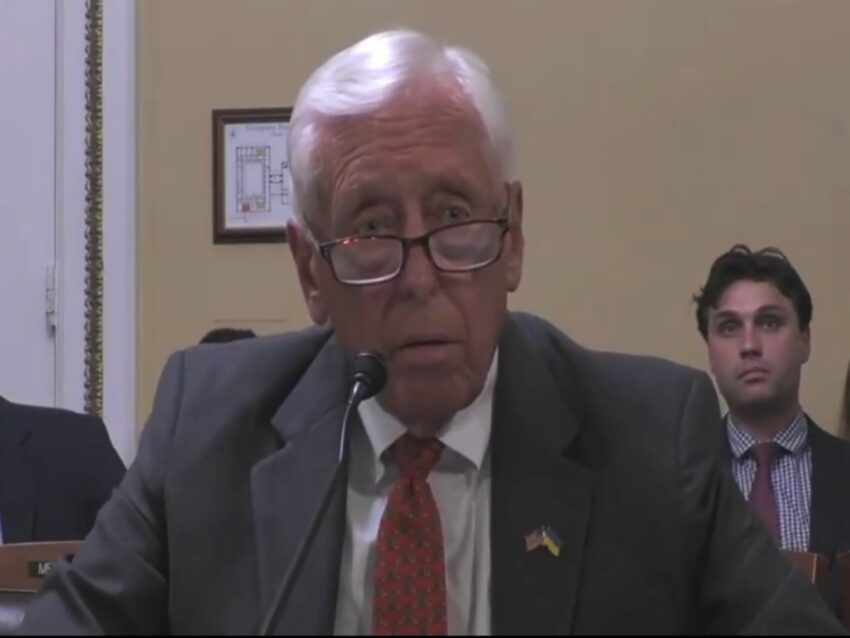
Washington, DC [US], September 16 (ANI): Pushing to amend the ‘Lindsey O. Graham Sanctioning Russia and Iran Act of 2026’, US lawmaker Steny H Hoyer on Tuesday (local time) urged Congress to adopt an amendment that explicitly lists target countries, including India, to prevent “manipulation of data” and forces President Donald Trump to get approval before expanding tariffs.
Testifying before the House Committee on Rules, defended his modification, explaining that Congress must retain strict control over secondary sanctions and tariffs rather than handing broad authority to the administration.
“Specifically, it tightens the scope of the legal tariff authority by naming the countries, as I said. I agree with the Administration [that] we ought to pass this bill. This bill would prevent manipulation of data on oil and gas imports, as well as sanctions evasions, in order to make them qualify or not. That language is pretty specific. It says no country that does not qualify for the formula – what we don’t trust is the formula, which is why we need to name the countries so that we, acting in our constitutional responsibility, do in fact give authority for those 9 or 10 countries – the two ‘-stans’ being the 10th, and that he would have to come back if he wanted to add another country,” Hoyer testified.
Throughout his testimony, the Maryland Democrat sharply criticised President Donald Trump’s past economic policies and foreign policy record. Hoyer made it clear that his co-sponsorship of the bill was not an endorsement of the White House, accusing Trump of showing far more sympathy toward Moscow than toward Ukraine.
“Nobody in this House believes that I am a defender of Donald Trump’s failure to address this issue head on and effectively. No one has opposed his tariff policies any more than I have. They have been harmful to the American people [and] harmful to our relationship in the international community,” Hoyer stated.
“However, none of us on our side trust Donald Trump to be bound by the strictures of legislation or of the Constitution of the United States. That’s not why I co-sponsored this bill because I had some trust in Donald Trump, who I think is far more partial to Russia than he is to Ukraine. That’s a tough statement, but I think that’s borne out by conduct,” he added.
Hoyer explained that his amendment lists 10 specific trade partners to stop the White House from manipulating energy data or arbitrarily expanding tariffs beyond what Congress approves. He noted that while the White House opposed adding this explicit list, doing so protects the law from being misused while keeping its main goal intact.
Addressing internal Democratic disagreements, Hoyer voiced support for several oversight amendments offered by Rep. Gregory Meeks, but strongly opposed Meeks’ proposal to strip the tariff mechanism entirely. Hoyer argued that while he dislikes tariffs, threatening duties of up to 100% acts as a necessary shield to deter foreign nations from buying Russian energy and funding Moscow’s military.
Reminding the committee that Congress has not passed positive assistance for Kyiv since April 2024, Hoyer advised lawmakers against putting disputes over tariff details, suggesting that gridlock over tariff mechanisms risks collapsing crucial US support for Ukraine.
“If we do not pass this bill, there will be great joy in the Kremlin and great devastation in Kyiv, who will see something that they thought they had in hand – a strong statement by the United States of America’s Congress – disappear because of a fight over tariffs. Their morale will tank and we will be still, since April 2024, having not taken the action,” Hoyer warned.
Concluding his remarks, Hoyer addressed historical comparisons made during the debate, urging Congress to speak with a unified voice.
“The Ranking Member said this may be a Chamberlain-Churchill moment. I agree with him. However, I believe that he chose this to be a Churchill moment rejecting this legislation. I believe it will be a Chamberlain moment, where we will leave unstated the policy of the Congress of the United States, and allow the President’s actions to be the only voice that is being heard. That is not in the best interests of our country, of Ukraine, of international law, and peace and freedom,” Hoyer concluded.
His remarks come as a newly introduced Senate amendment to the “Lindsey O. Graham Sanctioning Russia and Iran Act of 2026”, which was passed in August, mandates secondary tariffs of up to 100 per cent on goods imported from the top five largest buyers of Russian crude oil and natural gas, directly exposing major importers like India and China to massive trade levies, in a significant legislative move to curb funding for Moscow’s military operations in Ukraine.
The underlying legislation was passed by the US Senate on August 7, by an 86-11 vote to increase economic pressure on Russia and Iran.
The House Committee on Rules, amongst the oldest standing committees in the House, is currently processing the introduced Senate amendments.
The bill passed by the US Senate does not explicitly name Russia’s trading partners, but specifically targets the five largest importers of Russian oil and gas by volume.
As India remains among the largest buyers of Russian seaborne crude alongside China, it falls directly under this top five volume trigger.
Earlier on Friday, Russian President Vladimir Putin revealed that Russia has been hit with over 30,000 sanctions, more than double the total restrictions slapped on all other countries in the world combined, as he condemned global economic coercion and “ugly” competitive tactics.
Delivering his remarks at the Leaders’ Session of the BRICS Business Forum in the national capital, Putin lashed out at Western nations for turning trade and diplomatic pressure into state-level interference.
“More than 30,000 sanctions have been slapped on Russia which is twice as much as the number of all sanctions against all other countries of the world combined,” President Putin said.
In a veiled attack against the US, Putin also detailed how trade conflicts have escalated into extreme geopolitical disruptions, emphasising the blockade of transport corridors, destruction of pipelines, illegal restrictions and the threat of possible “so-called secondary sanctions” targeting countries that don’t abide by “someone else’s interest.” (ANI)