

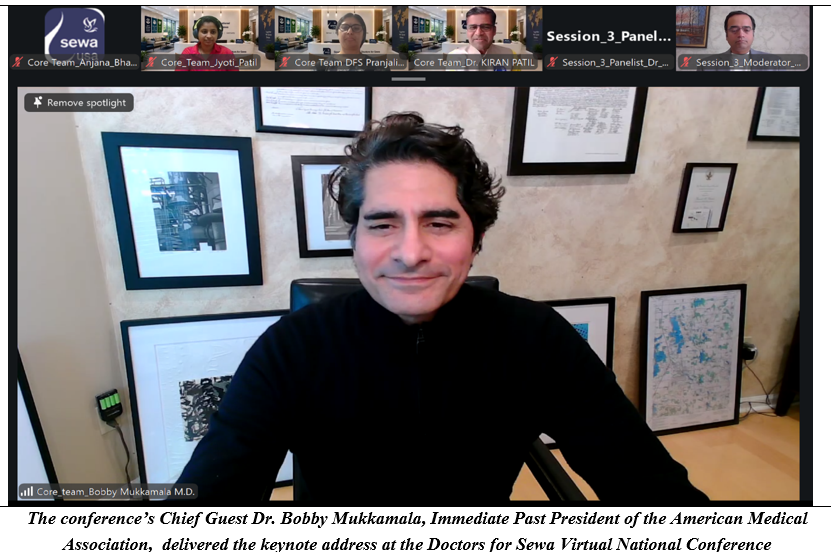
More than 380 attendees, including physicians, medical professionals, community leaders, and Sewa volunteers from 32 chapters nationwide, attended the first-ever Doctors for Sewa (DFS) National Conference virtually on September 26. Doctors for Sewa is a Sewa International initiative to involve physicians in community service.
Sewa partnered with the AAPI-CF (American Association of Physicians of Indian Origin) Charitable Foundation and AAPI to organize the conference, an October 6, 2026, press release from the organizers said.
The theme of the two-hour conference was “Advancing Healthcare through Selfless Service.” Discussants explored how to engage healthcare professionals in local and global service projects.

In his keynote address, Dr. Bobby Mukkamala, Immediate Past President of the American Medical Association (AMA), said, “Service is not an obligation; it is an extension of why so many of us chose medicine in the first place. By working together, we can build healthier communities and expand access to care. Our commitment to service can create a lasting impact beyond the walls of a hospital.”
ADVERTISEMENT

In his opening remarks, Dr. Kiran Patil, a Neurologist introduced DFS and said it focused on three areas of work: Serve Local, International Medical Yatra, and EVOLVE (Explore the Virtue of Obeisance towards life by volunteering and educating), and mentoring. Dr. Patil is currently serving as a DFS volunteer in Suriname.
The conference featured three focused sessions. The first session, ‘Serve Local and Beyond,’ moderated by Dr. Shashwati Kale, brought together Dr. Sreeni Gangasani, Dr. Sangeeta Sinha, and Dr. Meher Medavaram, president of AAPI. The panel highlighted free clinics and health fairs already led by physicians across the country and offered practical insights for doctors looking to launch similar initiatives in their communities.
Dr. Gangasani shared his experience running the GAPI-Sewa (Georgia Association of Physicians of Indian Heritage) free clinic in Georgia since 2010, including a case in which the clinic helped detect cancer at an early stage. Panelists encouraged physicians to volunteer one day a month—or even one day a year—and suggested stronger connections between health fairs and free clinics.

The second Session, ‘Mental Health, Alternative Medicine & Holistic Well-Being,’ moderated by Dr. Vibhor Gupta, featured Dr. Hetal Nayak, Dr. Unnati Jain, and Dr. Jashvant Patel, who examined integrative approaches to care built around the whole person.
The third Session, ‘Workforce Empowerment & Policy Shaping,’ was moderated by Dr. Pranshu Adavadkar, featured Dr. Ravi Jahagirdar, Dr. Deepu Sudhakaran, and Dr. Monika Kapur. The panel focused on challenges facing International Medical Graduates and explored policy opportunities for physicians to play a stronger role in shaping healthcare.
Immediate Past President of the Texas Medical Association, Dr. Jayesh Shah, described Sewa International as a bridge between those with expertise and those who need it. Drawing on his experience with Sewa’s disaster response after the Kerrville floods and the organization’s ongoing relief efforts in Nepal, Dr. Shah’s take-home message to every attendee was simple: Sewa begins when we stop asking what we have, and start asking what we can give. He challenged each physician in the program to commit to one concrete act of service in the next 30 days. The conference concluded with Dr. Sarvalakshmi Kurella delivering the vote of thanks.