

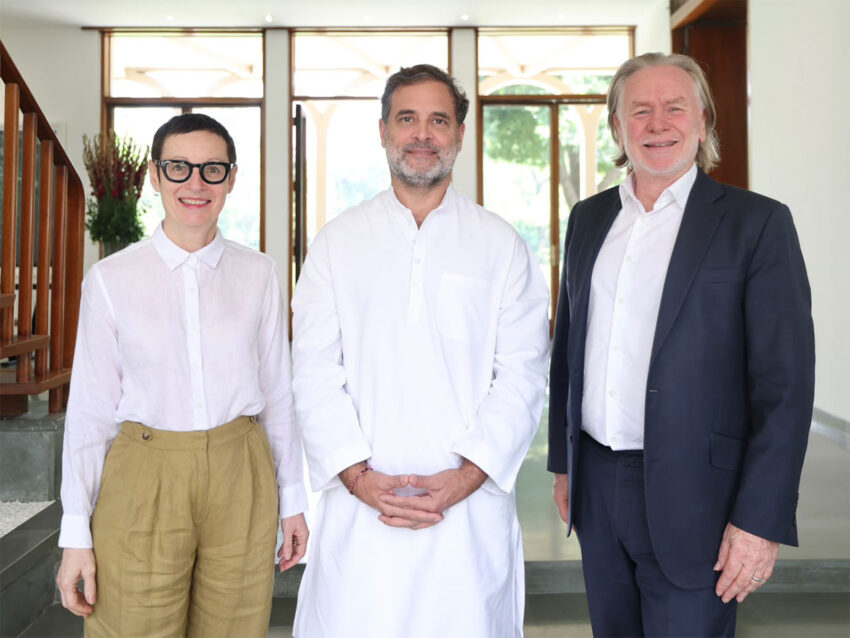
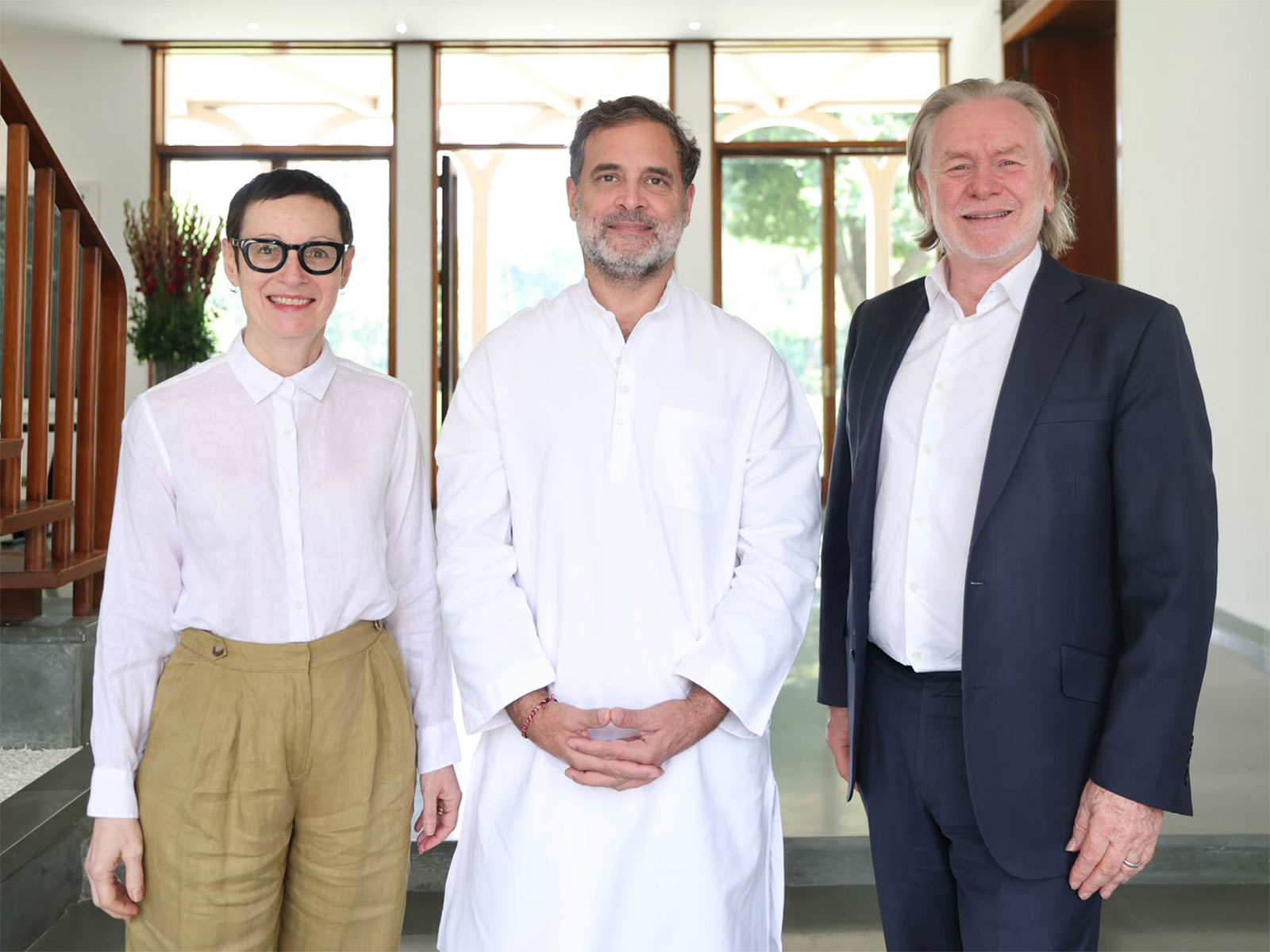
New Delhi [India], September 23 (ANI): Lok Sabha Leader of Opposition (LoP) Rahul Gandhi on Wednesday met Australian High Commissioner Philip Green and Professor Susan Marks of the London School of Economics (LSE) in the national capital.
The update on the meeting was shared by the All India Congress Committee (AICC). According to the official website of the LSE, Susan Marks joined the university in 2010 as Professor of International Law. She previously taught at King’s College London and, before that, at the University of Cambridge, where she was a fellow of Emmanuel College.
According to the official website, “Her work attempts to bring insights from the radical tradition to the study of international law and human rights”. Susan is a ‘Fellow of the British Academy’.
Rahul Gandhi’s meeting with the Australian High Commissioner to India, Philip Green, comes as, earlier in September, Green praised India’s growing role on the global stage.
He described Prime Minister Narendra Modi and External Affairs Minister S Jaishankar as “giants” and highlighted the growing momentum in the Quad, while also outlining opportunities for deeper India-Australia cooperation in agriculture, technology and healthcare.
Speaking to ANI on the BRICS Summit hosted by India, Green lauded India’s diplomatic leadership, particularly the role played by Prime Minister Modi and EAM Jaishankar.
“The Ministry of External Affairs has some of the finest diplomats in the world, and in Dr Jaishankar and Prime Minister Modi, you have people who are real giants on the world stage,” he said.
Green said Australia’s engagement with India has primarily progressed through the bilateral relationship as well as the Quad, which brings together India, Australia, Japan and the United States.
“I can say that my engagement with your finest diplomats and your leaders has been through the Quad as well as bilaterally, and the Quad is moving at great pace,” he said.
Referring to the Quad Foreign Ministers’ meeting held in India earlier this year, Green said the grouping is developing greater coherence and expanding its scale and areas of cooperation.
“You will have seen we had a very successful foreign ministers meeting here just three months ago. We have more foreign ministers meetings on the way,” he said.
“The Quad is really growing in coherence and scale and effort, and I think you’re going to see more of that in lots to come,” Green added.
On the Quad’s recent tabletop exercise in Tokyo to advance the Indo-Pacific Logistics Network, Green said the grouping is focusing on practical areas where the four countries can make a tangible difference across the region.
“Well, what we’re doing in the Quad is focusing on a few areas where we can really make a difference,” he said, highlighting maritime domain awareness and subsea cables as key areas.
“These are the sort of interventions that the Quad is making to engage all of the countries of our region and to ensure that they have the opportunity to benefit from the best things of the modern world,” he said.
Describing India, Australia, Japan and the US as a “democracy diamond”, Green said the four countries are leading an important effort for the Indo-Pacific.
“We are leading this effort, and it’s a very important one for our region, the Indo-Pacific,” he said.
On future India-Australia cooperation, Green identified agriculture and agri-tech as major areas of potential collaboration, saying Australia is keen to build on its existing engagement with India’s agricultural sector.
“We’ve made huge interventions in this country in the field of agriculture, and I’d be keen to do that again,” he said.
He said ongoing free trade negotiations and other initiatives could help connect Australian agricultural technology with India’s capabilities and requirements.
“Through our free trade negotiations and elsewhere, we’re trying to find new and better ways to connect Australian agri-tech and Indian capability and need,” Green said.
Green also highlighted the Australian-origin cochlear implant technology and its potential to transform the lives of people with profound hearing loss in India.
“The Australian connection is the cochlear implant, invented in my country, now available all over the world, with variants specifically designed for the Indian population here,” he said.
“My message to Indian governments and those with the resources to help is: we can really make a difference to people with profound hearing loss and allow them to live an utterly normal life,” Green added. (ANI)