

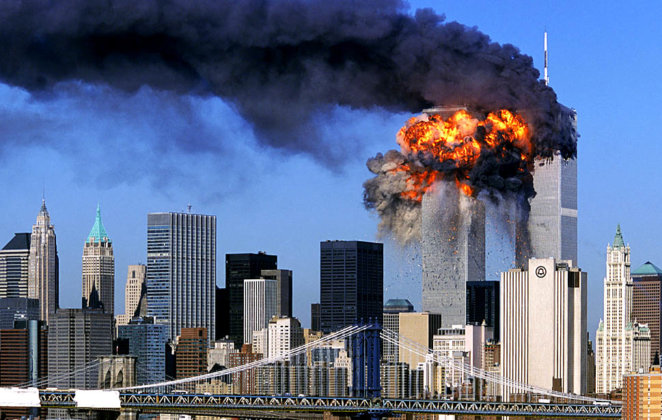
It’s been 25 years since the tragic day September 11, 2001. Since then, 9/11 has become one of those events imprinted in the minds of everybody, at least in North America. We know exactly where we were when we came to know and saw the attacks on the World Trade Center, when the buildings came down, when horrific pictures of people tumbling down, amazing newscasts of first responders going into the dangerous spaces to rescue whomsoever they could.

News India Times asked one Indian American who was saved by the skin of their teeth and lived to tell the tale.
Dr. Ronac Mamtani (in his own words):

Where were you on that day?
ADVERTISEMENT

I was a senior at Cornell, still trying to figure out what I wanted to do with my life. My father is a physician, and when I was younger I assumed I would probably become one too. Interestingly, he was the person who encouraged me to look into other careers. He had seen medicine changing and worried that the relationship between doctors and patients was becoming ‘transactional’ – almost a relationship between ‘providers’ and ‘consumers’. He wanted me to make my own decision about medicine rather than simply follow him.
Cornell had an “Urban Semester Program” that allowed students to spend time in New York City and explore different careers. I was good with numbers and interested in economics, so I ended up doing an internship at Merrill Lynch in the World Financial Center, located right next to the Twin Towers.
My first day was September 10, 2001.
September 11 was my second (and last) day.
I still have my Merrill Lynch name tag from that internship. I have kept it all these years. When I look at it now, it is strange to think about the young person wearing it. I had gone to NYC thinking I was exploring one possible career. Within 24 hours, I began thinking about an entirely different one.
What do you recall about that moment when planes began hitting the WTC?
I remember pieces of that morning rather than a clean sequence of events.
I had been paired during orientation with another intern – a young man from France. I wish I could remember his name. We were sitting in a cubicle doing training courses. I remember thinking the office seemed unusually quiet. At some point I wondered, where is everybody? Then I remember seeing debris falling outside. An announcement told us to stay where we were. I was a college student on my second day in a professional office, so my natural reaction was to follow the rules.
The French intern thought differently. He said we should leave. We got into an elevator. I remember how crowded it was. When we finally reached the ground floor, there were crowds of office workers looking upward.
I looked up and saw smoke coming from one of the towers.
And this sounds ridiculous now, but my first thought was that there had been a small office fire. My mind didn’t have a reference for what I was seeing.
Then a plane came over us – this was the second plane. I’ll never forget the sound of that engine. For a second, I remember wondering whether there was an airport on top of the WTC. That is how little I understood what was happening. Your brain looks for an ordinary explanation because the real one is unimaginable.
The French intern told me we needed to run – so I ran. After that, I mostly remember panic and dust.

Did you feel a sense of terror or calm, and how did you get out of the building?
I would not describe myself as calm, and I certainly would not describe myself as brave. In fact, someone I had known for barely a day had much better instincts than I did. We had been told to remain where we were. He was the one who convinced me to leave. When everyone was staring at the burning towers, he was the one who told me to run.
I do not remember his name, and I wish I did. Every September 11th, I think about him, I wonder where he is and what his life became. And I wish I could thank him. Maybe, somehow, he will read this.
Eventually, I made my way from lower Manhattan to the Upper East Side, where I was staying at Olin Hall at Weill Cornell Medical Center.
I could not reach my parents for hours. Phones were not working normally, and of course they had no idea whether I was safe. I was finally able to reach them in the early evening.
I also remember the Metro North train ride home to upstate NY afterward. I felt people looking at me differently. I was a young brown man, and in those first hours after the attacks, I wondered whether some people thought I looked like someone they should fear. Of course, I don’t know what anyone was actually thinking, so I don’t want to overinterpret. I only know what it felt like to me at the time.
But even this memory was overshadowed by something bigger.
I kept thinking about the people who had not been able to get out.
The official death toll from the attack was nearly 3,000 people. While thousands were able to evacuate – firefighters, police officers, and other first responders were moving in while others were trying to escape.
I kept wondering what the people who were trapped must have been feeling.
That sense of vulnerability stayed with me.
What effect did the tragedy have on your own life – in the short term and in the long term?
It changed the direction of my life. I don’t want to make it sound as though becoming a doctor had never crossed my mind before 9/11. My father was a physician, and I had grown up around medicine. But I was genuinely exploring other careers, and finance was one of them.
After 9/11, something became much clearer to me.

I had just seen people at their most vulnerable. I kept thinking how helpless they must have felt and how desperately they must have wanted somebody to help them.
I realized I wanted to dedicate my life doing something where, when people are frightened and vulnerable, I could be useful to them.
A few weeks later, my supervisor at Merrill Lynch called. He told me how relieved he was that I was okay. I told him I would not be returning to finance.
I applied to medical school.
My application essay was largely about 9/11 and how the experience had affirmed my decision to pursue medicine.
I remember one of my first medical school interviews afterward, at Downstate – in Brooklyn. The interviewer, a psychiatrist of Indian origin, question whether the story in my essay was actually true.
At the time I was deeply offended. This was something that I had just lived through, something that had affected me profoundly, and suddenly I felt as though I had to prove it had happened.
But 25 years later, this is not the part of the story I spend much time thinking about.
I ended up going to Stony Brook, in Long Island NY. I received outstanding medical education. And I met my wife there.
Somehow, this terrible day redirected my professional life, but the path it put me on also ultimately led me to the person with whom I built my family.
Today as you look back- do you feel a sense of fulfilment and do you feel that 9/11 is still the driving force in your life? how and why?
I don’t know that I’d use the word fulfillment when talking about 9/11. I think the better word for me is gratitude. I am grateful that I got out. Grateful for that young intern. And I am very aware that many people standing only a short distance away did not have the same outcome.
Today, I am the section Chief of Genitourinary Medical Oncology at Penn. I care for patients with bladder cancer. I train young oncologists. I lead a research program focused on generating real-world evidence in oncology and how we can learn from the experiences of patients outside clinical trials. I have also been fortunate to receive an endowed professorship, the David J Vaughn MD Professorship in Genitourinary Oncology.
I am proud of those things, but they are not really how I think about the connection to 9/11.
The connection is much simpler.
It is the patient sitting in front of me.
A cancer diagnosis can make a person feel incredibly vulnerable. One day you are living your life. Then suddenly, you hear a word like ‘cancer’, and your whole world changes.
I cannot always take their fear away and do not always have the answers to the questions my patients ask.
But – I can be there, help them understand what is happening, help them make decisions, and help them feel that they are not alone.
That is probably the closest connection between the young person I was on 9/11 and the physician I am today.
And there is one part of my career that I find particularly ironic.
Some of the patients I care for are firefighters and other first responders from 9/11.
I am very careful about saying that a particular individual’s cancer was caused by a particular exposure. But many responders experienced enormous exposure to dust, smoke, combustion products and other pollutants during rescue and recovery efforts.
There is something very moving to me about sitting across from one of those patients.
25 years ago, when I was frightened, I was running away from that scene.
They were running toward it.
And now, sometimes, I have the privilege of taking care of them.
You are now 25 years older and have two children of your own. What life-lessons can you teach them and others – about how to live their lives, and what courage, responsibilities, commitments etc. all of us should adopt?

I think one of the biggest lessons is that life rarely follows the plan you make for it.
Sometimes something terrible happens and there is no lesson that makes it OK.
But, we do get to decide what we do afterwards.
I also want my children to understand that courage does not mean being fearless.
I was afraid on 9/11 and so I ran.
The courage I remember that day belonged to other people- firefighters, police officers, emergency workers and ordinary people who helped strangers
And, on a much smaller scale, it belonged to a young French intern who ignored the instinct to wait and told another confused college student (me) – “we need to go”.
I have spent 25 years not knowing his name, but I have never forgotten what he did.
If I could say something to my children about how to live, it would probably be this: be the person who notices when somebody else needs help.
You may never know what effect a small decision has on another person’s life.
That intern probably had no idea that the person running beside him would one day become a cancer doctor, have a wife and two kids, train other physicians, and still be thinking about him a quarter of a century later.
And every 9/11, I still wish I could tell him- Thank you.