

Several Democratic US Senators and Representatives introduced a resolution September 15, 2026, to block a regulation, entitled “Establishing a Fixed Time Period of Admission and an Extension of Stay Procedure for Nonimmigrant Academic Students, Exchange Visitors, and Representatives of Foreign Information Media.”
The regulation changes how international students, exchange visitors, and foreign journalists maintain their immigration status.
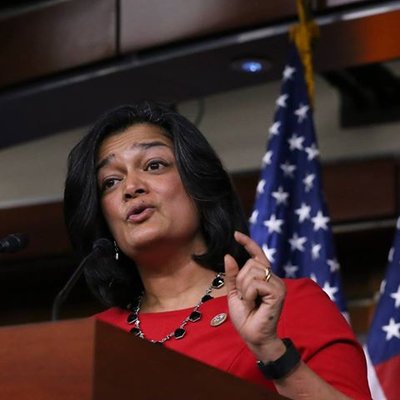
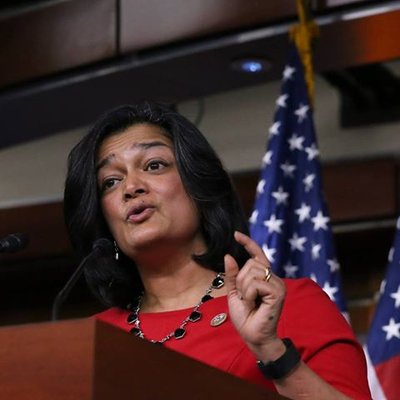
Those leading the legislation in the House Representatives include Pramila Jayapal (D-Wash.-07) and Jamie Raskin (D-Md.-08).
“International students make our institutions of higher learning better for all students and create pipelines to ensure the best and brightest lend their talents to strengthen our economy and American innovation,” Rep. Jayapal said. “We should be welcoming students, not wrapping the processes to obtain visas in layers of red tape.” She accused President Trump and his advisor Stephen Miller of having a plan “to prevent all forms of legal immigration,” and noted, “I first came to this country on a student visa and understand deeply just how important these visas are.”
ADVERTISEMENT

In the US Senate, Senator Alex Padilla (D-Calif.), Ranking Member of the Senate Judiciary Immigration Subcommittee, U.S. Senate Democratic Whip Dick Durbin (D-Ill.), Ranking Member of the Senate Judiciary Committee, and U.S. Senators Richard Blumenthal (D-Conn.) and Sheldon Whitehouse (D-R.I.), members of the Senate Judiciary Committee, introduced a Congressional Review Act (CRA) joint resolution of disapproval.
For more than 40 years, F-1 visa students, J-1 visa exchange visitors, and I visa international journalists have been permitted to remain in the U.S. for as long as they engage in the activity that qualifies them for the visa, known as “duration of status,” the press release from Padilla’s office noted.
However, on July 17, the U.S. Department of Homeland Security (DHS) published a final rule that eliminates duration of status and requires recipients of F-1 student visas and J-1 exchange visas to enter the U.S. for a fixed admission period capped at a maximum of four years. Similarly, recipients of I visas would be admitted for the length of their project in the U.S. or a maximum of 240 days.
The rule also includes significant limitations on transfers and changes of educational objectives for student visa recipients.
Lawmakers said educational institutions, labor unions, and medical associations have raised serious concerns about this rule’s impacts on the nation’s ability to attract the best and brightest students to U.S. universities and to retain doctors in American communities that desperately need them.
The rule was scheduled to go into effect on September 15 but is currently paused by court order.
Arguing that international students deserve fair opportunities to receive an education in the United States, Padilla added, “Diversity is our country’s strength, and international students and exchange visitors support American innovation, job growth, higher education, and global competitiveness. We have a responsibility to protect these visa holders, including international students who contribute to the culture of American universities and eventually to our nation’s economy.”
Pointing to negative effects of a previous similar effort when the federal government implemented a fixed period of admission for these visa categories in the 1970s, the lawmakers pointed to significant backlogs.
“This new regulation will likely yield the same result, as the most recent available data shows the United States Citizenship and Immigration Services (USCIS) processing backlog at 12 million cases,” the press release noted.
Universities and Medical associations have raised concerns about the impacts of the rule, the lawmakers said.
In addition to Padilla, Durbin, Blumenthal, and Whitehouse, the CRA resolution was cosponsored by U.S. Senators Ed Markey (D-Mass.), Chris Van Hollen (D-Md.), Ron Wyden (D-Ore.), Peter Welch (D-Vt.), Angus King (I-Maine), Jeanne Shaheen (D-N.H.), Tim Kaine (D-Va.), and Cory Booker (D-N.J.).
The CRA resolution of disapproval is endorsed by a slew of professional organizations, medical bodies and universities.