

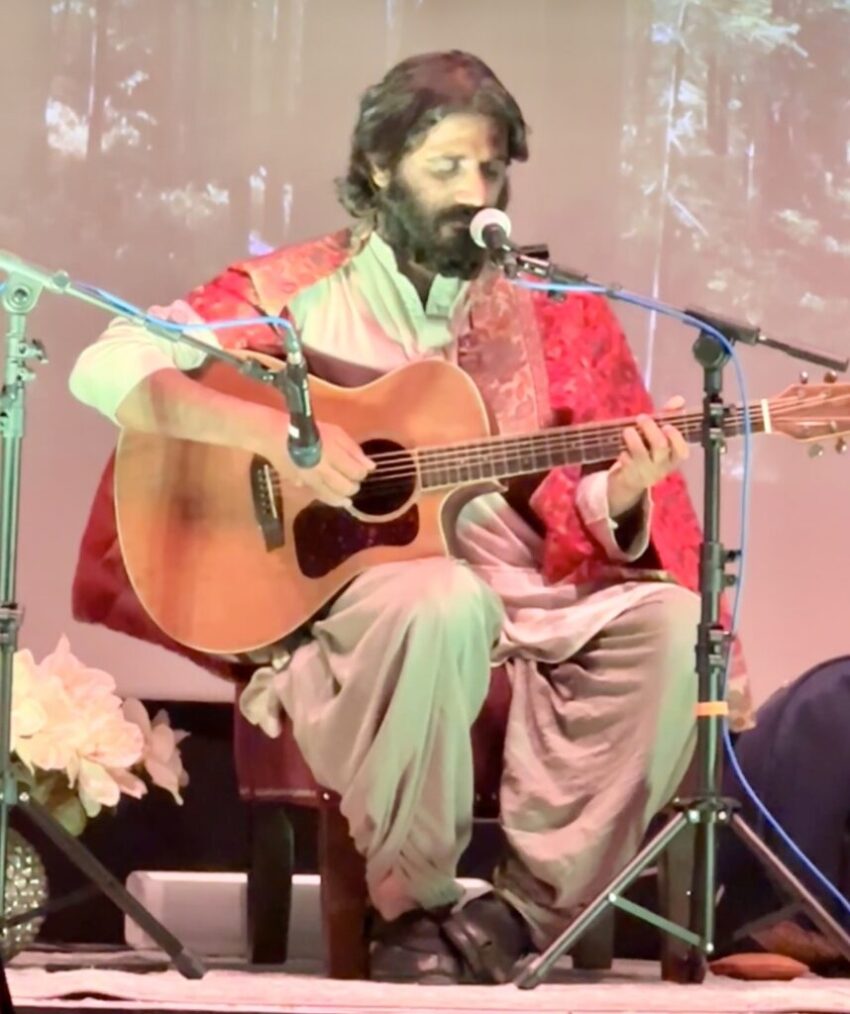
I first came across Kavish Seth through a few short video clips sent by a friend, Anima Johari. They were unassuming recordings—an intimate gathering, a small audience, and a young man singing with a guitar. There was nothing polished or staged about it. Yet something about the voice stayed back with me.

The sound was unusual in its texture—part conversational, part rooted in Hindustani phrasing, moving fluidly between melody and spoken rhythm. It didn’t demand attention. It simply held it.
Curious, I looked him up. Kavish Seth is the son of celebrated singer Kavita Seth, whose voice is associated with songs like Iktara from Wake Up Sid and Tumhi Ho Bandhu from Cocktail. But Kavish does not appear to lean on that lineage. If anything, his work seems to deliberately step away from it, carving out a language that is distinctly his own.
After an online interview over Zoom, I told him half in jest that I would be in the front row when he performed in New Jersey. I did not expect to follow through so literally. But when the day of the performance arrived at the ITV auditorium, I found myself exactly there—right at the center, on the steps, observing not just the stage, but the audience around me.
ADVERTISEMENT

The filmmaker in me has always believed that the best view is not always from the seat, but from where the frame holds both performer and audience together. That evening, the frame felt complete.
What unfolded was not a conventional concert. Kavish moved between singing, poetry, storytelling, and quiet conversations with the audience. His music carried ghazal influences, folk textures, and contemporary sensibilities, often blurring the line between performance and dialogue.
At the center of it was Noori—a custom-designed instrument he created and later patented. It is both musical object and personal philosophy, born from his desire to align sound with identity rather than convention.
He invited the audience to sing along. What followed was a rare kind of collective participation. People who had arrived as strangers began to respond in unison—smiling, swaying, and at times visibly moved. The distance between performer and listener seemed to dissolve entirely.
Kavish’s storytelling drew from his life—his years at IIT Bombay, his travels across India, and encounters that shaped his understanding of music and self. At one point, he spoke about Kashi, describing it not as a destination but as an experience that often answers questions one does not know how to ask.
For a performer in his thirties, there is an unhurried quality to his presence, as though urgency has been replaced by observation.
When the concert ended, the atmosphere remained suspended. The music had stopped, but the silence still felt inhabited.
A few days later, I met him again in Princeton, this time in a far more informal setting. He had just arrived from travel, visibly exhausted but still carrying the residual energy of performance. There was no stage, no audience, no instrument—only conversation at a small table in Palmer Square, joined by Anima.
In this setting, Kavish spoke more openly about his journey. An IIT Bombay graduate, he described a period of resistance within the structure he found himself in. Expectations from institutions, comparisons with established musicians, and internal pressure to define success in conventional terms all became part of that phase.
At one point, he recalled being told that not everyone could become A. R. Rahman. His response, however, was not imitation or rejection, but separation from comparison itself. He chose instead to ask a different question: why must he become anyone else at all?
That shift, he said, took time. There were academic setbacks, repeated subjects, and moments of uncertainty. Yet over time, something softened in his approach to both music and life.
A turning point came with the realization that instead of reshaping reality to fit ambition, it was possible to let ambition grow within the circumstances already present.
“I made friends with IIT,” he said in essence—treating the institution not as a limitation, but as a landscape.
Loss also became part of this recalibration. The passing of his father marked a moment of emotional and philosophical change, after which, he said, resistance no longer felt sustainable.
Over time, his approach to success itself changed. He no longer describes himself as driven by constant achievement or comparison. Instead, he speaks of observation, process, and a reduced need to constantly measure outcomes.
In one of his songs, he articulates this sensibility with striking simplicity (as sung in performance; wording may vary):
Aaj ka din yun hi maine jaane diya hai
Roz roz kosna maine jaane diya hai
Kaamyab ho har din, kaisi ratt lagi hai
Zamane ki zid ko maine ab yun hi jaane diya hai
Har sapna sach ho zaroori nahin hai
Kuch sapnon ko maine ab yun hi jaane diya hai
The lines reflect a quiet departure from the dominant narrative of relentless productivity. Not everything, the song suggests, needs to be completed, fulfilled, or optimized.
At one point during the performance, he offered a metaphor that lingered long after: a train journey does not require a passenger to get off at every station.
The simplicity of the image carries an unexpected weight. In a culture that often equates success with constant motion, the idea of remaining seated—of not responding to every stop—feels almost radical.
Much of Kavish’s music seems to emerge from this space of acceptance rather than pursuit. He is not interested in excellence as performance metric, he suggested, but in preserving the joy of creation itself.
Today, he continues to work as an independent musician, performing in intimate settings and developing new compositions shaped by travel, relationships, and lived experience. His instrument Noori remains central to his artistic identity, as both invention and symbol.
As the conversation in Princeton drew to a close—with music recalled in fragments, casual laughter, and a walk through the town—it became clear that Kavish Seth’s work is not defined by volume or visibility.
It is defined instead by attention.
Attention to sound, to silence, and to the spaces in between.
And perhaps that is what makes his music stay long after it ends—not as something that insists on being remembered, but as something that quietly teaches you how to listen.