


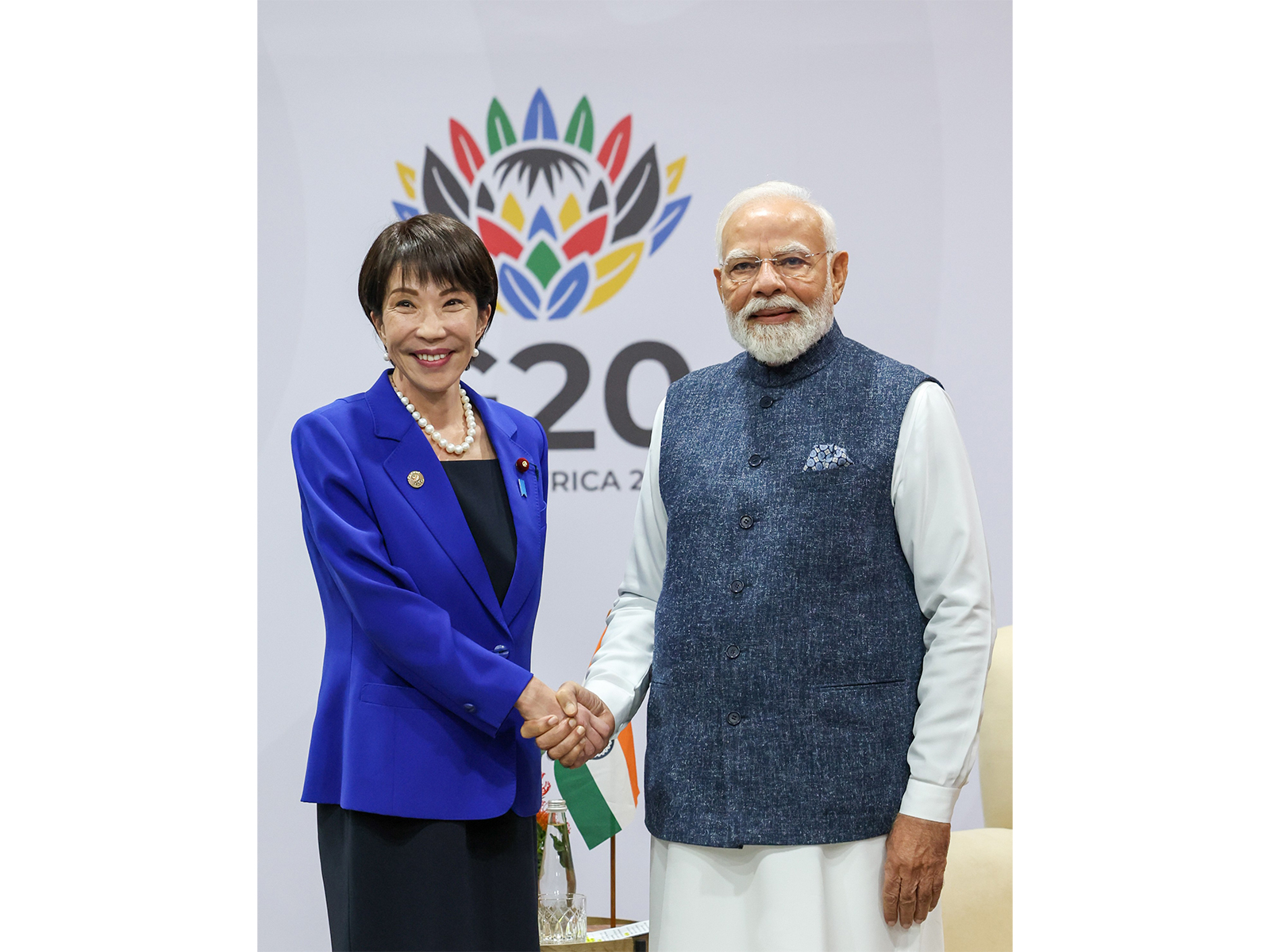
New Delhi [India], June 26 (ANI): The Ministry of External Affairs (MEA) on Friday confirmed the visit of Japanese Prime Minister Sanae Takaichi to India as part of her three-day official visit to the country, noting that during her visit, the Japanese PM will take part in the 16th India-Japan Annual Summit.
According to a press release issued by the MEA, Prime Minister Takaichi will visit New Delhi at the invitation of Prime Minister Narendra Modi from July 1 to July 3, during which she will take part in the annual summit.
The summit is expected to provide an opportunity for both leaders to review the full spectrum of bilateral cooperation and discuss regional and global issues of mutual interest.
“The Summit will provide an opportunity for both sides to review and strengthen the full spectrum of bilateral cooperation as well as exchange views on regional and global issues of mutual interest,” the MEA said in its release.
The ministry noted that this will be Prime Minister Takaichi’s first official visit to India since assuming office and described the visit as a reflection of the shared commitment of both countries to further strengthen the India-Japan Special Strategic and Global Partnership.
The upcoming summit follows Prime Minister Narendra Modi’s visit to Tokyo in August 2025 for the 15th India-Japan Annual Summit, during which the two countries reaffirmed their commitment to deepening cooperation across strategic, economic, technological and security domains.
“This would be the first official visit of Prime Minister Takaichi to India. This visit follows Prime Minister Modi’s visit to Tokyo in August 2025 for the 15th India-Japan Annual Summit and reflects the shared commitment of the two countries to further enhance India-Japan Special Strategic and Global Partnership,” the MEA release added.
India and Japan share a long-standing Special Strategic and Global Partnership, with cooperation spanning trade and investment, defence and security, infrastructure, high-speed rail, digital technologies, clean energy, and people-to-people exchanges.
Notably, Prime Minister Modi met his Japanese counterpart earlier this month on the sidelines of the 52nd G7 Summit in France, during which both sides discussed enhancing economic cooperation with a focus on trade and investment.
“Had a great interaction with Prime Minister Sanae Takaichi of Japan. India and Japan will continue to deepen ties in diverse sectors, with a priority on trade and investment,” PM Modi said in a post on X, following his interaction.
During the 15th India-Japan Annual Summit held in Tokyo in August 2025, Prime Minister Narendra Modi and the then Japanese Prime Minister Shigeru Ishiba adopted the joint statement titled “Partnership for Security and Prosperity of Our Next Generation”.
As part of the summit, the two leaders adopted a Joint Vision for the Next Decade, outlining a comprehensive roadmap to steer bilateral ties through cooperation across eight key pillars, including the economy, economic security, mobility, environment, technology and innovation, healthcare, people-to-people exchanges, and state-prefecture engagement.
The leaders also adopted a Joint Declaration on Security Cooperation, aimed at elevating defence and security ties in line with evolving geopolitical realities and the changing security landscape in the Indo-Pacific region.
In a major push to talent mobility and workforce collaboration, India and Japan unveiled an Action Plan for India-Japan Human Resource Exchange and Cooperation, which envisages the exchange of more than 500,000 personnel over the next five years. The initiative includes facilitating the movement of 50,000 skilled professionals and prospective talent from India to Japan while strengthening broader people-to-people ties.
The two Prime Ministers also announced the India-Japan Economic Security Initiative, designed to deepen cooperation in economic security by strengthening resilient supply chains for critical goods and strategic sectors.
The initiative also seeks to accelerate collaboration in critical and emerging technologies, with priority areas including telecommunications, pharmaceuticals, critical minerals, semiconductors and clean energy. (ANI)