

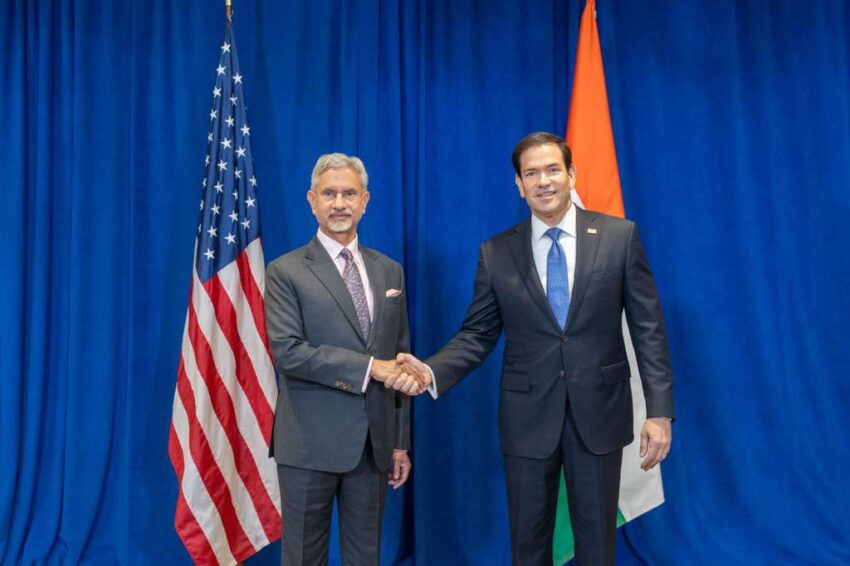

US Secretary Marco Rubio met India’s External Affairs Minister S. Jaishankar at the UN September 23, 2026, morning on the sidelines of the ongoing General Assembly meetings. Delegations of both countries discussed outstanding matters. In posts on X, the two leaders briefly expressed the gist of their talks.
“Great to meet with Indian External Affairs Minister @DrSJaishankar in New York today. Together, we are building on the U.S.-India strategic partnership and coordinating on key regional priorities and upcoming multilateral efforts.”
Jaishankar posted, “Good to meet @SecRubio of the US #UNHighLevelWeek Reiterated India’s interests and concerns with regard to SRIA. Also discussed the Gulf and Ukraine situations.”
He was referring to Sanctions on Russia and the Iran Act (SRIA) in his post.
ADVERTISEMENT


A readout from the State Department about the meeting said, “The two officials reaffirmed the important role the U.S.-India strategic partnership continues to play in promoting a safe, secure, and prosperous Indo-Pacific.”
The statement added, “Secretary Rubio and Minister Jaishankar also exchanged views on developments in the Middle East and beyond. The two also discussed sanctions that could be leveled against states that engage economically with Russia and Iran. The Secretary emphasized that the United States remains well-positioned to help regional partners address their energy security challenges.”
ADDON FROM ANI:
President Trump has endorsed the Lindsey O. Graham Sanctioning Russia and Iran Act of 2026, which have yet to be approved in both legislative houses of Congress.
The administration noted that the statute broadens formal sanctions, import duties, and trade restrictions concerning Russia while prolonging current economic penalties on Iran.
The regulatory framework focuses on Russia’s petroleum and military sectors, Russian administrators and banking institutions, alongside its designated “shadow fleet” of maritime vessels deployed to bypass limitations on Russian crude shipments.
For India, the legislation establishes a statutory pathway that could allow Washington to impose tariffs of up to 100 per cent on Indian imports in response to continued purchases of Russian energy.
However, the bill does not itself impose a 100 per cent tariff on Indian goods. Instead, it gives the executive branch authority to impose such tariffs under specified statutory conditions if the legislation is enacted and subsequently invoked by Trump.
India and China are among the major purchasers of Russian crude, making their continued energy trade with Moscow a significant element of the debate surrounding the legislation.
In a statement issued following the passing of the legislation, the Ministry of External Affairs said that New Delhi made clear its determination to protect its trade and economic interests while monitoring further developments on the matter
Reiterating India’s position on energy security, the ministry said, “As stated on several earlier occasions, India remains firmly committed to ensuring energy security for its 1.4 billion people. It will continue to do so through diversified sourcing and on the basis of evolving market dynamics.”
MEA added that the government was “monitoring further developments.”
Meanwhile, the US and India are continuing negotiations toward a bilateral trade agreement, with further talks expected on the sidelines of the G20 Trade Ministers’ meeting in Wisconsin later this month.