

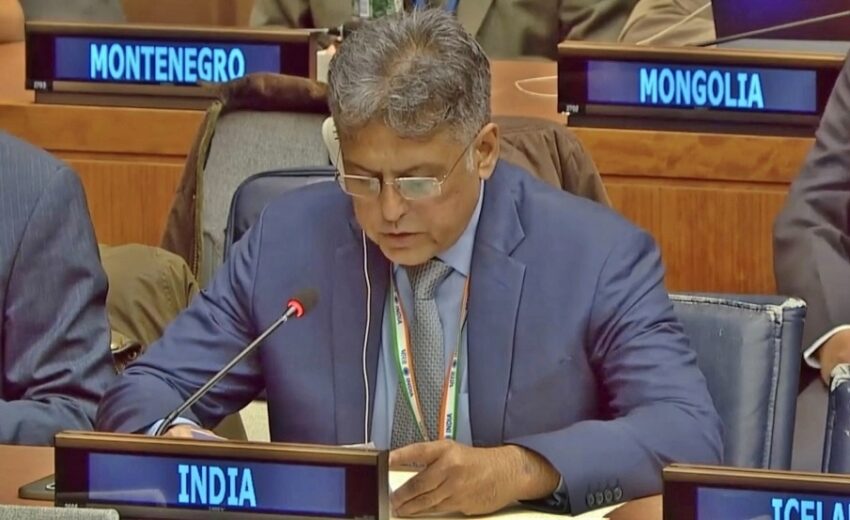
United Nations – India delivered a sharp warning regarding the intersection of artificial intelligence and military strategy, insisting that the ultimate choice to launch nuclear weapons must remain strictly in human hands.

Against the backdrop of broader global commitments under the Pact for the Future, which mandates a renewed push to address existential risks and manage the governance of emerging technologies, India outlined a comprehensive vision for global disarmament and structural risk-reduction during the 13th plenary meeting of the 81st session on Disarmament and International Peace and Security, on October 19, 2026.
Warning Against AI in Nuclear Command, India’s statement, delivered by Member of Parliament, Manish Tewari, focused on the rising complexities of emerging technologies and automated systems in military frameworks.
Echoing international concerns over the weaponization of advanced code and autonomous systems highlighted in recent UN frameworks, India stressed that algorithms must never replace human moral agency in existential decisions.
ADVERTISEMENT

“India acknowledges that the use of artificial intelligence in nuclear command and control raises real questions,” Tewari stated to the committee. “We espouse the principle that the decision to use nuclear weapons should be taken by humans,” he said.
While delegates highlighted that algorithmic speed and data processing in military decision-making exponentially raise the risk of accidental escalation or miscalculation, India emphasized that human moral agency and “human-in-the-loop” control must govern any choice to deploy nuclear weapons. India’s stand reflected a push to align military tech governance with broader global frameworks like the Pact for the Future.
In a pivotal move, India also expressed readiness for legal ‘No-First-Use’ frameworks. Addressing its own long-standing stand, India reaffirmed its adherence to credible minimum deterrence, anchored by a strict “no first use” policy and a commitment to non-use against non-nuclear-weapon states. In a notable signal to the international community, India declared its preparedness to transition these unilateral doctrines into formal multilateral legal arrangements.
At the same time, India reiterated that its military capabilities stem from unique regional security calculations rather than antagonism toward any specific nation, while emphasizing its continued dedication to a voluntary, unilateral moratorium on nuclear testing.
Advocating Step-by-Step Multilateralism over shortcuts to global disarmament, India argued that progress can only be achieved via a step-by-step process underwritten by a universal, non-discriminatory framework. Suman emphasized that this methodical approach remains profoundly relevant today, while drawing attention to its historical contributions, including a 2006 working paper and the Conference on Disarmament document CD 1816.
Tewari stressed that India’s commitment to preventing terrorists and non-state actors from accessing sensitive nuclear materials, technologies, and components remains steadfast, although the Treaty on the Prohibition of Nuclear Weapons (TPNW) does not impose direct obligations on India.
India reiterated its call for international backing for decades-long Resolutions on nuclear risk, highlighting its active legislative footprint at the UN.
Active since 1998, the resolution on Reducing Nuclear Danger, points to the dangerous hair-trigger alerts of modern arsenals. India has been advocating for de-alerting and de-targeting measures to curb accidental or unintended escalations.
Introduced since 1992, the Prohibition Convention initiative urges the Conference on Disarmament to launch formal negotiations toward an international convention banning the use or threat of use of nuclear weapons under any circumstances.
A defining takeaway from the session was the mounting international anxiety over the integration of artificial intelligence and automated systems into nuclear command and control (NC3) architectures.
With the conclusion of the thematic debate on nuclear weapons cluster, the Disarmament and International Security Committee was set to reconvene to open thematic deliberations on the cluster concerning other weapons of mass destruction.