

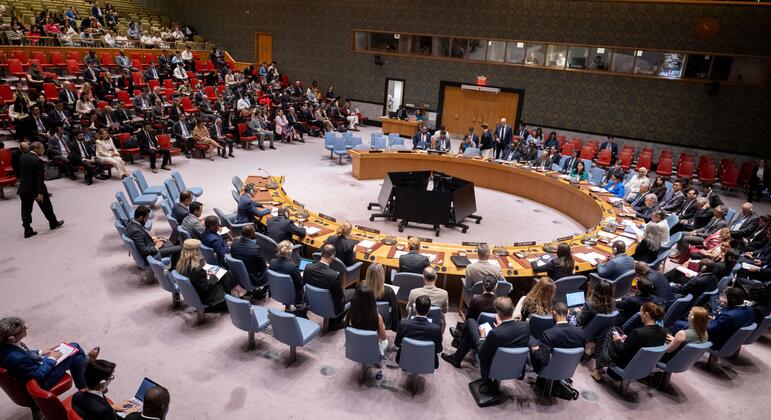
United Nations – India has called for dialogue, diplomacy, permanent ceasefire, a two-state solution, respect for sovereignty of Lebanon and Yemen, and respect for international law to resolve ongoing conflicts in the Middle East, during a UN Security Council open debate on 10 June 2026. The debate focused on “Advancing Political Solutions in the Middle East: Mediation and Dialogue for Lasting Peace.”

UN Photo/Manuel Elías
At the outset, India’s Permanent Representative to the UN, P. Harish, underscored the profound humanitarian and economic consequences of the conflicts in the Middle East. He highlighted disruptions to global supply chains and energy markets and a threat to international commerce and stability.
Harish stressed that India, as ‘a proximate neighbour with critical stakes of the region’, faces unique vulnerabilities. He identified three prime concerns: First, the safety and well-being of the ten million Indian citizens living and working in the Gulf; Second, the negative impact on Indian economy from trade and energy disruptions; and Third, the loss of Indian lives in global merchant shipping due to attacks on vessels and sea lanes.
India positioned itself in favor of dialogue and diplomacy, making clear that any actions in the region must not (1) interfere with freedom of navigation and trade, (2) target commercial shipping, and (3) harm civilian population and infrastructure.
ADVERTISEMENT

Referring to the grave humanitarian implications of the situation in Gaza, India called for a (1) sustained ceasefire, (2) unhindered humanitarian access, and (3) a credible pathway towards a durable and peaceful resolution.
India repeated its support for a two-state solution, with a sovereign, independent and viable State of Palestine, living in peace and security alongside with Israel within secure and recognized borders.
India described that as the only realistic route to lasting peace and prosperity. Harish also referenced India’s development partnership assistance to Palestine as a tangible expression of that commitment.
India insisted on full respect for Lebanon’s sovereignty and territorial integrity, urging implementation of UNSC Resolution 1701 and the US–France mediated Declaration on the Cessation of Hostilities of 26 November 2024.
Noting that Indian troops serve in United Nation’s Interim Force in Lebanon (UNIFIL), Harish stressed that UN peacekeepers carry out the vital mandate entrusted by the UNSC, and “must not be targeted”.
India also reiterated its support for the unity, sovereignty, independence and territorial integrity of Yemen, condemning attacks on maritime navigation as destabilizing for regional and global security.
India articulated a firm stance that durable conflict resolution cannot be achieved through externally imposed solutions that exclude those who are directly affected. Any initiative aimed at a peaceful resolution, must ensure that the parties concerned are fully involved at every stage, India argued, insisting on local ownership as essential for ensuring legitimacy and long-term stability in conflict situations.
Central to India’s approach is the primacy of alleviation of human suffering as the key focus of all interventions. “There must be a human-centric approach towards all efforts that endeavor to resolve disputes and address conflicts,” Harish emphasized, positioning humanitarian impact as the core objective of international engagement.
Citing the enduring peace agreements between Israel and Egypt and between Israel and Jordan, Harish highlighted the value of the UN Charter as a foundational international instrument for peaceful solutions grounded in negotiation and adherence to international norms.
At the same time, he cautioned that adherence to the Charter is not sufficient if the institutions built around it remain rigid. Harish argued that existing mechanisms need to be updated to address contemporary conflicts more effectively. The UN needs to be agile and equipped to deal with contemporary and future challenges, Harish said. Efforts and frameworks for mediation must be adapted according to changing realities, he added.
Strongly criticizing the current structure of the UN Security Council (UNSC) in this context, Harish argued that the Council’s ineffectiveness in contemporary conflicts stems from its eight-decade-old architecture that no longer reflects today’s geopolitical distribution of power and responsibility.
He called for “real reforms,” through expansion in both permanent and non-permanent categories of membership. “Implementing real reforms, through expansion of both permanent and non-permanent categories in accordance with today’s geo-political realities is vital to UN’s continued relevance and future,” Harish said. Such reform, he maintained, is essential for the UN’s continued relevance. “The UNSC has to be fit-for purpose,” he said.
Concluding his remarks, Harish reaffirmed India’s readiness to contribute actively to Council reform and to peace initiatives aimed at advancing peace, prosperity and well-being in the region and globally.