

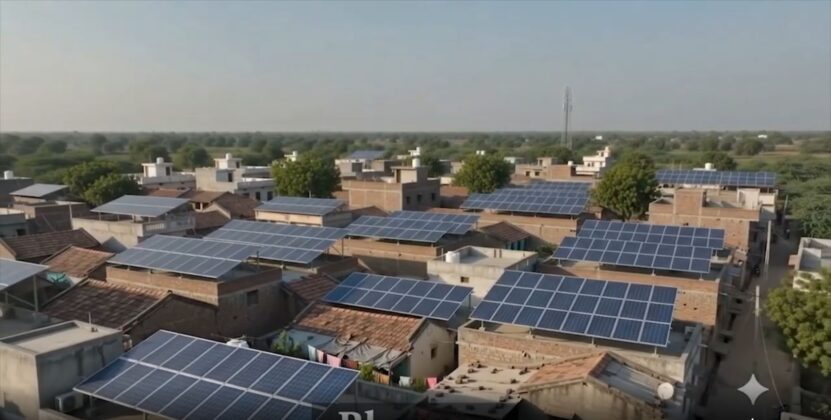

Nobody will be surprised if within the next five to 10 years India displaces the US as the world’s second-largest solar grid after China. But if its ambition is to become the world’s factory – or host AI workloads for Western tech giants – the power play around energy must stop.
When you add wind and other renewables, nearly $120 billion has gone into reducing the nation’s reliance on fossil fuels over the past five years. The shift couldn’t be more timely. Energy from Russia and the Middle East is fraught with geopolitical risk; coal is abundant locally, but it contributes to deadly air pollution in cities.
Yet just when you’d expect an all-out push for green energy, there is utter confusion where electric power meets erratic policymaking.
Nowhere are the stakes as high as in Maharashtra, one of India’s richest and most industrialized states. The steel plants, pharmaceutical firms and other large businesses outside Mumbai, the state capital, tap the public grid operated by the Maharashtra State Electricity Distribution Company Ltd.(1) Lately, a new category of customer has entered the fray: AI data centers.
ADVERTISEMENT

This surge in activity is encouraging enough for the state utility to seek a listing on the stock market. But there’s a problem: farmers. Although MSEDCL earned a profit in 2024-25, its balance sheet remains saddled with 884 billion rupees ($9 billion, at the current exchange rate) in uncollected bills from the prior financial year, particularly from agricultural consumers. The management has provided for a 34% loss on receivables, which its own auditor considers inadequate.
Across India, politicians routinely supply cheap power to farmers to win votes. When state-run utilities fail to collect even those subsidized bills, they fall into endless deficits. Maharashtra wants to break this cycle by carving out supplies to agriculture into a separate entity. That would leave MSEDCL as a cleaner distributor – backed by commercial and industrial customers who would no longer have to cross-subsidize the sector.
Well-meaning as it may be, the cost of this reform is being extracted from private solar producers. While they have contracts to sell their output to MSEDCL, open-access rules also allow them to rent the grid from the utility to reach factories and commercial establishments directly. This worked fine until early last year, when the state electricity regulator – at MSEDCL’s behest – slashed solar producers’ ability to store their day-time surplus with the state-run distributor (for a fee) to supply clients through the night.
The change isn’t devoid of logic. Early in India’s solar revolution, utilities provided so-called energy-banking services to guarantee producers a market. But with supply now abundant, deploying the grid as a battery is putting enormous strain on infrastructure. It makes more sense to encourage batteries right at the production site – or for the distributor to use the banking fees to build larger, more economical storage.
That much is noncontroversial. But the shift should have applied to fresh investments, which can factor battery costs into contracts. Wrecking existing projects by rendering 40% of their power generation useless makes no sense. In neighboring Karnataka, courts have previously rejected similar retrospective rule changes.
In Maharashtra, existing independent producers are trapped. Regulations around setting up battery storage won’t be finalized before March next year, yet existing operators aren’t allowed to sell excess power out-of-state. Even if they can keep storing their surplus with the grid, the proposed charges will make energy banking prohibitively expensive. Forced to cut daytime production, they risk losing high-value clients to MSEDCL.
For the utility, this will be a short-term gain. Where power is critical – like for AI token factories – investors may ditch Maharashtra for more welcoming states. Where will they go? In southern Andhra Pradesh, where the Adani Group is building a large data center for Alphabet Inc., the local government has decided to let these operations have their own power distribution license. That’s more investor-friendly, though the project has already attracted its share of controversy for how generous it is to corporate interests.
Disagreements over state-level regulatory orders usually land at APTEL, the appellate tribunal for electricity. But after Maharashtra Chief Minister Devendra Fadnavis wrote to Prime Minister Narendra Modi alleging a “pro-private” bias at the national body, it froze hearings involving the state utility. APTEL has now asked Maharashtra officials to file an affidavit stating whether they have any faith in it at all.
The timing of this stasis is unfortunate. India needs to do all it can to get the most out of its solar boom. Yet thanks to Maharashtra’s retrospective rules, factories that had transitioned to 50% solar power may now cut back. What they’ll get from the utility at night is very likely going to be power generated from fossil fuels.
Across India, large industrial users paid roughly 7 cents per kilowatt-hour last year; Chinese rivals paid 6.8 cents. Adjust for purchasing power, and Indian energy is twice as pricey – a stubborn gap first highlighted by the International Energy Agency in a 2020 study.
The rapid growth of solar may have eased India’s past shortages of power, but erratic policymaking is still keeping it costlier than it needs to be – both for traditional industries and for the upcoming AI data centers.

Andy Mukherjee is a Bloomberg Opinion columnist covering industrial companies and financial services in Asia. Previously, he worked for Reuters, the Straits Times and Bloomberg News.