

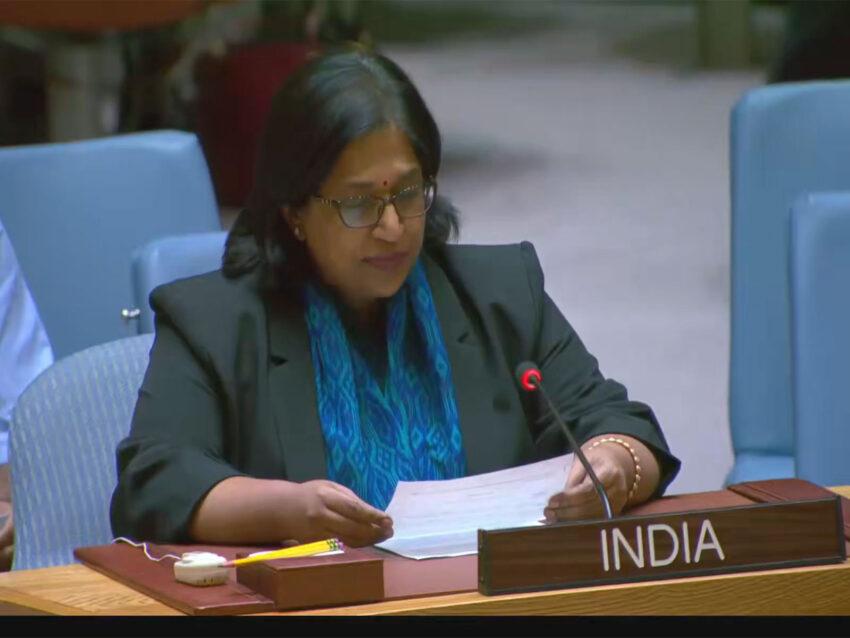
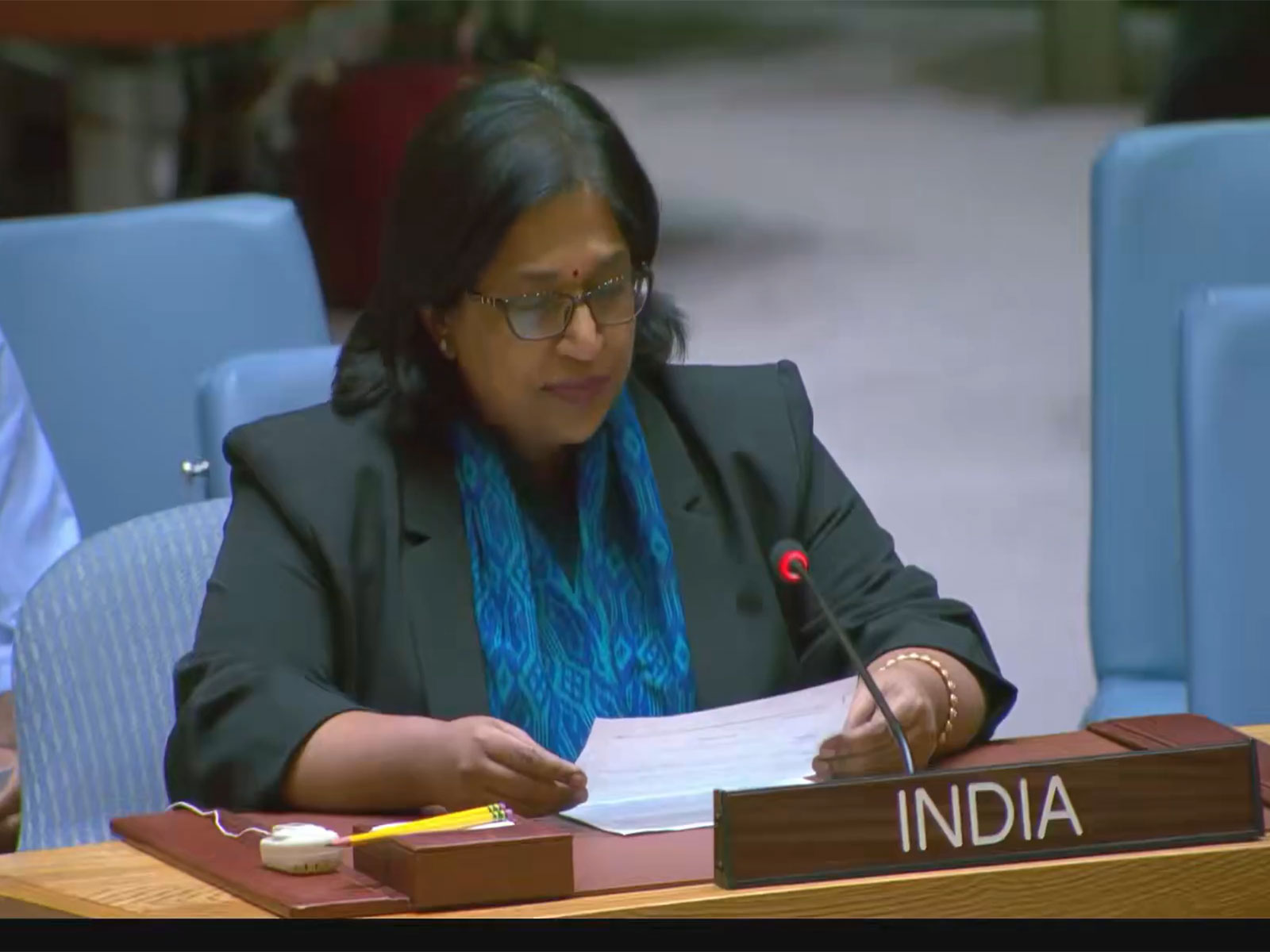
New Delhi [India], April 29 (ANI): Ambassador Yojna Patel, Deputy Permanent Representative of India to the UN, said that attempts to target commercial ships passing through the Strait of Hormuz is deplorable.
Patel, while delivering India’s statement at the UN Security Council on the Situation in the Middle East on Tuesday (local time), said that the Strait of Hormuz is of great concern for India in terms of the country’s energy and economic security.
Cd’A @PatelYojna delivered 🇮🇳’s statement at the @UN Security Council on the Situation in the Middle East. @MEAIndia @IndianDiplomacy pic.twitter.com/x3qZcdN0N8
ADVERTISEMENT
— India at UN, NY (@IndiaUNNewYork) April 29, 2026

“Commercial shipping through the Strait of Hormuz is of particular concern to India, given its importance to our energy and economic security. Commercial shipping must not be the target of military attacks, and such attempts are deplorable. India notes with concern that precious lives of Indian seafarers aboard ships have been lost during the course of the conflict,” she said.
Patel said that international law that prohibits the targeting of commercial shipping must be respected.
“We underscore that the targeting of commercial shipping and endangering innocent civilian crew members, or otherwise impeding the freedom of navigation and commerce in the Strait of Hormuz, are unacceptable. International law in this regard must be fully respected. It bears mention in this context that India had co-sponsored UNSC Resolution 2817, which was adopted on 11th March. We strongly urge for an early restoration of safe and unimpeded freedom of navigation and global commerce through the Strait of Hormuz,” she said.
She also said that developments in the have serious implications across various domains, like, security, economy, energy, food security, etc.
“India would like to express its sincere appreciation to Bahrain for convening today’s open debate. I would also like to thank the briefers for their insightful remarks. There have been major developments, particularly in the Middle East, since the last quarterly open debate in January this year. These developments have serious implications across domains: international peace and security, economic and energy security, food security, international trade, and global supply chains. Today’s debate, therefore, could not have been more timely and relevant,” she said.
Patel said that India has interests in the region, as almost 10 million Indians live and work in the Gulf, and their security is of utmost priority.
“For India, the Middle East is our proximate neighborhood, and we have significant stakes in the security and stability of the region. Our trade and energy supply chains are strongly linked to this geography, with implications for our economy and energy security. Almost 10 million Indians live and work in the Gulf region; their safety and well-being are a key priority for us. Since the outbreak of the conflict in the region on 28th February, India has been guided by its consistent and categorical calls to pursue dialogue and diplomacy and de-escalate tensions,” she said.
Patel said that to tackle the underlying issue, India has urged all involved parties to exercise restraint.
“Addressing the underlying issues is central to these goals. We have also expressed deep concern at the conflict and its aftermath and urged all the relevant parties to exercise restraint, avoid escalation, and prioritize the safety of civilians. In this context, India also underlines that the sovereignty and territorial integrity of all states must be respected,” she said.
Patel said that the destruction and loss of civilian lives in Gaza also continue to be a cause of concern.
“Mr. President, ongoing developments in Gaza and the West Bank also deserve our utmost attention. The humanitarian situation there calls for more active discussions and urgent action to alleviate it. The loss of civilian lives, including women and children, and the destruction of civilian infrastructure continue to be a concern. Over the years, including in the recent past, India has been supporting Palestinians in Gaza and the West Bank through the implementation of projects with a view toward making a tangible impact on their daily lives,” she said.
Patel further said that India called for a two-state solution in the region under human-centric approach.
“Capacity building and livelihood development receive considerable attention under India’s human-centric approach on this front. Even as we undertake such projects, the need for a lasting solution can hardly be overemphasized. At this juncture, India reiterates its support for a two-state solution and for all efforts towards a lasting and durable peace in the region,” Patel said.
She also said that peacekeepers should not be attacked, as is seen in Lebanon.
“India would now like to draw the attention of Member States towards developments in Lebanon, including regarding UNIFIL. Blue helmets serve in challenging circumstances in accordance with the UN Security Council mandate towards the cause of maintaining international peace and security, and they must not be targeted. We strongly condemn all attacks on UN peacekeepers deployed in UNIFIL,” she said.
Patel said that such attacks must be investigated, and perpetrators brought to justice.
“Such attacks must be thoroughly investigated in an expeditious manner and perpetrators brought to justice. It is vital to respect the sanctity and inviolability of UN premises. Safety and security of peacekeepers are non-negotiable. There must be accountability for crimes against these peacekeepers. It bears recall that India piloted UNSC Resolution 2589 regarding accountability for crimes against peacekeepers. We welcome the announcement of a ceasefire in Lebanon and hope that this will advance the negotiations between Israel and Lebanon, leading to lasting peace in the region and an end to the suffering of people on both sides,” she said.
Patel said that in Syria, India supports a Syrian-led and Syrian-owned political process.
“Turning to Syria, India supports a Syrian-led and Syrian-owned political process, and our commitment to the Syrian people is manifested in our humanitarian and development support to them in diverse ways. Mr. President, the Middle East cannot remain a theater of conflict. The people of the region deserve peace, dignity, and hope after decades of turmoil. India stands ready to support all sincere efforts that are aimed at realizing a just and lasting peace in the region,” she said.
The comments come as the Middle East continues to boil.
Amidst intensifying maritime friction, Iran has lodged a formal complaint with the United Nations, accusing the US of engaging in “piracy” following the seizure of Iranian vessels. According to the Iranian state media Tasnim News Agency, the protest was detailed in a letter sent by Iran’s UN envoy, Amir Saeid Iravani, to the UN Secretary-General, Antonio Guterres, and the Security Council.
The envoy argued that Washington’s justification for the maritime interceptions lacked any standing under global statutes. “Reliance on domestic arrangements, which are inherently illegal, can under no circumstances justify such an abhorrent crime committed through the use of force,” he stated in the correspondence. (ANI)