

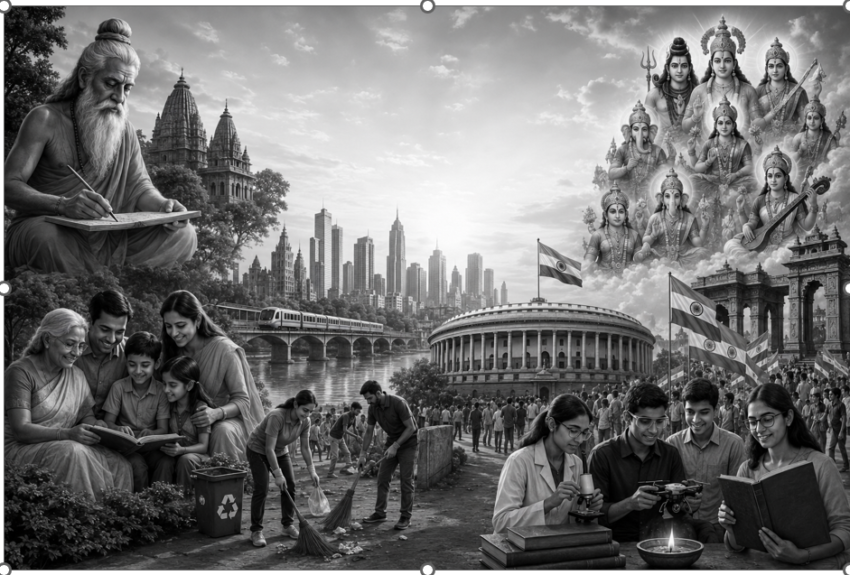

Every Independence Day, Indians reflect on the journey that began in 1947. Some celebrate the country’s remarkable economic transformation, democratic resilience, and growing global stature. Others lament persistent poverty, weak governance, corruption, and social divisions. Still others look beyond economics and politics, asking what India’s ancient civilization can contribute to the modern world. After nearly eight decades of independence, perhaps the more useful question is not whether India has succeeded or failed, but how we should honestly assess where the nation stands today.
If one chooses to see the glass as half full, the evidence is not difficult to find. India’s economic and technological transformation has been extraordinary. Poverty has declined substantially, digital payments have become ubiquitous, financial inclusion has expanded through bank accounts linked to mobile technology, and infrastructure development has accelerated. Supporters of the Narendra Modi government also cite improvements in welfare delivery, healthcare access, manufacturing initiatives under the “Make in India” program, national security, women’s empowerment, and India’s growing geopolitical influence. During a recent visit to India, I met several people who urged even skeptical observers like me to allow the country more time to realize its enormous potential.
Economic achievements, however, do not erase everyday experience. Critics argue that beneath the headlines lies a far less flattering reality. There is a jarring quality to the “We are the Vishwa Guru” proclamations of some who ignore the “concrete realities” of present-day India – where no road runs straight, where no driver maintains their lane, and where no work, it seems, can be done without greasing the palms of someone. Our cities are a patchwork of the ugly, the dilapidated, the crooked, and the smelly. If one goes looking or is invited to a wealthy friend’s place, one can see how the well-endowed build their ostentatious dwellings and palatial apartment complexes. Fancy restaurants serve food from across the world to the disposable-income-endowed generation of “techies” who rush to their air-conditioned corporate offices to escape the din of “reality,” while across the street we find weary men and women living on meagre and unassured incomes, eating little to save a little for the inevitability of disease, loss, accident, and debt. Among them are the 1.5 million or so delivery service workers who jump on their scooters and bicycles to deliver whatever it is their wealthy patrons seek within 10 to 15 minutes, rain, shine, rabid dogs, or darkness.
The urban landscape is only one side of the picture. India’s smaller towns and villages reveal many of the same structural weaknesses, and any amount of romanticization of how hardy and wise our rural folks are can mask how tawdry and ugly their dwelling places are, how a clean restroom is a rarity, how careless they are about maintaining and respecting public spaces.
ADVERTISEMENT

Underlying many of these problems is a demographic reality that cannot be ignored. India is home to 18 percent of the world’s population on barely 2 percent of its land area. There are just too many people, and not acknowledging the dangers awaiting them – unemployment and job mismatch, infrastructure and resource strain, widespread poverty and inequality, vote bank politics, and the looming threat of AI – will ensure the “end of India”. Thus, while the glass-half-full folks can talk about the demographic dividend, the glass-half-empty critics can point out that Indian leaders have their heads buried in the sand and are unprepared to face the cataclysm of a vast, unprepared or poorly prepared population straining the country’s infrastructure to breaking point, led by a cabal of the crooked.
The consequences extend beyond India’s borders. They also influence how the rest of the world sees the country. India seems to make the news only when some disaster strikes, or when lists of the best and worst in something or the other are published, with India almost always ranked on the bottom rungs. Our universities and research centers don’t make it to the top 100; our sporting abilities are mostly confined to the cricket pitches; our cities are ranked among the most crowded and the unhealthiest; and our heritage places are described as unkempt and ill-managed. Who wants to be friends with us, then? How many tourists will visit India and tell the world that it is their most sought-after destination and that they will visit again and again?
These shortcomings are symptoms rather than causes. If one asks why these problems persist decade after decade, the answer increasingly points toward India’s institutions rather than its people. Indian discontent with democracy is valid because India’s diversity fault lines have been taken advantage of by politicians and conmen who spend billions to win elections and then rob the public coffers dry as an “election dividend.” The judicial system delivers justice poorly and late, if ever, and India’s caste divisions are both leveraged to gain public office while at the same time sought to be “annihilated.” The caste-horse is flogged regularly and publicly to keep it alive, and Western academic institutions and policymakers join hands with the local critics to paint the Indian horse saffron. Deliberately ignored is the “reservation train” that is overcrowded and long, to which more coaches continue to be added to allow more people to clamber onto the gravy train to claim more and more “reservation seats”.
None of this is to deny India’s remarkable strengths. Every criticism has its counterargument, and every weakness can be balanced by an undeniable achievement. But, at this juncture, Indians need to be paying more careful attention to poor governance by the feudal and criminal political classes, the privileging of the unprepared and underprepared under the guise of caste discrimination, the weakness and fragility of India’s schools and colleges, and the cunning foreign hands of religious monopolists seeking to undermine the Hindu foundation of India’s civilization. Policymakers should be seriously working to tackle carefully and systematically the overcrowding of cities, the threat and dangers of climate change and extreme weather that can break the already creaky and weak infrastructure, cybersecurity and digital fraud, underprepared and absent teachers, and the mountains of disinformation and misinformation that weaken communities and families.
There is, however, another way of judging India’s place in the world—one that goes beyond GDP, infrastructure, or institutional rankings. If India’s material achievements invite debate, its civilizational legacy offers a different standard altogether.
India has never been a meddling and meddlesome nation, has never waged war against others unless attacked, and our philosophy of “you to yours, we to ours, and there are many ways to reach God” is the most embracing and energizing way of accepting our common humanity, and that is the only way to ensure that the human species survives. India’s greatest contribution has arguably never been military or political power. Rather, it has been the search for knowledge—of the self, consciousness, and humanity’s place in the cosmos.
Civilizations endure not because they are perfect, but because they possess the capacity for self-correction. India’s future will depend on whether it can once again reform itself while remaining true to its civilizational foundations. Indians are resilient, and the strong family networks, the innate ability to adapt, and a strong belief in perseverance and faith in the goodness of the many Gods have kept India a functioning, thriving nation and a strong civilization. If Indians can rethink governance, refashion public institutions, resist the temptation of Abrahamic uniformity, respect and take care of public spaces, continue to believe in and strive for excellence, and leverage the wisdom of their sages, then there is hope for India that is Bharat.

Ramesh Rao recently retired as Professor of Communications at Columbus State University, Columbus, GA.