


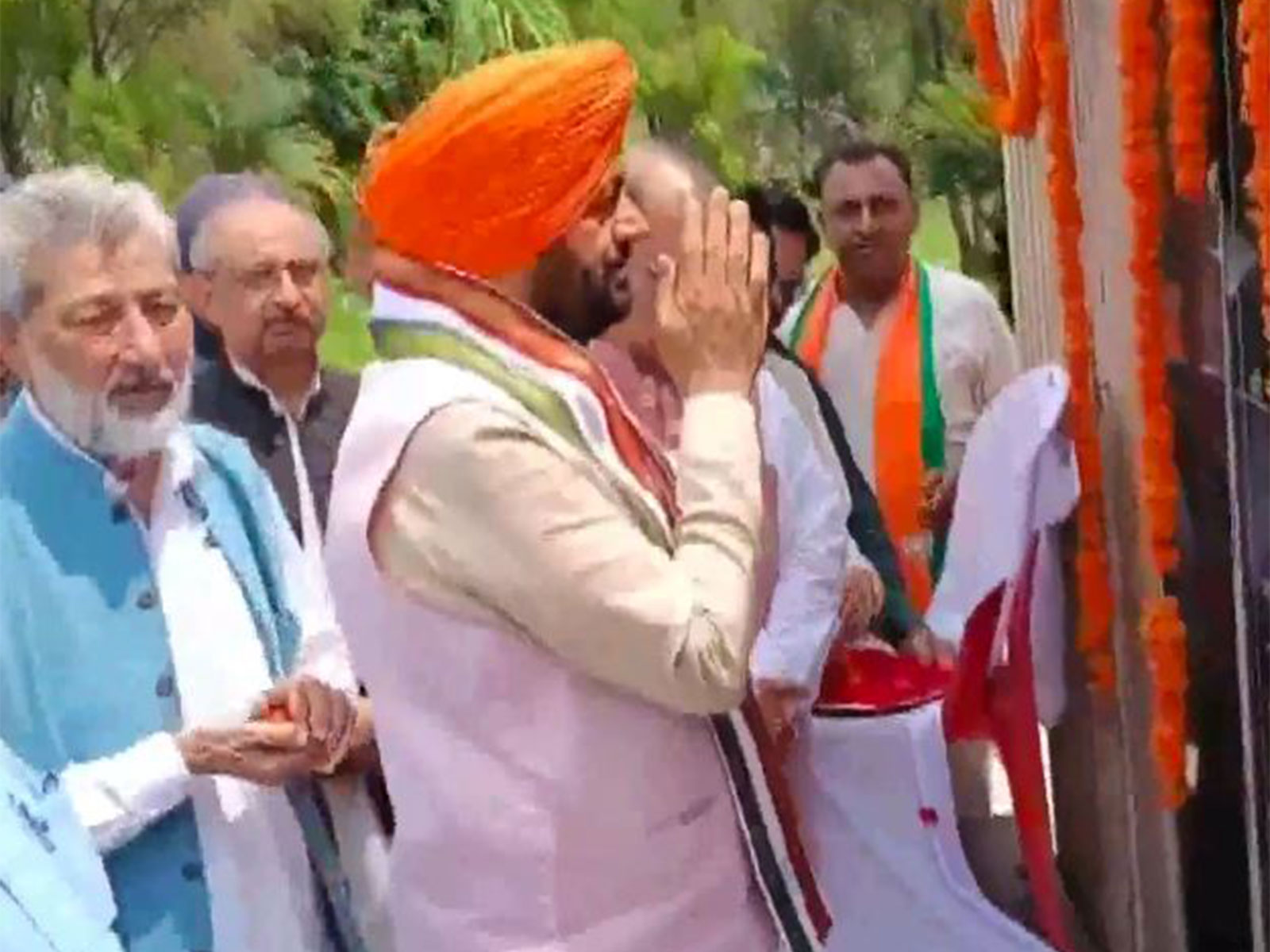
Pathankot (Punjab) [India], July 5 (ANI): Haryana Chief Minister Nayab Singh Saini on Sunday paid floral tributes to the founder of Bharatiya Jana Sangh (BJS), Dr Syama Prasad Mookerjee, at ‘Ekta Sthal’ in Madhopur on the occasion of his birth anniversary.
Addressing a programme organised to mark the day, Chief Minister Saini hailed Dr Mookerjee’s contribution to national integration, particularly his stance on Jammu and Kashmir.
“Dr Syama Prasad Mookerjee said that there cannot be two supreme leaders, two legislatures, and two constitutions in the country. This was not merely a slogan but the very foundation of the nation’s system. He rejected power and position, placing the nation above all,” the Chief Minister said.
Speaking to reporters, CM Saini further emphasised that Dr. Mookerjee’s vision was centred around the idea of a “United India.”
“He was a great personality who envisioned an undivided India. Today marks the 125th birth anniversary of such a great personality, and we are all remembering him and his sacrifices for the unity and integrity of the country,” Saini added.
Syama Prasad Mookerjee was the founder of Bharatiya Jana Sangh, the ideological parent organisation of the BJP.
Born on July 6, 1901, in Calcutta, he was a multifaceted personality, a patriot, an educationist, a parliamentarian, a statesman, and a humanitarian.
He inherited a legacy of erudition and nationalism from his father, Sir Ashutosh Mookerjee, an esteemed Vice-Chancellor of Calcutta University and Judge of the Calcutta High Court. In 1940, he became the acting President of the Hindu Mahasabha and declared complete independence for India as its political goal.
Jan Sangh was the political predecessor of the Bharatiya Janata Party (BJP), and the party marks Mookerjee’s death anniversary as ‘Balidan Diwas’ following his demise in Kashmir on June 23, 1953.
He founded the Bharatiya Jana Sangh on October 21, 1951.
Mookerjee was a tall political figure in pre-independence India and was the Finance Minister in the Progressive Coalition Ministry headed by Fazlul Haq, from which he resigned in less than a year.
He also joined the Hindu Mahasabha, but later quit the year Mahatma Gandhi was assassinated.
After independence, former Prime Minister Jawaharlal Nehru inducted him into the Interim Central Government as a Minister for Industry and Supply. (ANI)