

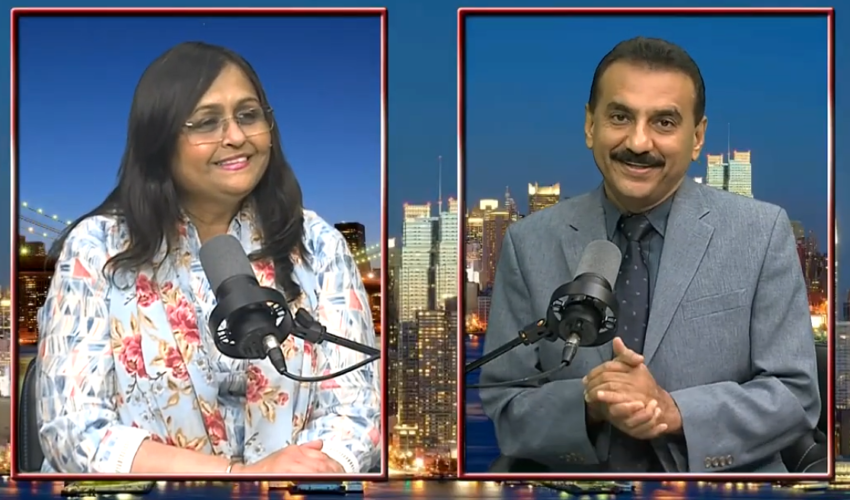

EDISON, N.J. — Renowned Gujarati poet, author, playwright, lyricist, translator and former physician Dr. Raeesh Maniar reflected on his remarkable journey from medicine to literature, his passion for preserving the Gujarati language, and his experiences with some of India’s most celebrated literary figures during a recent interview with Shailu Desai, Sub Editor of Gujarat Times, at ITV GOLD Studios, part of Parikh Worldwide Media.
The wide-ranging conversation explored Maniar’s evolution from a practicing physician in Surat, India, to one of the most respected voices in contemporary Gujarati literature. The discussion touched on language preservation, education, poetry, humor, cultural identity and the role of literature in connecting communities across generations and continents.
Although widely known as a physician for many years, Maniar revealed that poetry entered his life long before medicine.
“I started writing poetry when I was 11 years old,” he said. “People often think I became a poet after becoming a doctor, but poetry was always a part of my life.”
ADVERTISEMENT

After completing his medical education, Maniar established a successful practice in Surat in 1993. Yet even as he built a respected medical career, literature remained his true passion. He recalled making a commitment with his wife, Dr. Ami Maniar, that he would retire from medical practice after 20 years and devote himself entirely to literary pursuits.
True to that promise, Maniar closed his practice in August 2013 and transitioned into a full-time literary career.
Today, he is recognized as one of the leading figures in Gujarati literature, with contributions spanning poetry, ghazals, plays, essays, translations, television scripts, public speaking and film songwriting. He has written numerous Gujarati songs for films and has become a familiar presence at literary festivals and cultural gatherings in India and around the world.
Reflecting on his decision to leave medicine, Maniar said that success should not be measured solely by financial gain.
“Money is important, but it is not the only measure of life,” he said. “If God has given you a talent, you have a responsibility to use it in a way that benefits society.”
His years in medicine, particularly in counseling children, teenagers and families, provided valuable lessons that later influenced his writing. Listening to patients’ concerns, fears and aspirations gave him unique insights into human nature and emotion.
“Doctors often see people at their most vulnerable,” he said. “That teaches you a great deal about life.”
Throughout the interview, Maniar repeatedly credited his wife for her unwavering support.
A physician and gold medalist herself, Dr. Ami Maniar played a critical role in helping him balance medicine, literature and family responsibilities.
“She supported every stage of my journey,” he said. “Whether it was my medical career or literary work, she stood beside me and helped make it possible.”
A significant portion of the discussion focused on the future of the Gujarati language, a subject that Maniar has championed for decades.
Having traveled extensively across North America and interacted with Gujarati communities worldwide, he expressed concern about the gradual disconnect between younger generations and their linguistic heritage.
At the same time, he noted that similar challenges exist in India, where English-medium education has increasingly overshadowed regional languages.
To address the issue, Maniar helped develop what is known as the “Global Gujarati Medium,” an educational model that combines Gujarati and English instruction. The approach encourages children to learn concepts through their mother tongue while gradually building proficiency in English.
The initiative began in Surat and has since expanded to numerous schools throughout Gujarat.
According to Maniar, thousands of students have benefited from the program, which aims to preserve linguistic identity without compromising academic and professional opportunities.
“Children understand concepts best in their mother tongue,” he said. “Learning English does not require abandoning Gujarati.”
Beyond India, Maniar is also developing educational initiatives for Gujarati families living abroad. He described plans for a digital program focused on spoken Gujarati, storytelling, poetry, theater, music and cultural traditions rather than conventional language instruction alone.
The proposed program is intended to help children connect with Gujarati culture while creating opportunities for interaction between young people in India and members of the global Gujarati diaspora.
The interview also highlighted Maniar’s contributions as a literary researcher and translator.
Among his most acclaimed works is his extensive research on the legendary Gujarati poet Mareez, often referred to as the “Ghalib of Gujarati literature.” Maniar spent years studying Mareez’s life and work, meeting family members and contemporaries to document the poet’s legacy.
His literary pursuits eventually brought him into contact with some of India’s most respected literary figures, including Gulzar and Javed Akhtar.
Maniar recounted how his translation work related to renowned Urdu poet Kaifi Azmi received appreciation from Azmi’s family and literary circles. His translations and adaptations later led to meaningful interactions with Gulzar and Akhtar, both of whom praised his ability to preserve the spirit, rhythm and poetic structure of the original works.
Over the years, Maniar has helped introduce Gujarati readers to some of the finest works of Urdu and Hindi literature while fostering greater appreciation for literary traditions across languages.
Despite his reputation as a serious literary figure, Maniar has also earned widespread popularity for his humor writing and stage performances.
He explained that humor and serious literature are not opposites but complementary forms of expression.
“Humor often contains deep truths,” he said. “Likewise, even the most serious poetry contains moments of lightness.”
His humorous essays, satirical writings and live performances have attracted audiences across generations and have helped make literature accessible to broader audiences.
When asked about his experiences performing in the United States, Maniar praised the enthusiasm of Indian-American audiences and their commitment to preserving language and culture.
He observed that immigrants often develop an even stronger appreciation for their heritage after settling abroad and frequently make significant efforts to pass those traditions to future generations.
“Whenever I visit the United States, I see people who genuinely want to remain connected to their roots,” he said. “Wherever I go, I try to create a little piece of Gujarat.”
The conversation concluded with an invitation to audiences in the New York-New Jersey region to attend his upcoming literary and humor program, where he will share poetry, storytelling and reflections drawn from a lifetime of experiences in medicine, literature and public life.
As the interview came to a close, Maniar expressed appreciation for organizations, volunteers and media platforms that continue to promote Indian languages, literature and culture abroad.
He specifically praised the efforts of ITV GOLD, Gujarat Times and community organizations that provide a platform for cultural and literary expression.
For Maniar, the transition from physician to poet was never truly a change of profession. Rather, it was an expansion of the same mission: understanding people, serving society and enriching lives through meaningful communication.
Whether through medicine, poetry, education or cultural advocacy, his message remains clear: language, literature and human connection are among society’s most enduring treasures.
The interview was conducted by Shailu Desai, Sub Editor of Gujarat Times, at ITV GOLD Studios, part of Parikh Worldwide Media.
Based on an interview conducted at ITV GOLD Studios.