

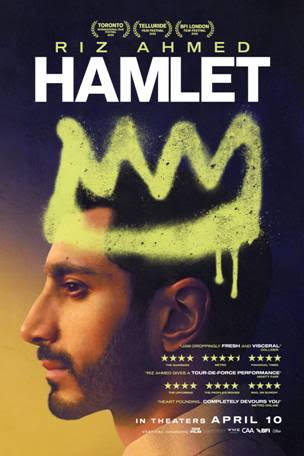
Hamlet; Release Date: April 10, 2026. Director: Aneil Karia. Starring: Riz Ahmed, Morfydd Clark, Joe Alwyn, Sheeba Chaddha, Avijit Dutt, with Art Malik, and Timothy Spall. Written by Michael Lesslie. Based on the play by William Shakespeare

Adapting Hamlet into a contemporary setting is an ambitious creative gamble, and this film opens on a striking note—with the haunting visual of a man performing last rites, immediately grounding the story in a cultural space that feels intimate and evocative.
Directed by Aneil Karia and led by Riz Ahmed, the film premiered at major festivals before its wider rollout. After its U.K. release earlier this year, it is set to open in the United States on April 10, 2026, in select theaters.
 The performances are intense and committed. The cinematography is stark and controlled, while the background score effectively amplifies Hamlet’s psychological unrest. And yet, this is where the film begins to feel conflicted.
ADVERTISEMENT

Indian cinema has already shown us what a truly immersive Shakespeare adaptation can look like—through the work of Vishal Bhardwaj. With Maqbool (inspired by Macbeth) and Omkara (based on Othello), Bhardwaj demonstrated how Shakespeare’s themes could be transplanted into Indian socio-political landscapes without losing their essence. But it is Haider that stands as the most compelling benchmark for any modern adaptation of Hamlet.
Haider did not simply retell Shakespeare—it reimagined him. Set against the turbulent backdrop of Kashmir, the film absorbed the emotional, political, and cultural realities of its setting so completely that the story felt organic, not imposed. The characters were renamed, reshaped, and rooted in their environment. The language was accessible yet poetic. The conflicts were not just personal but deeply political, giving the narrative a lived-in authenticity.
 Most importantly, Haider trusted its audience. It did not rely on Shakespearean dialogue to prove its lineage. Instead, it translated the spirit of Hamlet into a form that felt immediate, cinematic, and culturally resonant. Even its most theatrical moments—songs like “Bismil,” for instance—were staged with a scale and intent that enhanced the storytelling rather than distancing the viewer.
This is where the current film feels uncertain.
It doesn’t fully commit to being a South Asian adaptation, nor does it remain purely Western. Cultural elements appear, but without clear integration. A traditional song like Dama Dam Mast Qalandar surfaces in the staging but feels disconnected. Gertrude is styled with an Indian aesthetic, a wedding features lehengas, while Claudius—Hamlet’s stepfather—appears as an Englishman dressed in a sherwani and traditional Indian headgear.
The question that arises is simple: why?
These choices feel visual rather than narrative—layered in, but not lived in.
This tension continues in the film’s language and structure. The characters retain their original names—Hamlet, Gertrude, Claudius, Ophelia—and speak almost entirely in Shakespearean English, even as they navigate a modern world of clubs, fractured relationships, and substance use. The result is a tonal dissonance that keeps the audience at a distance.
Perhaps this was intentional. Perhaps the director is engaging with the very dilemma at the heart of the play:
“To be, or not to be.”
To be faithful, or not to be?
To adapt, or to preserve?
But in trying to hold on to both, the film never fully becomes either.
 There is sincerity in the performances, and the technical craft—particularly the cinematography and background score—adds texture to the film’s psychological landscape. But, as is often said, even the most unusual worlds can feel real if they are cohesive. Here, that cohesion remains elusive.
The film ultimately caters to a niche audience—those who appreciate theatre and Shakespeare in its original form. For a wider audience, it risks feeling inaccessible. A more grounded approach—either fully embracing localization, as Bhardwaj did, or committing entirely to a stylized theatrical form—might have created a stronger impact.
And yet, this is not a careless film. It is a deliberate one. A risk taken with intent. For the director’s sake, one hopes the gamble pays off.
In the end, the film exists in a liminal space—between cultures, between forms, between identities. Much like Hamlet himself, it seems caught in indecision, unable to fully answer the question it poses.