

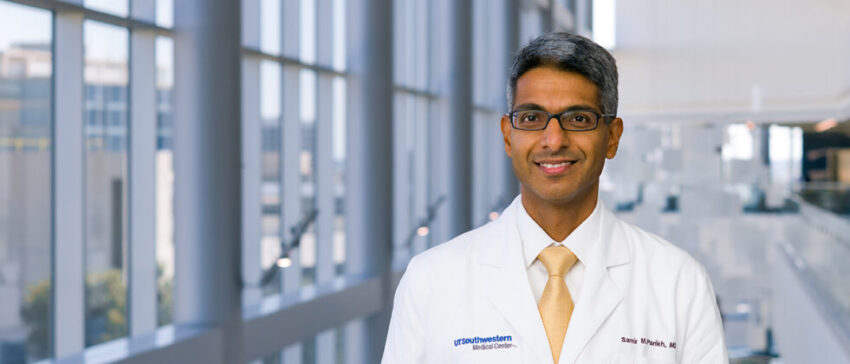

On June 15, 2026, Dr. Samir Parikh took over as Chair of Internal Medicine at the University of Texas Southwestern (UTSW). It is the largest department in the University with 839 faculty members, and it operates the second largest residency program in the country.
The Internal Medicine department was also allotted more than $108 million in research funding from the National Institutes of Health in fiscal year 2025 alone.
“Internal Medicine at UT Southwestern is a Department of great historical significance and tremendous present-day momentum,” Dr. Parikh is quoted saying in a interview carried July 23, in the Center Times Plus, a publication of UTSW. “I am so excited and humbled by this opportunity.”
Dr. Parikh graduated in chemistry, magna cum laude, from Harvard College, and earned his medical degree at Vanderbilt University, where he was awarded the Founder’s Medal. He did his internal medicine residency training, along with research and clinical fellowships in nephrology, at Beth Israel Deaconess Medical Center (BIDMC).
ADVERTISEMENT

At Harvard, Dr. Parikh became a Professor of Medicine, was Co-Director of the Center for Vascular Biology Research and Associate Vice Chair for Research in the Department of Medicine at BIDMC. He joined UTSW in 2021 as Professor of Internal Medicine and Pharmacology and Chief of Nephrology.
He specializes in acute kidney injury and chronic kidney disease, and has been published in leading journals like Science, Nature, Nature Medicine, and Cell Metabolism.
In his interview with Center Times Plus, Dr. Parikh emphasized how he likes to be in close touch with all departments and faculty that make up the large Internal Medicine Department. “
“I aim to be visible – for our clinicians, for our residents and fellows, researchers, fellow Chairs, and for people across our community who take pride in UT Southwestern and who seek us out in moments of need. I hope to share my most cherished values: integrity, community, creativity, execution, and excellence,” he told CT Plus. He harked back to history on how the Department was build by two physicians who went on to get Nobel Prizes.
“Today, we have an outstanding opportunity to build on that legacy. We are one of the largest departments of internal medicine (IM) in the country in terms of the number of faculty. We also have one of the largest IM residency programs in the U.S., with more than 230 residents,” he noted.
In addition to the NIH funding, he noted that five of UTSW’s IM specialty care areas are ranked among the best in the nation (Cardiology, Heart & Vascular Surgery; Diabetes & Endocrinology; Geriatrics; Gastroenterology & GI Surgery; and Pulmonology & Lung Surgery) by U.S. News & World Report.
He sees this as an opportunity to expand three core components – clinical care, education, and research, a mission shared by UTSW and IM.
“Together, we can elevate our trainees to new heights, empower our faculty, and embark on collaborations across departments and services to foster clinical transformation, innovation in education, and excellence in research,” he said.
Dr. Parikh also dwelt on his own research passion in the field of kidney disease, saying they were on the verge of breaking new ground. “We are on the path to understanding one of the most common and complex, yet orphan conditions in medicine – namely kidney failure,” adding, “I derive so much joy from research and want to share it with others. The same holds for clinical care. Having the privilege to comfort always and heal often remain extraordinary experiences for me.”
As a recipient of many awards for his mentorship and teaching, Dr. Parikh said he would continue with his passions. “Seeing the dots connect for a medical student interrogating a challenging case or witnessing the power of being seen when a research trainee’s first big paper is accepted – these have been among the peak joys of my career,” he said, adding that IM provides an opportunity to multiply those goals for the next generation.