

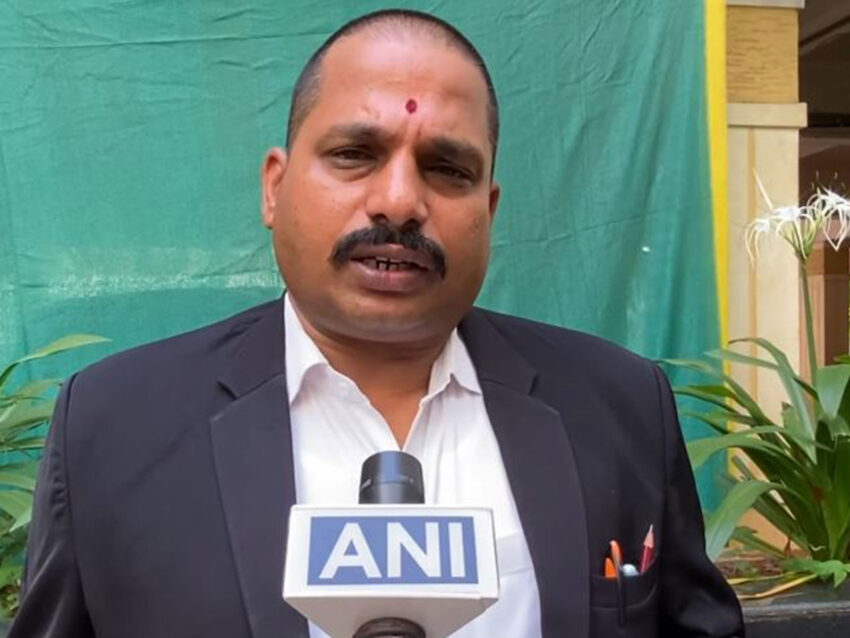
Hyderabad (Telangana) [India], September 17 (ANI): BJP leader Karunasagar on Thursday hit out at Congress leader Rahul Gandhi and his party over the revised Unified Payments Interface (UPI) Merchant Discount Rate (MDR) framework, questioning whether the Congress was opposing UPI or seeking “another political slogan” against Prime Minister Narendra Modi.
“Rahul Gandhi and Congress should first decide whether they are opposing UPI or they want just… looking for another political slogan against Prime Minister Narendra Modi,” Karunasagar told ANI.
He said the Parliamentary Standing Committee had recommended a tiered revenue model for UPI transactions and claimed that five Congress MPs, including P Chidambaram, Manish Tewari and Gaurav Gogoi, were present when the model was adopted and had not registered dissent against it.
“And now Rahul Gandhi wants to term it as ‘UPI tax’ under America’s pressure, but the Union Finance Ministry has rejected it,” Karunasagar said.
Explaining the revised framework, he said the MDR was not a tax on every UPI transaction and would not be charged to customers.
“More importantly, it is not a tax on every transaction; that is, the person-to-person transaction, and it is only those transactions which are done between the person and the businessman. And those transactions which are below 2,000 are not charged, but above 2,000 it is only 0.4% which will be charged, and not to the customer; that is not to the person who is transacting, but it is a discount which will be adjusted between the businessman, bank, and the intermediary only to facilitate them,” he said.
“It is not charged on the customer, and the facts should be made clear to the people before making any allegations of UPI tax just to attack Narendra Modi,” Karunasagar added.
Meanwhile, the Opposition has criticised the revised framework. AIMIM leader Waris Pathan alleged that it would place an additional financial burden on ordinary citizens.
“This will place an extra financial burden on ordinary citizens, and the government is attempting to collect more money from the public,” he told ANI.
Odisha Congress president Bhakta Charan Das also opposed the move, saying consumers and small traders would be affected.
“When we shop, we pay taxes to make purchases. Now, even when paying via UPI, you’ll have to pay tax. This means consumers, small traders, grocery shop owners, vegetable vendors, all of them will be troubled. The economic exploitation of millions of people is happening. What was the need for this?… If banks can be operated, then why is this tax being levied? We are opposing this,” Das told ANI.
The remarks came amid a political row over the revised UPI MDR framework announced by the National Payments Corporation of India (NPCI). Under the framework, a 0.4 per cent MDR will apply to select Person-to-Merchant (P2M) UPI transactions above Rs 2,000, capped at Rs 300 per transaction. The framework is scheduled to come into effect from October 15, 2026.
The Centre has maintained that MDR is neither a tax nor a charge collected by the government, but is distributed among participants in the digital payments ecosystem, including banks and payment application providers.
Union Minister for Communications Jyotiraditya M Scindia has said consumers will continue to use UPI free of cost and that merchants cannot pass the MDR cost on to customers.
“There is no recommendation to levy this on the customer. Doing so would violate the law and amount to a criminal offence,” Scindia told ANI.
Meanwhile, the government on Thursday rejected claims that the new MDR framework was introduced under external pressure, terming the allegation “false and misleading,” according to government sources. Officials clarified that no separate GST is levied on MDR charges, as businesses can claim full input tax credit against it, and said the government does not expect any net revenue from the levy.
The government has also said that Person-to-Person (P2P) transactions will remain exempt and around 96 per cent of P2M transactions will remain unaffected as the MDR applies only to specified merchant transactions above Rs 2,000.
Sources also cited a US Trade Representative report that had sought parity for foreign-operated credit cards on the UPI network — a demand India did not accept — to counter claims of the policy favouring foreign interests. They said RuPay debit cards have deliberately been kept MDR-free to give them a competitive edge.
Officials said the revised framework was aimed at creating a sustainable revenue model for the UPI ecosystem and encouraging competition among payment service providers, while monitoring implementation to ensure merchants do not pass the charges on to consumers. (ANI)