

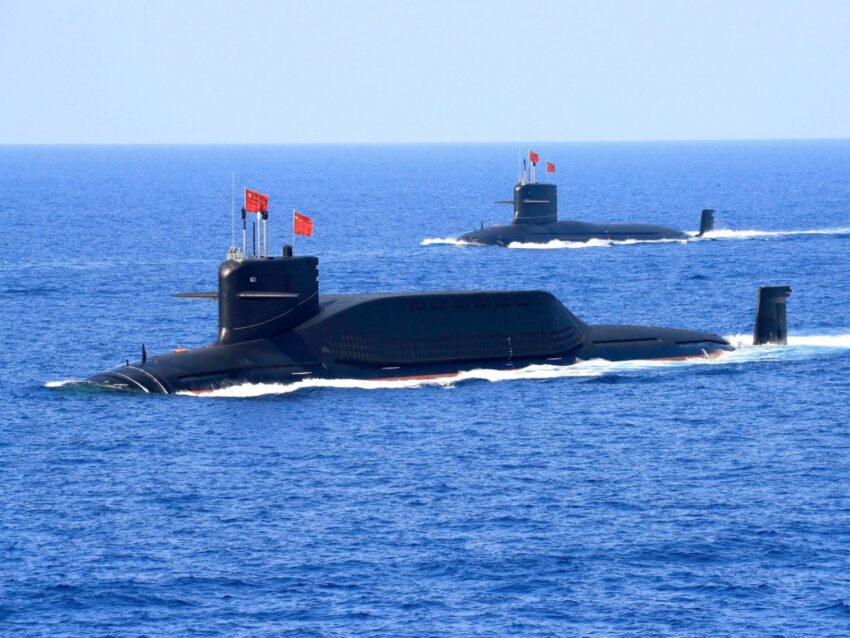
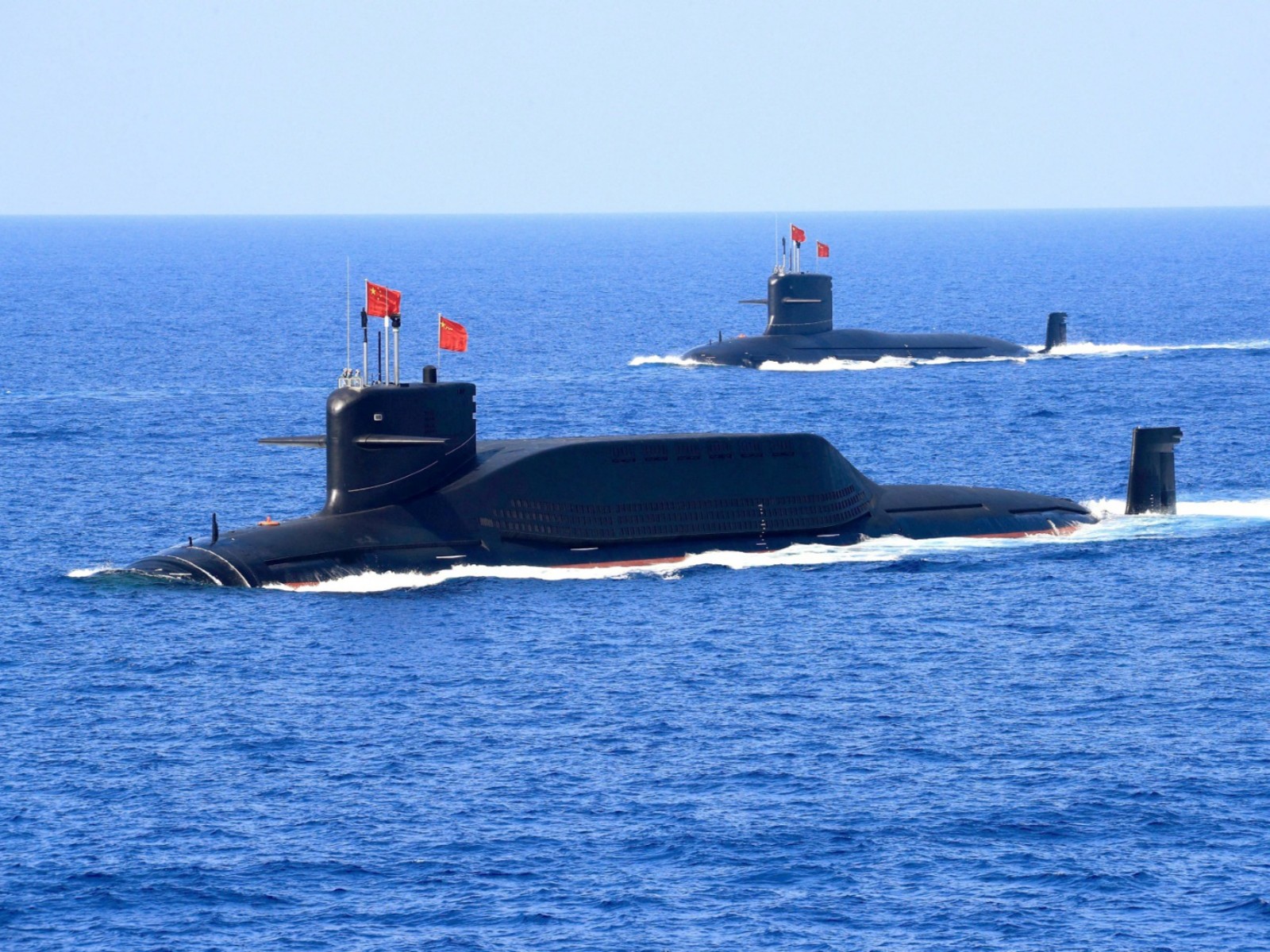
Hong Kong, June 23 (ANI): Submarines are the undisputed apex predator for navies around the world, and none have the range, endurance and payload capacity that nuclear-powered submarines do.
China is currently leading the world in terms of production of such lethal underwater weapons, and new ones are regularly wending their way into the People’s Liberation Army Navy (PLAN).
Although Chinese submarines are cloaked in secrecy, a small part of the veil was recently lifted when satellite imagery revealed the existence of a mysterious new type at a berth in the fitting-out basin at Jiangnan Shipyard, Shanghai, on May 31. It is distinguished by the fact it does not have a sail, or what used to be called a “conning tower” in the old days.
The first publication to highlight this new vessel was France-based Naval News, which announced that China’s “latest design, a distinctive and innovative vessel that dispenses with the traditional sail, marks another step in the evolution of an increasingly capable and technologically advanced submarine force.”
The boat’s location at Jiangnan Shipyard is interesting, since this site has not previously built nuclear-powered submarines.
H I Sutton, the report’s author and an expert on submarines, remarked, “The main distinguishing features of the boat are its sleek bow, X-form rudders and minimal sail. China has experimented with sailless submarines before, with one being built at the same yard.” He added that the configuration is likely chosen to reduce drag.”
The submarine is approximately 120m long and some 10-11m wide. Sutton said it is unquestionably a new class, though it definitely is not a nuclear-powered ballistic-missile submarine (SSBN). Sutton noted that, around the same time, another submarine may have been launched at the Huludao Shipyard in Liaoning, the site that traditionally builds nuclear-powered submarines.
This latter boat was first observed back in February, and analysts immediately took it to be the long-awaited Type 095 nuclear-powered attack submarine (SSN). However, the Huludao submarine is slightly shorter but wider than the one in Shanghai. That means it is now debatable as to which of the two slightly different designs is actually the brand new Type 095.
Sutton discussed other implications too. “Questions remain regarding the new submarine’s role and propulsion. For the latter, standard nuclear propulsion seems most likely given the boat’s size. If it is conventionally powered, then it is by far the largest conventional boat afloat anywhere in the world.”
Incidentally, China has been developing a form of propulsion that couples a low-power nuclear reactor to act as a form of air-independent propulsion (AIP). The first such Chinese vessel to adopt this power unit was the Type 041 Zhou class, which was launched at Wuchang Shipyard in Wuhan in 2024. Such a choice offers greater power and essentially unlimited endurance, but Sutton concluded that “nuclear AIP” seems unlikely for this new boat in Shanghai.
China steadfastly refuses to reveal what new types of submarines it is developing. That naturally leads to a lot of speculation whenever any new class appears. However, one thing is undisputed, and that is the pace at which China is churning out new submarines. Indeed, somewhere between 15 and 20 submarines across eight distinct classes have been launched in the past five years alone.
Rear Admiral Mike Brookes, Intelligence Director – Navy Commander, US Office of Naval Intelligence, testifying before the US-China Economic and Security Review Commission in early March, painted a threatening picture of the scale and capability of the PLAN’s submarine fleet.
He said China’s submarine force is projected to reach roughly 70 boats by 2027, up from the current 60+. This figure could include six new guided-missile, nuclear-powered attack submarines (SSGN), three smaller-class SSNs and two SSBNs. It would certainly be a remarkable feat if the PLAN adds eleven nuclear-powered submarines in the next two years.
Brookes predicted that, by 2035, the PLAN could have 80 submarines, half of which are nuclear-powered. He described this as “a major shift in force composition”.
Importantly, this growth spurt comes soon after the time when the US Navy’s (USN) SSN fleet reaches a nadir of 46 vessels in 2030. China is thought to be launching an average of three new SSNs annually, compared to no more than 1.3 boats per year in the USA.
Looking further into the future, China may have 20-30 new-class SSGNs and SSBNs in service by the early 2040s. “These platforms will be designed from the keel up for blue-water operations and persistent presence beyond the First Island Chain, representing an evolution in PLA Navy undersea operational capabilities,” Brookes solemnly testified.
Of course, China is not the only country to value nuclear-powered submarines. Australia also sees their worth too, which is why it dumped French-designed conventionally powered attack submarines and opted to throw in its lot with the USA and UK and adopt a fleet of SSNs. Under the first phase of the trilateral AUKUS agreement, Australia is expected to buy three second-hand Virginia-class SSNs from the USA. The second phase will see the Royal Australian Navy receive new SSN-AUKUS boats built for both itself and the Royal Navy.
South Korea, too, has decided to pursue SSNs via an indigenous project with technical input from the USA. It formally launched its plan for developing SSNs on 26 May, with the aim of commissioning its first submarine in the late 2030s. The navy wants four submarines, with the Ministry of National Defense arguing, “Nuclear-powered submarines possess dramatically enhanced operational capabilities compared to existing diesel submarines,” especially their submerged endurance and mobility.
Dr. Kim Jae Yeop, Senior Researcher at the Sungkyun Institute for Global Strategy in Seoul, told ANI that Seoul wants to adopt SSNs since it must “counter Pyongyang’s submarine-launched ballistic missile threats, and possess a highly survivable deterrent against neighboring powers like China”.
Kim assessed, “As one of the leading powerhouses in nuclear energy and shipbuilding industry in the world, Korea is widely believed to have sufficient capacity for developing and building its own nuclear-powered submarine.”
This includes developing a small modular reactor. Kim also noted that South Korea’s acquisition of SSNs “will contribute to efforts of the USA and its allies and partners in the Asia-Pacific region to maintain a strategic balance against the challenge of revisionist powers like China”. However, Kim said one side effect is that “it’s highly probable Japan may also pursue development of nuclear-powered submarines in response to Korea’s choice”.
China has come a long way in terms of submarine design. Vice Admiral Richard Seif, Commander, Submarine Forces of the USN, testified in the same hearing as Brookes that China’s new Type 095 SSN “represents significant advances in capabilities, posing a multi-faceted threat to the US and its interests in the Indo-Pacific. These next-generation submarines are formidable, incorporating advanced technologies that challenge the US Navy’s long-standing undersea dominance.”
He added that the Type 095 is “significantly more capable than China’s previous submarines, with enhancements in stealth, propulsion and armament, with the ability to launch a significant salvo of long-range land attack cruise missiles from a concealed, submerged position.”
It is not easy to predict when the first Type 095 will enter PLAN service – whether of the Shanghai or Huludao design – but it could be as distant as 2029. China often builds two submarines of a new type before commencing series production, to allow teething problems to be ironed out. This therefore allows the possibility that current Type 093B production will continue into the early 2030s.
Chairman Xi Jinping has been prominent in his demands that the PLAN prioritize nuclear-powered submarines. Ryan D. Martinson, in a report written for the China Maritime Studies Institute of the US Naval War College, commented: “Since assuming power in November 2012, Xi Jinping has participated in at least 15 engagements with the PLAN. He has inspected multiple PLAN units, including the navy’s two nuclear submarine units; attended the commissioning of new naval vessels; visited the PLAN headquarters; and presided over two major fleet reviews.”
Martinson recorded, “Xi has played a direct role in the formulation of PRC naval strategy and policy. He personally decided to prioritize the construction of nuclear-powered ballistic missile submarines, to build a carrier-centric navy, to establish China’s first overseas military base, and to expand the size of the PLAN Marine Corps.”
Furthermore, Xi signaled early in his tenure his intention to reorient the PLA for maritime operations. Xi had declared, “Threats to national security are mainly at sea, the focus of military struggle is mostly at sea, and the center of gravity of the nation’s expanding national interests is at sea.”
Martinson assessed: “While Xi probably left it to the PLAN to choose what to build to meet the needs of the strategy, he apparently was directly involved in at least three key decisions. According to one authoritative article, ‘Chairman Xi Jinping personally promoted sea-based nuclear force construction and personally made explicit the need to develop aircraft carriers.”
The first part of this claim was later confirmed by a 2019 article written by then-PLAN commander Shen Jinlong and then-political commissar Qin Shengxiang, in which they explained, ‘Nuclear forces are the strategic cornerstone for safeguarding national sovereignty and security, and sea-based nuclear forces are important components of the nuclear force system … Chairman Xi is extremely interested in the construction of the nuclear submarine force.'”
David C Logan, in a separate report for the China Maritime Studies Institute, outlined a couple of implications from the expansion of the PLAN’s ballistic missile submarine force. He noted: “First, the SSBN force will likely impose new demands on other elements of the fleet. Regardless of whether the PLAN adopts a bastion or an open-ocean strategy for its SSBN force, it will have to dedicate other naval forces to the defense of SSBNs.”
There is debate over whether the PLAN will employ its SSBNs in bastions close to Chinese shores, or will disperse them in open-ocean patrols. Both have pros and cons. Bastion areas would be the Bohai Gulf, Yellow Sea and northern parts of the South China Sea, shielding them behind conventional PLA forces. Advantageously, bastion operations would reduce operational demands on the SSBN fleet, minimize interactions with potential adversaries, and eliminate the need to transit the problematic First Island Chain.
As for an oceangoing strategy, Chinese SSBNs would have to transit the First Island Chain that runs from southern Japan, through Taiwan, the Philippines and ends in Indonesia. Chinese submarines would have to run the gauntlet of these maritime chokepoints. However, once they have successfully transited the straits, they would be harder to detect in the Pacific Ocean. This strategy would also allow Chinese submarines to launch ballistic missiles on trajectories that avoid American ballistic missile defenses.
Logan outlined another implication as well. “Second, the PLA will need to develop personnel reliability and warhead handling programs for the SSBN force, which could lead to changes in its historically centralized approach to nuclear weapons. China has traditionally maintained strict, centralized control over its nuclear warheads and adopted rigorous requirements for nuclear-weapons personnel. The need to provide warheads to the PLAN may require the establishment of new navy-specific bodies and policies or the expansion of previously established ones.”
Brookes of the US Office of Naval Intelligence had highlighted a dramatic increase in China’s domestic submarine production capacity “through major infrastructure investments at three primary shipyards, accelerating production from less than one nuclear submarine per year to significantly higher rates.
These expansions include the construction of expansive facilities that have tripled construction hall capacity, enabling higher production rates for conventional submarines, while upgraded infrastructure now accommodates the construction of larger-diameter, advanced submarines across all three facilities. These investments, initiated as early as 2010, have more than doubled China’s submarine production capacity, and position the PLA Navy for sustained force expansion through the 2030s and beyond.”
Other countries might be boosting the capability of their submarine fleets, but none comes close to the sheer numbers and different classes that are merging from China’s behemoth naval shipbuilding complex. (ANI)