

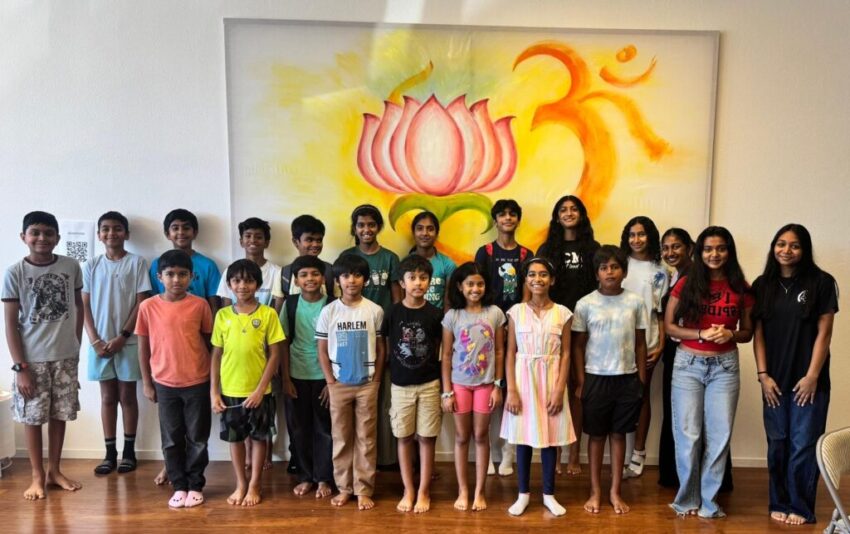
Suvidha International Foundation, based in California, (suvidhainternational.org) expanded its youth education and leadership efforts during summer 2026 through two monthly summer camps and a global virtual AI hackathon that connected students through academics, technology, teaching and community service.

The foundation hosted two summer camp sessions from June 1 through June 30 and July 1 through August 4, offering 16 educational programs in each of the camps, a press release from Suvidha said. Courses included Speech and Debate, Python Coding, Introduction to Agentic AI, SPIKE Prime Robotics, Raspberry Pi Programming, English Writing, introductory Spanish, Vedic Mathematics, Integrated Math 1, Integrated Math 2, Integrated Math 3 and Precalculus.

More than 40 student volunteers, primarily in grades 8 through 12, served as instructors, mentors and teaching assistants.
Most courses were delivered virtually, allowing students and instructors from different locations and time zones to participate. Several programs, including Speech, Debate, English Writing and Robotics, also included in-person sessions in Folsom, California.
ADVERTISEMENT

Adult mentors including founder Bhaskar Vempati, Bharath Pingali, Vandna Sharma, Avinash Maddy, Padmapriya Maddy, Balu Kodavatikantla, along with a broader team of volunteers, supported the student instructors in developing lesson plans, organizing course content and strengthening their teaching and presentation skills.
Students from underserved families were able to participate without charge, Suvidha said. Families who were financially able were invited to make a suggested contribution, with proceeds from the summer programs expected to help support the education of approximately 10 underserved students facing financial challenges.
Summer AI Learning Leads to Global Competition

Artificial intelligence was one of the major themes of the summer programming. Youth instructors including Arav Parikh, Sathvika Nivasini and Tanvi Rathore helped introduce students to AI concepts during Suvidha’s educational summer programs. That experience was followed by the Suvidha AI Virtual Hackathon 2026, held August 15–22.
More than 300 middle and high school students from seven countries registered for the free virtual competition. Students who had previously participated in Suvidha International Foundation’s AI Basics Program during the summer camps 2026 also took part in the hackathon.
Participants were given a single challenge: Build something that makes learning accessible to someone who is currently locked out of it.
By the submission deadline, 75 teams had completed working projects which were then evaluated by an external panel of judges who considered problem relevance, originality, execution and presentation.
First place went to Class of One, built by Christian Satersfield from the United States.. The project functions as an AI-powered computer science teacher for students who may not have access to one at their school. It guides students through problems rather than simply providing answers and includes several computing disciplines. The first place team was awarded $250.
Second place went to Team VS from Canada, consisting of Viraj Randhawa, Seth Van Vynckt and Michael Zamesnik. Their project, Peel, helps students who may feel overwhelmed by full worksheets by presenting questions individually and offering features such as text-to-speech, timers and background noise options.The second place team was awarded $150.
Third place went to Learn Your Way, developed by Rohit Gautam from Delhi, India. The application helps students access educational material in formats that better match their individual learning needs. The third place team was awarded $100.
Featherless AI, the presenting sponsor, provided $25 in inference credits to every registered participant and additional credits for winners, helping young participants experiment with AI technology without requiring personal computing budgets.
SIF was founded in 2018 by Bhaskar Vempati and a group of friends with a vision to empower the Greater Sacramento area through educational, cultural, and community service initiatives, as well as support underprivileged villages in rural India. What began with just a few villages in India has grown into a broader effort, with the foundation now making a meaningful impact in communities across two states, according to the organization.