

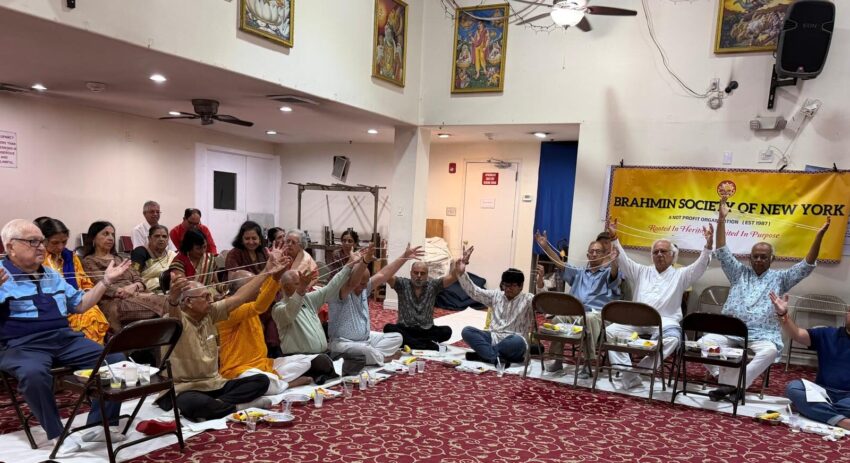

Audiences watched with fascination as adults sat on the floor, carrying out the upnayan sanskar or the thread ceremony (Janoi in Gujarati) at a special event organized by the Brahmin Society of New York (BSNY).
The Samuh Yagnopavit (Group Thread Changing) and Raksha Bandhan, both of which fell on the same day, the Nariyeli Purnima, were celebrated at the Hindu Center in Flushing accompanied by Vedic rites under the guidance of Priest Jayesh Bhatt.

The event began with a welcome address by BSNY President, Kalpita Parikh, who charted out the day’s program which included Janoi changing, Raksha Bandhan and a solemn group prayer for the loss of lives in the landslide tragedy in Nepal. The prayer also included a wish for the safe return of all the people stuck there.
The Thread Ceremony which is considered a sacred religous ritual, was sponsored by BSNY members who had made donations specifically for it. They were acknowledged and thanked by BSNY Treasurer Pankaj Devashreyee for making it possible.
ADVERTISEMENT

Trustee Ruta Dave detailed the much awaited upcoming Navratri event, Navratri Dandiya Night, organized for October 10, 2026, and invited all to participate.

The thread changing ceremony involved ‘achaman’ or internal purification while chanting shlokas, shifting the old thread and offering water, while praying to the Rishis, consecrating the new Janoi, chanting the Gayatri Mantra and then wearing it.
“The ceremony was for the older adults who wear Janoi round the year,” said BSNY President, Kalpita Parikh, to Desi Talk.
“The number of people for this ritual has been falling over the years, especially as the younger generation does not wear the Janoi (sacred thread). However, we, at BSNY, are trying to keep them educated about our traditional rituals through such events,” Parikh added.
The event also celebrated Raksha Bandhan, the tying of the sacred Raksha thread on the right wrists of the brothers by the sisters, praying for their safe and long life. Women tied Rakshas on the wrists of the men, accompanied by Vedic chanting by the priest, which invoked blessings of the Gods. The two rituals concluded with an Arati.

Once the religious rituals were complete, the solemn prayer for the lost lives in Nepal tragedy began with the priest explaining why it is necessary to pray for the Sadgati and Shanti of the souls of the departed. He said it was a great coincidence that those on the Kailas-Mansarovar pilgrimage died there in the nearness of god Shiva. He then led the gathering through the prayer by reciting the shloka:
Krishnaay Vaasudevaay Haraye Paramaatmane
Pranat Kleshnashaay Govindaay Namo Namah
(We offer our obiesances unto Lord Krishna, Hari, the son of Vasudeva. That Supreme Soul, Govinda, vanquishes the suffering of all who surrender to Him.)
This chanting was followed by chanting of Shanti Mantra and a silent prayer the departed.
The event ended with a simple meal. Parikh explained that the meal was kept simple to pay respect to those involved in the Nepal tragedy. “Both Janoi and Raksha Bandhan are happy events and our usual Gujarati meal consists of many sweets to celebrate both. But keeping the tragedy in mind, we kept the menu simple,” she said.