

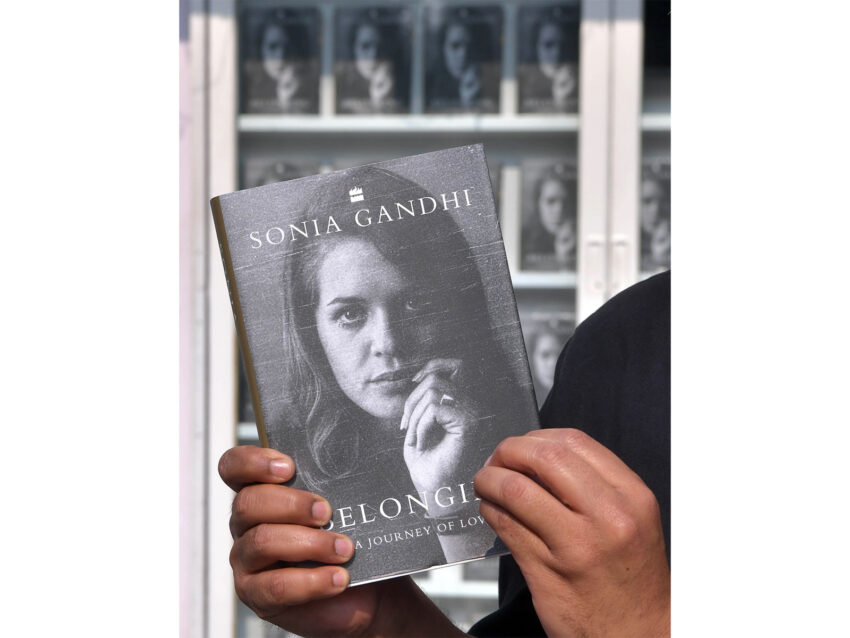
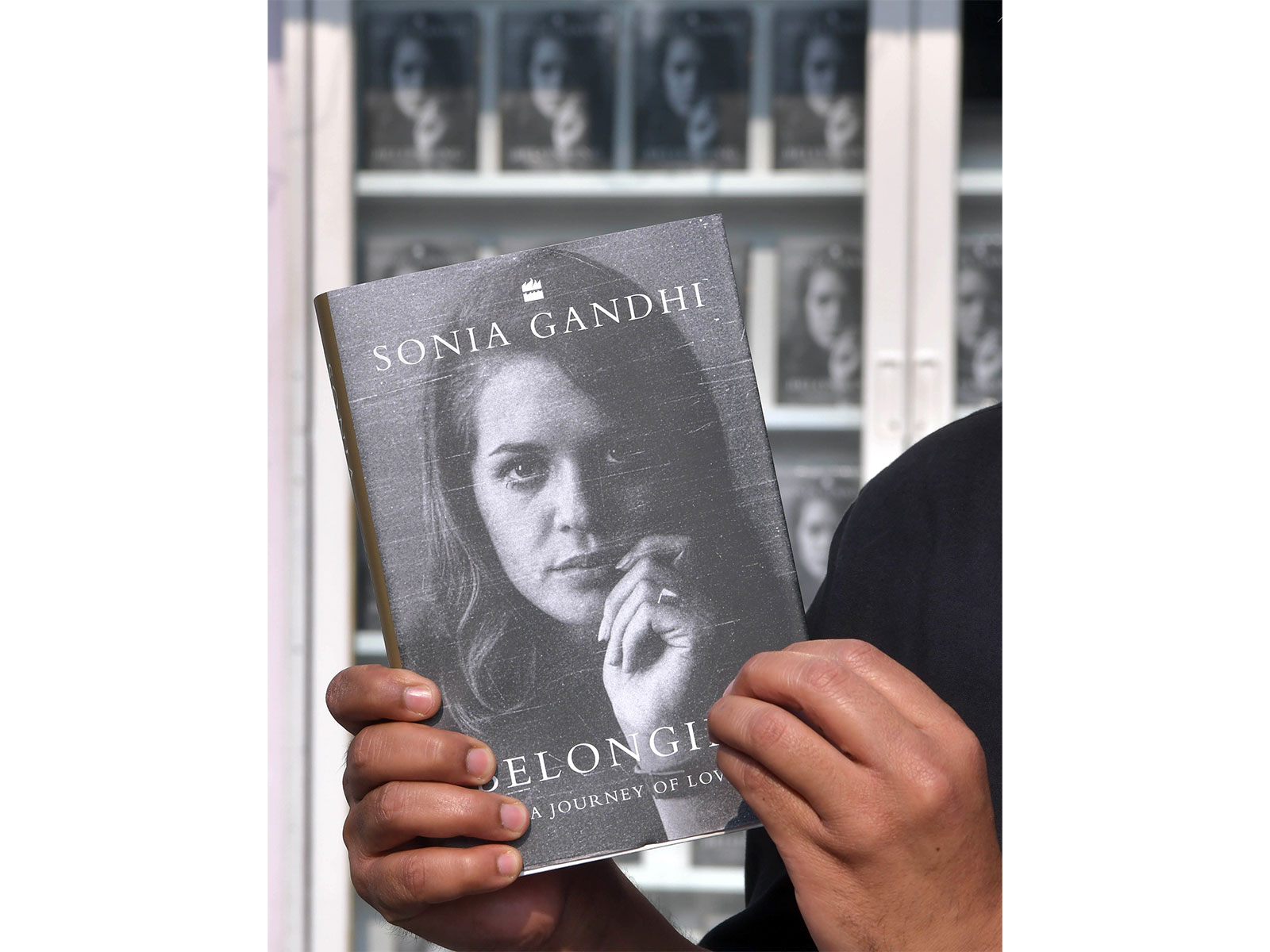
New Delhi [India], November 10 (ANI): A demolition that brought tears to her eyes, an Italian passport she found difficult to surrender, a Prime Minister whose India she says is shaped by the RSS, and a political movement she alleges was backed by the BJP to dislodge the UPA government. Congress Parliamentary Party Chairperson Sonia Gandhi’s memoir, ‘Belonging: A Journey of Love’, has opened several chapters of India’s political history, triggering a fresh war of words between the BJP and Congress, with Opposition leaders also weighing in on the contentious recollections.
From the demolition of the Babri Masjid in 1992 and the 2002 Gujarat riots to the 1984 Operation Blue Star, the Emergency, the 2004 Prime Ministerial episode and the Anna Hazare-led anti-corruption movement, Gandhi’s memoir has brought several politically sensitive episodes back into the spotlight.
While the BJP has accused the former Congress president of attempting to “whitewash” the Nehru-Gandhi family’s historical record and selectively expressing grief, Congress leaders have defended her right to recount her personal experiences, accusing the ruling party of deliberately politicising the memoir.
The sharpest exchange has centred on Gandhi’s recollection of watching the Babri Masjid being demolished on December 6, 1992, and breaking down in tears.
In her memoir, Gandhi revisits the demolition as a defining moment in India’s political journey, describing it as an indication of the growing influence of the BJP-RSS and their affiliates.
“There had been for several years clear indications that the BJP-RSS and their affiliates were single-mindedly advancing their divisive agenda. The tragic demolition of the Babri Masjid in 1992 and the ensuing spiral of communal violence were definite pointers: Those outfits were no longer going to work behind the scenes. The BJP was drawing closer to its dream of absolute power,” she wrote.
Her account has drawn a sharp response from BJP leaders, who have questioned why she expressed grief over the demolition but, according to them, did not show similar sensitivity towards Hindu victims, security personnel and victims of terrorist attacks.
BJP national spokesperson CR Kesavan launched one of the strongest attacks, suggesting that the memoir should have been titled ‘Whitewashing’ instead of ‘Belonging’.
“Sonia Gandhi could have titled her memoir ‘Whitewashing’, instead of ‘Belonging’, because the motive of this book appears to be sugarcoating the historical wrongs perpetrated by the Nehru-Gandhi family and camouflaging the cardinal sins committed by the Congress party,” he said.
Questioning her recollections of the Babri Masjid demolition, the 1984 anti-Sikh massacre, the Batla House encounter and the 26/11 Mumbai terror attacks, Kesavan asked, “Sonia Gandhi says she cried for Babri Masjid. Did she shed even a drop of tears when Gurdwaras were attacked and thousands of innocents were brutally targeted and killed during the 1984 anti-Sikh massacre, which happened under Congress rule?”
“Sonia Gandhi wept profusely for the Batla House terrorists. Did she cry when our brave jawans, in the line of duty, were martyred protecting our nation and people? Did Sonia Gandhi shed even a drop of tears when innocent lives were killed during the merciless 26/11 terrorist attacks in Mumbai?” he asked.
Kesavan also accused Gandhi of attempting to normalise the Emergency imposed by former Prime Minister Indira Gandhi, saying, “The way in which Sonia Gandhi has tried to normalise and justify the notorious Emergency imposed by Indira Gandhi, which suspended fundamental rights and murdered our Constitution, is appalling and shocking.”
He credited Prime Minister Narendra Modi with “resolutely course-correcting the historical wrongs and the sins committed by the Congress Party”.
Union Minister Giriraj Singh went further, alleging that Gandhi’s account exposed her “true face” and accusing her of selectively expressing concern over incidents involving different communities.
“Tears only well up in their eyes when incidents like the Babri (Masjid demolition) or the Batla House (encounter) occur–but when an incident like Godhra happens, her tears dry up,” Singh said.
Referring to the Pahalgam terror attack, he asked why she did not express similar grief when Hindu pilgrims were targeted and killed by Pakistani terrorists.
He also questioned Gandhi’s criticism of PM Modi and the RSS, bringing former Prime Minister Jawaharlal Nehru into the debate.
“Perhaps Sonia ji should have written about Pandit Nehru’s ‘achievements’ like how he handed Tibet over to China, how he facilitated China’s entry as a permanent member of the UN Security Council, or how he introduced Articles 370 and 35A,” Singh said.
Defending the Prime Minister, he said, “The Prime Minister looks the country’s enemies straight in the eye when he speaks to them. It does not matter how powerful they might be–whether it is China, Pakistan, or any other nation in the world.”
On Gandhi’s account of retaining her Italian passport, Singh alleged that she had remained without Indian citizenship for 12 years and questioned her explanation for holding on to the passport.
“‘It belonged to me.’ ‘The citizenship also belonged to me.’ She is only exposing herself. Who is she trying to fool?” he said.
He further alleged that Gandhi had “no love for India” and accused her of pursuing a political strategy centred on dividing Hindus along caste lines and securing Muslim votes.
The BJP’s criticism of Gandhi’s Babri Masjid recollections prompted Congress leaders to invoke the reactions of senior BJP leaders Atal Bihari Vajpayee and LK Advani following the demolition.
Congress leader Salman Khurshid said there was widespread regret over the incident, including among leaders of the BJP.
“Advani ji had also said that they did not want this to happen. Atal Bihari Vajpayee had said they didn’t want this,” Khurshid said, arguing that nobody could accept attempts to alter the course of democracy through force.
Congress MP Rajeev Shukla also questioned the BJP’s criticism, asking whether the former BJP leaders had similarly been accused of sympathising with Babri for condemning the demolition.
“When Babri Masjid was demolished, Atal ji had heavily criticised it. Did Babar live in his heart? Advani ji had called it a grave mistake. Did Babar live in his heart? Jaswant Singh strongly condemned it. Did Babar live in his heart?” Shukla asked.
“This should not be turned into a controversy… BJP is trying to give this a political spin. What is the need for this?” he added.
Khurshid said the memoir should be read before being subjected to political attacks.
“Let them play politics. Even Sonia ji acknowledged that there would inevitably be some uproar. But they should read the book and try to understand it, rather than starting to shout right away,” he said.
However, BJP leader Pothireddy Krishnakanth questioned whether Gandhi and Congress leaders had displayed similar sensitivity towards the Ram Temple in Ayodhya.
“Did you ever show such similar sensitivity towards the Ayodhya Ram Mandir? Did you and your party leaders ever, including your son Rahul Gandhi, did they ever visit Ayodhya Ram Mandir after its construction?” he asked.
He further alleged that Gandhi had shown sympathy towards Babar while failing to empathise with Hindu religious sentiments.
BJP MP Nishikant Dubey also questioned the memoir’s portrayal of the Gandhi family, particularly its account of Sanjay Gandhi and Rajiv Gandhi.
“What kind of relaunch is this? Sonia Gandhi has written a book in which she has portrayed Sanjay Gandhi as a villain and Rajiv Gandhi as a hero. Neither Sanjay Gandhi, Indira Gandhi, nor Rajiv Gandhi is alive to respond to these claims. Ultimately, who will decide whether what she has said is right or wrong?” Dubey said.
He also questioned Sonia Gandhi’s account, asking why she had not expressed similar grief when kar sevaks were killed during the Ram Janmabhoomi movement. He further referred to Rajiv Gandhi’s role in the foundation-laying ceremony for the Ram temple in 1989 and accused Sonia of portraying members of the Gandhi family selectively in the memoir.
Gandhi’s account of surrendering her Italian citizenship has emerged as another major point of political confrontation.
In her memoir, she explained that retaining her Italian passport was initially important because it represented the part of her identity she had brought with her to India and allowed her to visit her parents without complicated paperwork.
“I’d kept my Italian passport because it was the part of me that I brought to India, the Italy that my proud and patriotic father had fought for with his comrades,” she wrote.
However, she said her visits to Italy had gradually become less frequent and she no longer related to the way of life there.
“I had adopted Indian ways in my food and dress habits and in my way of thinking. It was my unquestioned world, and I felt rooted in it. I was, to all intents and purposes, Indian, and formal nationality seemed irrelevant,” she wrote.
Describing the moment she formally renounced her Italian nationality, Gandhi recalled being asked by an embassy official to understand the finality of her decision.
Her emotional reaction, she said, reminded her of the time she had changed her name after marriage.
“My heart began to race, my face was burning, and I could barely hide my agitation. It felt very like the disquiet I’d experienced at the time of my wedding when I had to change my name and let go of one part of my identity. Now the little that had remained of it was going forever,” she wrote.
The account drew criticism from Union Minister Giriraj Singh, who questioned her explanation for retaining the passport.
Haryana Power Minister Anil Vij also challenged her eligibility to become Prime Minister, referring to provisions of the Italian Constitution.
“Consequently, we could not have appointed her to such a position; it was not a matter of her being willing to take on the role–it was for this specific reason that she could not be appointed,” Vij said.
BJP leader Dinesh Pratap Singh claimed that former President APJ Abdul Kalam had refused to administer the oath of office to Gandhi because of her foreign origin.
“The entire country knows why Sonia Gandhi refused the PM post. People of Raebareli know this very well. Sonia Gandhi and AICC had written to the then President that she be administered the oath of office as the PM. The then President, APJ Abdul Kalam, clearly refused to administer the oath of office as Prime Minister to a woman of foreign origin,” he alleged.
He further claimed that after the alleged refusal, Congress projected Gandhi as ‘tyag ki devi’.
Union Minister Giriraj Singh also dismissed Gandhi’s account of stepping aside from the Prime Minister’s post in 2004 as “lies”, alleging that preparations had already been made for her to assume office.
The controversy also drew reactions from JD(U) MP Sanjay Kumar Jha, who questioned Gandhi’s account of refusing the top post.
“This is a controversial matter as well. While managing numbers, what we know is that Mulayam Singh Yadav had refused to support her. Otherwise, there was a full attempt to become the PM. But she could not become. It is a different matter what she did or did not do,” Jha said.
Jha also questioned Gandhi’s account of the Emergency, particularly her reported suggestion that Indira Gandhi had not really wanted to impose it.
“How can this be? She was the PM of the country. Saying that a few people advised her is surprising,” he said.
BJP MP Rahul Sinha dismissed the memoir’s significance, saying, “Sonia Gandhi’s writings will not make any difference; nobody is going to read it.”
One of the most politically significant sections of the memoir is Gandhi’s direct assessment of Prime Minister Narendra Modi and the ideological differences between Congress and the BJP.
Gandhi described their political rivalry as a contest between two fundamentally different visions of India rather than a personal feud.
“We come from different ideological worlds; his idea of this country is vastly different from mine. All I learnt about India was assimilated from the members of my family, their lives of service, and their faith in a nation that encompassed a host of races and cultures, languages and faiths, based on principles of liberty and equality for all,” she wrote.
She alleged that the Prime Minister’s understanding of India was shaped by the RSS.
“Narendra Modi’s idea of India was constructed by the ideologues of the RSS and the experience of his own growing up. It affirmed a fundamentalism in which his faith and culture superseded all others. In that India, hierarchy, order, and control are central,” she wrote.
“He was fighting for his vision of India, and I for mine: an India against hegemony, an India that stands for inclusiveness, secularism, and social justice,” she added.
Gandhi also described her interactions with PM Modi, saying that despite his having been Prime Minister for more than 12 years, she had practically no real contact with him.
She recalled that their interactions at the end of Parliament sessions were limited to formal greetings.
“When he comes face-to-face with me, we greet each other with a formal namaste. This is different from the past, when leaders across party divides would treat one another with cordiality,” she wrote.
The Congress veteran also accused the BJP of systematically dismantling democratic institutions, suppressing dissent and using central investigative agencies against political opponents.
“The BJP has systematically dismantled our democratic institutions. They’re unwilling to acknowledge that the opposition has a vital role to play in a democracy,” she wrote.
She alleged that the Enforcement Directorate had been turned into “a tool for political vendetta and persecution of opponents”, while accusing the Election Commission of India of becoming an accomplice in the ruling party’s pursuit of power.
Gandhi also criticised the mainstream media, alleging that television anchors and private channels had become “no better than propaganda arms of the government”.
She accused the RSS of bringing educational institutions under its ideological influence through textbook changes and appointments of university vice-chancellors.
“The BJP’s stated aim is what they call a ‘Congress-free India’–free of the party, its policies, and its ideology,” she wrote.
She further alleged that attacks on minorities and Dalits had increased since the BJP came to power and were mostly going unpunished.
Gandhi also criticised the November 2016 demonetisation exercise, describing it as a “telling example” of the Prime Minister’s “autocratic methods”.
She alleged that the sudden invalidation of Rs 500 and Rs 1,000 currency notes had thrown trade into disarray and driven millions into hardship.
On the other hand, BJP leaders defended PM Modi and accused Gandhi of selectively presenting India’s political history.
Gandhi also revisited the 2002 Gujarat riots, which took place when Narendra Modi was the Chief Minister of the state.
Recalling the Godhra train tragedy and the violence that followed, she wrote that the Sabarmati Express was returning from Ayodhya carrying Hindu kar sevaks when four coaches were set on fire, killing 59 pilgrims.
“The cause of the fire remains disputed, but the turmoil that followed spread to many parts of the state, and the victims were overwhelmingly Muslims,” she wrote.
She recalled watching television coverage of the violence and attempting to reach Congress colleagues in Gujarat.
“We watched the live reports in horror, and tried to get help to our colleagues in Gujarat who were calling us in desperation, but the administration failed to respond,” she wrote.
Gandhi alleged that the riots were fuelled by a fanatical fringe of the BJP and RSS, including the Bajrang Dal, and noted that Modi was the Chief Minister at the time.
She also alleged that the RSS was laying the groundwork for Modi’s emergence as the BJP’s Prime Ministerial candidate while he was serving as Gujarat Chief Minister.
Her remarks on the RSS also extend to the Anna Hazare-led anti-corruption movement, which she alleged had covert BJP-RSS backing.
Gandhi has alleged that the India Against Corruption movement, spearheaded by Anna Hazare, was covertly organised and supported by the BJP and RSS to weaken the UPA government.
“In 2012 a well-known activist from Maharashtra, Baburao ‘Anna’ Hazare, emerged as the figurehead of a movement that titled itself ‘India Against Corruption’. Some of its prominent participants have stated since that it was covertly organised and supported by the BJP and RSS,” she wrote.
Recalling the movement’s impact on the Congress-led government, she said the large crowds and aggressive campaign had put the UPA on the backfoot.
“The movement drew large crowds, and we found ourselves on the backfoot, unable to counter the BJP’s aggressive campaign,” she wrote.
However, the major Anna Hazare-led India Against Corruption agitation took place in 2011, with protests and related developments continuing into 2012.
Gandhi also claimed that the Lokpal mechanism, which the UPA government brought in, had become a “toothless and near-invisible tiger” under the BJP.
She further recalled former Prime Minister Manmohan Singh’s response to criticism during the UPA-II years, quoting his remark that “history will be kinder to me than the media”.
Furthermore, Sonia Gandhi has also accused the Narendra Modi government of repackaging UPA-era welfare programmes, alleging that the NDA has adopted “no less than thirty” schemes introduced during the Congress-led government, while renaming them and reducing their scale.
“It has failed to come forward with any new ideas of governance and instead has adopted no less than thirty of our UPA-era programmes, but retitled under catchier names and considerably reduced in scale; some of these welfare schemes the prime minister himself had earlier criticised,” she wrote.
One of the schemes she specifically flags is the Mahatma Gandhi National Rural Employment Guarantee Act (MGNREGA), which she describes as a flagship UPA programme that provided employment in rural areas to alleviate distress.
She alleges that the scheme has been “virtually hollowed out” after being renamed.
The reference is to the Viksit Bharat–Guarantee for Rozgar and Ajeevika Mission (Gramin), or VB-G RAM G Act, 2025, which replaced MGNREGA with effect from July 1, 2026. The new law raises the statutory employment guarantee from 100 to 125 days per rural household in a financial year.
The government has defended the change as a reform of the rural employment framework, while Opposition parties have criticised the removal of Mahatma Gandhi’s name and the revised Centre-State funding structure.
On sanitation, Sonia Gandhi writes that the Swachh Bharat Abhiyan was “repackaged from our Nirmal Bharat Abhiyan”.
“Anyone looking around our towns and cities can plainly see that the initiative is largely symbolic; there’s a very long way to go in achieving public cleanliness and hygiene,” she wrote.
The Union Cabinet approved restructuring the Nirmal Bharat Abhiyan into the Swachh Bharat Mission on September 24, 2014. The mission was launched on October 2, 2014, with separate rural and urban components.
She also acknowledges that the NDA government expanded digital public infrastructure, connecting millions of people outside the formal financial system to banks, but raises concerns about its implementation.
“The actual working of this structure leaves a great deal to be desired,” she wrote, referring to findings of the Comptroller and Auditor General (CAG) on alleged misuse, corruption and implementation failures.
Another contentious section concerns Operation Blue Star and the aftermath of the Army operation at the Golden Temple in June 1984.
Gandhi recalled watching Indira Gandhi view footage of the operation’s aftermath and described her mother-in-law’s emotional response.
“As my mother-in-law watched the slow-moving record, I could see her face wet with tears–tears of pain and regret, I think: sorrow at the manner in which the siege has ended, at the large number of lives lost,” she wrote.
The account drew criticism from BJP leaders and the Aam Aadmi Party.
AAP Delhi president Saurabh Bharadwaj questioned the significance of Gandhi’s recollection, saying that any expression of remorse from Indira Gandhi herself at the time would have carried greater weight.
“Sonia Gandhi is now attempting, in her own way, to help people move past these wounds. However, had Indira Gandhi herself expressed such remorse at the time, it would have carried far greater significance,” Bharadwaj told ANI.
“This sentiment, coming from Sonia Gandhi, is merely hearsay–it cannot be independently verified. It should be viewed as a political statement tailored to the current political climate,” he added.
Bharadwaj also questioned Congress party’s secular credentials, referring to the Army’s deployment inside the Golden Temple and the subsequent anti-Sikh violence.
BJP MP Satnam Singh Sandhu questioned who would take responsibility for the destruction at the Golden Temple.
“If there were remorse, like Sonia Gandhi has said that before Indira Gandhi passed, she had the realisation, the feeling that her death was imminent… Was that remorse for the injustice that happened to the Sikhs? Was it for the attack on the Golden Temple, or was it about her own political decision?” he asked.
Delhi Minister Manjinder Singh Sirsa rejected Gandhi’s account, accusing the Gandhi family of expressing “crocodile tears”.
“This statement coming from Sonia Gandhi ji that Rajiv Gandhi was very sad and grieving after the 1984 Sikh massacre–all of this is a lie,” Sirsa said.
“Rajiv Gandhi orchestrated all of it… Sonia Gandhi is only talking about shedding crocodile tears, whereas the reality is that Rajiv Gandhi rewarded the very people who massacred Sikhs,” he alleged.
He further said, “She (Indira Gandhi) had no sorrow whatsoever. In a calculated manner, she worked to tear down Sri Darbar Sahib—the holy shrine of Sikhs.”
BJP leader Tarun Chugh also demanded that Sonia Gandhi explain the Congress leadership’s position during the Emergency and the 1984 anti-Sikh violence.
“The nation cannot forget who deployed tanks and fired cannons inside the sacred Sri Harmandir Sahib, reducing the site to ruins. The Congress party turned 52 cities across the country into graveyards and burned Sikhs alive. What was your reaction, and that of your husband, at that time?” he asked.
BJP leader RP Singh accused Gandhi of selectively presenting the events surrounding Operation Blue Star, arguing that alternative options had been available.
“Sonia Gandhi is being selective in her writing. Alternative options could have been considered during Operation Blue Star but were not pursued. Later, during Operation Black Thunder, electricity and water supplies were cut off to force the militants to surrender. Sonia Gandhi’s account is therefore selective,” he said.
BJP MP HS Phoolka also questioned the account of the 1984 anti-Sikh riots, saying that he had purchased the memoir to verify its references to the Army’s deployment.
“If this is written in the book, it is against the records. It is absolutely false,” he said, referring to reports that the Army was called in on October 31.
Phoolka cited the Misra Commission’s findings, claiming that the Army was called in only on the evening of November 1 and reached Delhi the following evening.
Gandhi’s account of declining the Prime Minister’s post after the Congress-led alliance won the 2004 general elections has also reignited debate over the political developments surrounding the formation of the UPA government.
In an excerpt shared on X, Gandhi recalled the moment she decided against taking the top post.
“‘Sonia, be true to yourself,’ I could hear myself say. ‘You’ve always known it. Just leave it!'” she wrote.
She also recalled informing her son Rahul Gandhi about her decision.
“‘I’ve made up my mind. I’m going to stick to my stand,’ I told him. He stepped up to me and with his arms around me said, ‘It’s the right decision,'” she wrote.
However, JD(U) MP Sanjay Kumar Jha claimed that Gandhi’s decision was linked to the numbers game and the refusal of Samajwadi Party leader Mulayam Singh Yadav to support her.
BJP leaders, meanwhile, alleged that the decision had been influenced by questions surrounding her foreign origin and her eligibility to become Prime Minister.
Gandhi also recalled a conversation with former President Pranab Mukherjee in 2010, when he allegedly suggested that it was time for a change at the top.
“He (Pranab) had developed serious differences with the Finance Minister P Chidambaram, and on one occasion, in 2010, I think after expressing his frustration, he shocked me with the suggestion that perhaps it was time for a change at the top, which I understood as a hint of his long-held desire to become prime minister,” she wrote.
Mukherjee’s daughter Sharmistha Mukherjee strongly defended her father’s ambition, saying there was nothing wrong with a politician aspiring to become Prime Minister.
“What’s there to get ‘shocked’ about? Is it a crime to be ambitious, especially when that ‘ambition’ was supported by decades of experience in politics and governance, hard work and a brilliant mind?” she asked.
She recalled her father telling her that “any politician worth his salt has this ambition”.
“My father came from a very humble background. Whatever he achieved in his life was through sheer merit and hard work. There was no one to serve him positions, including PM-ship, on a platter due to dynastic entitlements,” she said.
Sharmistha also clarified that her father did not harbour resentment towards Sonia Gandhi over the issue.
Gandhi’s memoir also revisits the Shah Bano controversy, one of the most politically consequential episodes of the Rajiv Gandhi government’s tenure.
She recalled questioning Rajiv Gandhi over his government’s decision to bring legislation in 1986 following the Supreme Court’s verdict granting maintenance to Shah Bano, a divorced Muslim woman.
“I argued with him and questioned him: ‘The papers are accusing you of sacrificing Muslim women’s interests. What’s going on? Why are you letting this happen?'” she wrote.
According to Gandhi, Rajiv defended his position, saying he was attempting to address a complicated issue.
“‘Wouldn’t I defend women’s rights–don’t you know me?’ he said in a slightly irritated tone,” she recalled.
Gandhi said the compromise sought to balance religious beliefs with gender justice.
“The compromise he accepted did in fact strike a balance between religious beliefs and gender justice, and it also gave Muslim women a more fair and reasonable portion than the pitiful monthly amount of Rs 179.2 awarded by the court to Shah Bano,” she wrote.
However, she acknowledged that the legislation overturning the Supreme Court’s decision was widely criticised.
“The legal amendment that overturned the court’s decision was a political step that was widely criticised,” she wrote.
She also linked the Shah Bano controversy to the BJP’s electoral strategy, arguing that the party sought an emotive issue after its poor electoral performance in the 1980s.
“When in 1984, against Congress Party’s tally of 404 seats, the BJP won just two seats out of the 514 in Parliament, it had come as a big blow to them,” she wrote.
Meanwhile, the Shah Bano judgment also brought renewed attention to Article 44 of the Constitution, which directs the State to endeavour to secure a Uniform Civil Code (UCC) for citizens. The UCC debate has since remained politically contentious, with the BJP repeatedly advocating a common civil framework and citing gender equality as one of its arguments.
Uttarakhand became the first state in independent India to bring a new UCC into force in January 2025. The issue remains part of the BJP-led NDA’s political agenda, with Union Home Minister Amit Shah reiterating the alliance’s commitment to expand across 21 NDA-ruled states before the 2029 Lok Sabha elections.
Furthermore, Gandhi also recalled the emotional dilemma she faced before reaching out to DMK leader M Karunanidhi to forge an alliance against the BJP.
The DMK’s alleged association with the LTTE, the organisation responsible for Rajiv Gandhi’s assassination, had initially made her question whether an alliance would amount to a betrayal of her husband.
“With those painful memories returning to torment me, I’d ask myself, ‘What should I do? If I join hands with them, won’t it amount to a betrayal of Rajiv?'” she wrote.
However, she said she eventually considered whether Rajiv himself would have supported the alliance if it strengthened the Opposition against the BJP.
“Perhaps Rajiv himself would have gone ahead with this alliance, if he knew it was necessary to strengthen our front against the BJP,” she recalled thinking.
Gandhi also described her nervousness before making her first telephone call to Karunanidhi.
“My heart was in my mouth, and I was trembling when I made that first telephone call to M. Karunanidhi to initiate a conversation with the DMK,” she wrote.
The Congress-DMK alliance subsequently became an important component of the UPA’s formation after the 2004 Lok Sabha elections.
The memoir has also drawn varied reactions from Opposition leaders, with some defending Gandhi’s political legacy while others questioning the Congress’s own historical record.
Congress leader Digvijaya Singh dismissed the BJP’s criticism of Gandhi’s Babri Masjid remarks as “utter nonsense”.
“Essentially, in this book by Sonia Gandhi that has come out, she has narrated the full story of her life and presented her ideology. An ideology that is based on our Sanatan traditions, on respect for all religions (Sarva Dharma Sambhava), and on walking the path of love, harmony, truth, and non-violence,” he said.
“And that is why our ideology stands against the hate-filled ideology of Narendra Modi ji,” he added.
However, AIMIM president Asaduddin Owaisi, while expressing respect for Sonia Gandhi, questioned Congress’s historical role in the Babri Masjid episode.
“I have great respect for Madam Sonia Gandhi and will continue to respect her, because I was with them in the UPA from 2004 to 2012,” Owaisi said.
But he pointed towards Congress government’s role in the events leading up to the demolition.
“And as far as the question of Babri Masjid is concerned, many questions will arise then. Many questions… Who opened the locks? You understand, right? Look, these are all historical facts,” he said.
He further asked, “Who gave the solemn promise to the Supreme Court that the Masjid will not be touched?”
Owaisi also questioned the Congress-led UPA government’s enactment of the Unlawful Activities (Prevention) Act (UAPA), saying he had opposed it because he believed it could be used against Muslims, Adivasis and intellectuals.
On whether Gandhi’s remarks were linked to electoral calculations, Owaisi said, “I cannot speak on behalf of Congress or on behalf of respected Sonia Gandhi.”
Peoples Democratic Party president Mehbooba Mufti, meanwhile, praised Gandhi’s personal journey and criticised the BJP’s ideological approach.
“I have seen Sonia Gandhi evolving into a leader and then into a stateswoman. She has gone through a lot. I mean, in my opinion, no woman politician has endured as much as she has,” Mufti said.
She also defended Jawaharlal Nehru’s legacy, saying, “That is Jawaharlal Nehru’s legacy.”
Describing the ideological divide, Mufti said, “I feel that this book… tells you the truth: that the BJP’s ideology is the ideology of the RSS, Jan Sangh, and Godse, whereas Sonia Gandhi associates herself with Gandhi ji, secularism, and democracy.”
Samajwadi Party MP Mohibullah Nadvi also defended Gandhi, saying her life should not be viewed through a political lens.
“She even had the opportunity to become Prime Minister–she could have, had she wished–but she chose not to,” he said, adding that Gandhi had endured personal tragedies while continuing to live and work in India.
Trinamool Congress (TMC) leader Kunal Ghosh said his party and former West Bengal Chief Minister Mamata Banerjee shared respect for Gandhi.
“My leader Mamata Banerjee respects Sonia Gandhi ji. Our party respects Sonia Gandhi. We are originally from the Congress. Indira Gandhi ji was our leader, and after her, Rajiv Gandhi ji was our leader,” he said.
Ghosh also recalled Rajiv Gandhi’s affection for Banerjee, saying, “Rajiv Gandhi loved Mamata Didi so much and respected her so much that had he been alive, the political history of West Bengal would have had to be written quite differently.”
On Gandhi’s account of Pranab Mukherjee’s Prime Ministerial ambitions, Ghosh said the former President had the stature and experience required for the top post, while maintaining that the decision rested with the Congress leadership.
Uttar Pradesh Minister Om Prakash Rajbhar, however, criticised the memoir, calling it a publicity exercise and alleging that it was originally prepared with the expectation of a Congress victory in 2024.
“The primary purpose of the book is solely the praise of Sonia Gandhi and the praise of the Congress party; there is nothing else in that book,” he said.
Congress leaders have strongly defended the memoir, describing it as a personal account of Gandhi’s experiences rather than a political document intended to settle scores.
Congress MP Rajeev Shukla said the memoir should not be turned into a controversy.
“I believe people should respect her views and value the emotions she has expressed; this should not be a matter of controversy. It shouldn’t be turned into one,” he said.
“That is the hallmark of a good autobiography–to be open and candid about everything. She has done exactly that. People should recognise that these are her personal reflections,” he added.
Congress leader Pawan Khera described the memoir as an attempt to reclaim Gandhi’s personal narrative.
“To free us from the prison of petty tales told about us. To give us back to ourselves, unapologetically and unabashedly. To tell the truth, with courage and with conviction. To love with grace and grieve without bitterness. That is the Politics of Love,” he wrote.
Congress General Secretary KC Venugopal described Gandhi’s life as “one of the most inspirational journeys in modern times”, praising her leadership through difficult political periods.
Congress leader Shashi Tharoor also congratulated her, describing the memoir as a deeply personal journey of “love, loss, resilience and an abiding bond with India”.
Businessman Robert Vadra, Gandhi’s son-in-law, described her life as an extraordinary story of love, courage, resilience and strength.
“I am incredibly proud of her and her journey. Hers is truly an extraordinary story of love, courage, resilience and strength. She has been through so much in life, yet continues to stand tall with remarkable grace and conviction,” Vadra said.
He added that he believed her story could inspire women, while encouraging readers to read the book and form their own opinions.
In a significant passage in her memoir, Sonia Gandhi has remembered late Congress veteran Ahmed Patel as one of her most trusted colleagues and a key political troubleshooter, describing him as a loyal party colleague who was “approachable day and night”.
Recounting his role in Congress organisation, Gandhi writes that Patel, popularly known as “AP”, was always ready to listen patiently to disgruntled colleagues and played an important role in resolving internal differences. She says she consulted him, along with Ambika Soni and Scindia, on party-related matters before appointing him as her political secretary.
Describing his political approach, Sonia Gandhi writes that Patel was “deeply religious but secular to the core in his politics”. She says he maintained a low profile while coordinating between Congress and its allies, but gradually came to wield considerable influence across the political spectrum.
“He came to wield considerable influence across the political spectrum but could be unforgiving towards those who crossed him,” she writes.
Reacting to the memoir’s mention of her father, Ahmed Patel’s daughter Mumtaz Patel said the description reflected him accurately and that she was happy his contribution had been acknowledged.
“I have also seen what has been written about my father, Ahmed Patel. One particular line caught my attention. As you can see here, it says, ‘He was unforgiving towards those who crossed his path.’ I think this reflects my father accurately,” Mumtaz said.
She described her father as deeply loyal and committed to Congress, adding that whenever he felt someone was acting against the party’s policies or attempting to weaken its leadership, he would take a firm stand.
However, the memoir contains a factual error in its reference to Patel’s death. Sonia Gandhi writes that he fell victim to the Covid pandemic in 2022. Ahmed Patel, however, died on November 25, 2020, at the age of 71, due to COVID-19-related complications at a hospital in Gurugram. He had tested positive for the virus on October 1, 2020.
The memoir also received support from Congress leaders and party workers, with Telangana Congress leader V Hanumantha Rao praising Gandhi for continuing the ideals of Indira Gandhi and Rajiv Gandhi through her work for underprivileged sections.
Beyond the political exchanges, ‘Belonging: A Journey of Love’ chronicles Gandhi’s childhood in post-war Italy, her relationship with Rajiv Gandhi at Cambridge, her entry into the Nehru-Gandhi family and the personal tragedies that shaped her life, including the assassinations of Indira Gandhi and Rajiv Gandhi.
The memoir also revisits her decision to enter active politics in the late 1990s, when the Congress was facing internal divisions and electoral setbacks.
Gandhi recalled how she turned to the Bhagavad Gita during a period of uncertainty, drawing strength from Krishna’s advice to Arjuna to perform one’s duty without worrying about the fruits of one’s actions.
“Something awoke in me: I was sure. I had the answer to my own doubts and questions. I had to step out and go where my duty called. And I did,” she wrote.
The book, published by HarperCollins India, was released across bookstores nationwide on Tuesday. At Bahrisons Booksellers in Delhi’s Khan Market, owner Rajni Bahri Malhotra described it as “one of the biggest books of this decade”, saying readers had been enquiring about it for months.
But even as readers begin turning its pages, the memoir has already opened a political chapter of its own, with the BJP and Congress locked in a battle over history, identity, secularism and the legacy of the Nehru-Gandhi family. (ANI)