

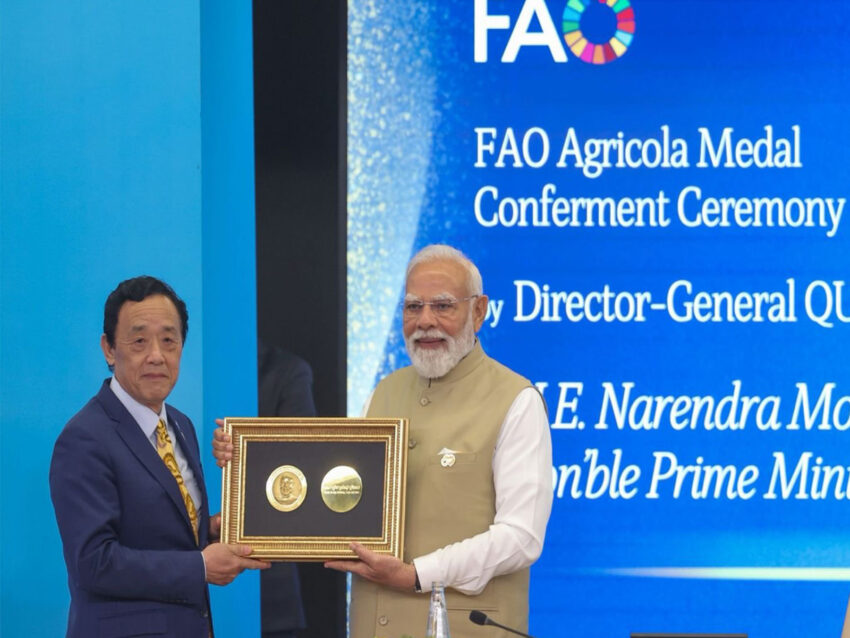
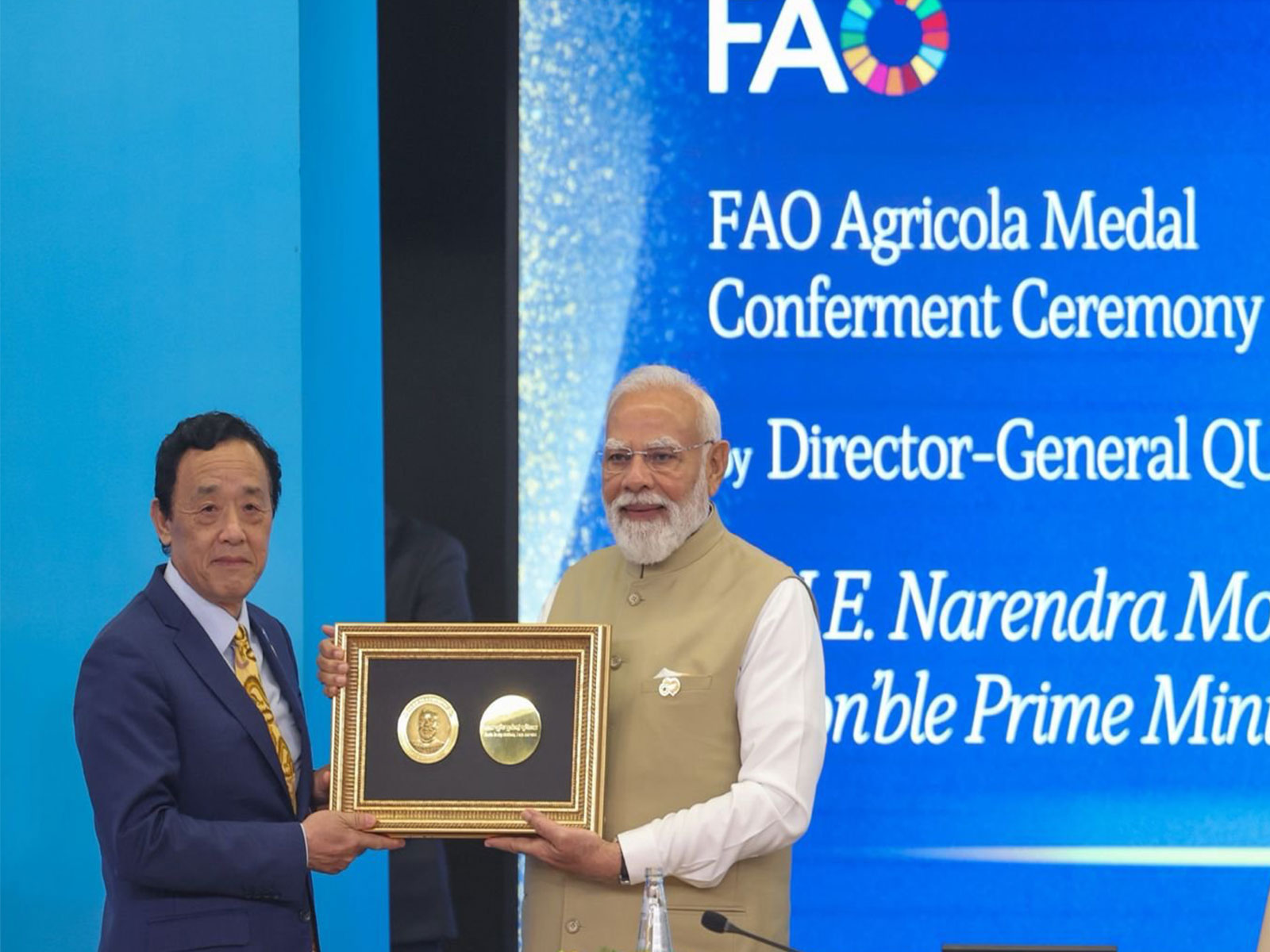
Rome [Italy], May 21 (ANI): Prime Minister Narendra Modi on Wednesday was conferred with the prestigious Agricola Medal for 2026 by the Food and Agriculture Organization (FAO) of the United Nations at the FAO Headquarters in Rome, which he said honoured India’s unwavering commitment to human welfare.
PM Modi dedicated the honour to Indian farmers and the Indian agricultural scientific community, who tirelessly work to ensure food security and nutrition for Indians and for people around the World. He underlined that the recognition was a tribute to India’s commitment to human welfare, food security and sustainable development. Highlighting the centrality of agrarian life in India, Prime Minister emphasised that agriculture was a sacred bond between Mother Earth and the Indian people.
“For our grand welcome and for honoring me with the Agricola Medal, I express my heartfelt gratitude to the Director-General of FAO. I appreciate his friendly words towards India and his years of contribution to the FAO. This honor is not just for me; it belongs to the billions of farmers, cattle herders, fishermen, agricultural scientists, and our workers in India. It is also an honor for India’s unwavering commitment, at the center of which are human welfare, food security, and sustainable development. I accept this medal with extreme humility and dedicate it to the food providers of India,” he said.
Prime Minister Modi noted that India’s scientific and innovation-based approach to farming was fostering a sustainable, climate-resilient and future-ready ecosystem.
“Friends, in Indian civilization, agriculture is not just a means of growing crops. It is given the status of a deep and sacred relationship between human beings and Mother Earth. In India, agriculture is the core stream of life. It is an integral part of our culture and a reflection of our life values. In our country, the earth is called Mother, and the farmer is given the title of “Son of the Earth.” These same values from thousands of years ago are the inspiration for our efforts even today,” he said.
PM Modi expressed that practices such as ‘Per Drop More Crop’ and a mission-based approach to micro-irrigation and precision farming were guiding its agricultural policies.
“Friends, with thousands of years of learning and India’s agricultural tradition, today our country is moving forward with a science, technology, and innovation-driven approach in the agriculture sector. We are working not just to increase production, but also to create a farming ecosystem that is sustainable, climate-resilient, and future-ready. Therefore, scientific agriculture is being promoted in mission mode across India. With the help of Soil Health Cards, we are providing farmers with scientific testing of soil and nutrient-based guidance. Campaigns like “Per Drop, More Crop” are promoting micro-irrigation and precision farming so that farmers can get more crops with less water,” he said.
Elaborating on tech-based farming solutions, he stated that Digital Public Infrastructure, AI-based advisory systems, drones, remote-sensing technologies and sensor-based machinery were helping Indian farmers to reap a rich harvest and higher farm incomes.
“Friends, technology is becoming the new strength of Indian agriculture today. Digital public infrastructure like AgriStack, AI-based advisory systems, drones, remote sensing technologies, and sensor-based machinery are making farming in India smarter and data-driven. Today, even a small farmer in a village is receiving weather updates, crop advisories, and market information through mobile technology,” he said.
PM Modi stated that in the last 10 years, India had developed around 3,000 climate-resilient crop varieties. Prime Minister noted that India’s science-driven agriculture is strengthening global food security, in particular for countries in the Global South.
“India is also working rapidly on climate-resilient agriculture. In the last 10 years, about 3,000 climate-resilient crop varieties have been developed in the country. Billions of farmers in the country are benefiting from this. Friends, we believe that the future of farming is not just in “producing more” but in “producing better.” With this thought, emphasis is being laid on increasing biodiversity and reducing dependence on chemical fertilizers. India’s experience is showing the world that scale and sustainability can go hand-in-hand. Technology and inclusion can strengthen each other, and science-driven agriculture can become a strong foundation for global food security,” he said.
PM Modi highlighted that India’s agricultural exports, which were USD 35 billion in 2020, crossed the USD 51-billion-mark last year.
“Friends, today the form of agriculture in India is changing rapidly. Along with being a food-surplus nation, India is also making a significant contribution to global food security. India is at the forefront of milk and spice production. In rice, wheat, fruits, vegetables, and cotton production, India is also among the leading countries. India’s agricultural exports, which were $35 billion in 2020, crossed the $51-billion-mark last year,” he said.
PM Modi recalled that as a founding member of FAO, India was privileged to work with the organisation to foster global food security, sustainable agriculture and a hunger-free world.
“These achievements are important because India has only 2.5% of the world’s agricultural land, but 18% of the world’s population resides there. India’s successful experience inspires the entire Global South to move forward with new self-confidence. For us, food security is not just a policy matter; it is our responsibility towards humanity,” he said.
He thanked FAO for working with India to promote healthy food choices through the celebration of the International Year of Millets.
“Friends, India’s cooperation with FAO is decades old. We are proud that great scientists like Dr. Swaminathan and Dr. Binay Ranjan Sen contributed significantly to world food security by associating with FAO. India has always believed that when science, policy, and human values come together, history changes. As a founding member, India has played an active role along with FAO in advancing the goals of global food security, sustainable agriculture, and a hunger-free world,” he said.
“The best example of our partnership was seen during the International Year of Millets. With the cooperation of FAO, the world recognized the power of millets in a new form. We will continue to work shoulder to shoulder in the future as well. I have seen that whenever millets are discussed, everyone’s attention goes to nutrition. But millets are also an environment-friendly crop. They require the least water and grow without chemical fertilizers. In a country like India, where 85% of farmers have very little land and no irrigation facilities, depending only on rain, millet cultivation allows them to care for nutrition while providing the greatest service to the environment,” he added.
PM Modi expressed India’s grit to contribute with full commitment to global efforts against hunger.
“Friends, in India we say “Jai Jawan, Jai Kisan” (Hail the Soldier, Hail the Farmer). When a farmer sows a seed, he doesn’t just grow a crop; he sows faith for the coming generations. Today, when the world is passing through a period of uncertainty and instability, the contribution of farmers becomes even more important. Today, the honor given will further strengthen the resolve of every farmer in India. India will continue to contribute with full commitment to global efforts against hunger, poverty, and malnutrition,” he added.
“As mentioned, tomorrow you are going to celebrate Tea Day. To celebrate Tea Day, a “Chai-wala” (tea seller) has come among you a day in advance! India’s tea varieties are many, and the strength of India’s tea is also great. Once again, I express my heartfelt gratitude to the Director-General of the FAO. I also congratulate all of you. Thank you very much,” he added.
Prime Minister received the award from Qu Dongyu, Director General of FAO, who called PM Modi a symbol of hope for India’s rural masses.
“Prime Minister Modi has been a symbol of hope for India’s rural masses. He envisioned a dawn of self-reliance when the darkness of food insecurity still loomed over millions. Thank you, your Excellencies, for leading India and, by example, the rest of the world towards a more food-secure tomorrow. It is therefore my distinct honour and privilege to confer upon your Excellency the FAO Agricola Medal as a symbol that the fight against hunger is the most noble mission of all. Congratulations, Honorable Prime Minister,” he said.
Prime Minister Modi’s visit to FAO Headquarters was the first by an Indian Head of Government in the last 30 years. (ANI)