

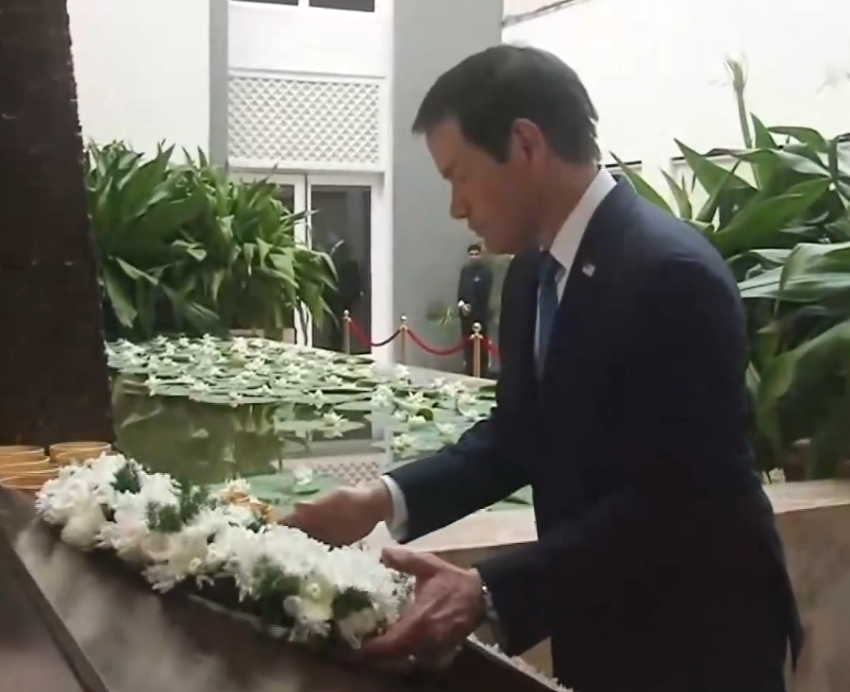

MUMBAI – Secretary of State Marco Rubio arrived in India on Tuesday (October 20, 2026) to meet some of the country’s most influential business leaders and visit the world’s largest oil refinery as the wars in Iran and Ukraine intensify pressure on global energy markets.
The visit, Rubio’s second this year, comes as ties between Washington and New Delhi remain strained. However, unlike Rubio’s last visit, which focused on Indian political power and pageantry, this trip will center on business and security ties, according to the State Department.
In Mumbai, India’s financial capital, Rubio was greeted by his Indian counterpart S. Jaishankar. Later in the trip, he is expected to travel to the western city of Jamnagar and tour the sprawling Reliance Industries refinery complex.
Speaking to reporters in Mumbai shortly after he arrived, Rubio said he would be asking Reliance to help address pressure on global energy markets by refining more Venezuelan crude.
ADVERTISEMENT

“We’ve talked to them about it in the past. We’re going to go see what the holdup is,” he said. Reliance is one of the few refining facilities in the world that can handle the kind of heavy crude typical of Venezuela.

Reliance, owned by chairman Mukesh Ambani, has already cultivated close ties with the Trump administration with its recent announcement backing a new multibillion-dollar refinery project in Texas. By taking on additional crude, the facility could help provide “relief” in the short term to global energy markets, Rubio said.
Rubio’s visit occurs as some of the central issues in the U.S.-India relationship remain unresolved. Ties between the two governments reached a high during President Donald Trump’s first term, but the relationship has deteriorated sharply over the last two years because of Trump’s tariffs, immigration policy and U.S. outreach to Indian archrival Pakistan.
Despite more than a year of back-and-forth, a U.S.-India trade deal is still being negotiated. The U.S. ambassador to India, Sergio Gor, a Trump ally who has organized both of Rubio’s India visits, said last week that the trade deal was close to competition, but he did not indicate an announcement was imminent.
“The big items are done,” he told an energy conference.
Just ahead of Rubio’s departure from the United States on Saturday, Trump paused sanctions related to Russian oil sales, a move that drew bipartisan criticism in the U.S., but one expected to be greeted with relief by the Indian government.
India relies heavily on imports of Russian energy, a situation exacerbated by disruptions to Middle Eastern oil exports related to the Trump administration’s war in Iran.
In the initial days of the Iran conflict, India encountered fuel shortages due to the standoff between Washington and Tehran over the Strait of Hormuz. More recently, the conflict’s inflationary pressures have stoked unrest, as waves of protests have engulfed the capital in recent weeks and crowds of thousands have rallied against the government of Prime Minister Narendra Modi.
That turmoil has made Modi more vulnerable to tensions with the Trump administration, according to Sadanand Dhume, an Indian writer and fellow with the Council on Foreign Relations.
“Had the sanctions gone through, it would have been a body blow to the relationship” with the U.S., Dhume said. “It would be seen as humiliating the prime minister and sort of showing him to be more or less powerless.” The news of Trump’s pause was a “great relief” to Modi’s government, he added.
When asked about the sanctions pause, Rubio said the move was intended to protect countries like India that need time to move away from Russian energy imports.
“You’ve got countries like India, for example, that have voluntarily diversified their energy portfolio but are still getting a substantial amount of energy from Russia,” Rubio said. “It’s hard to pivot from one day to the next, but they’re also an important ally and partner of the U.S.”
Despite the simmering tensions, core elements of the U.S.-India relationship remain intact. Trade between the two countries grew in 2025, hitting a historic peak of $240 billion. They also maintain strong military ties.
However, other analysts point to the fact that Rubio thus far hasn’t addressed many of the issues at the heart of the strained ties.
During his May visit, Rubio “was clearly trying to signal Washington’s appreciation for India, across the board,” said Michael Kugelman, a South Asia analyst at the Atlantic Council, who cited Rubio’s visits to cultural sites, political outreach and attendance at lavish events.
“But this didn’t address the issues that were bothering New Delhi,” he said, specifying anger over tariffs, overtures to Pakistan and the Trump administration’s transactional approach to the relationship.
“You can’t solve those policy differences,” Kugelman said, “with mere PR.”