

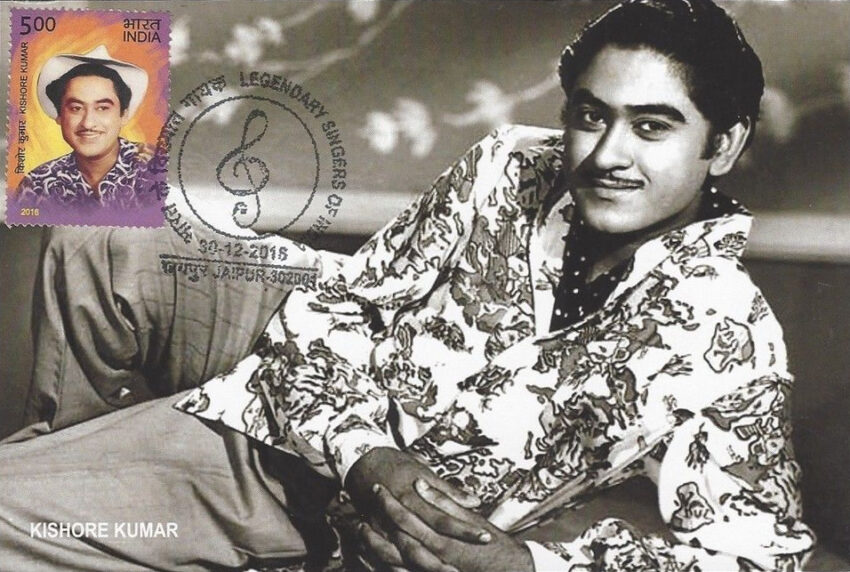

Thirty nine years ago, there was a Kishore Kumar, who could drive most cinegoers crazy with his ultra masculine baritone, playing, and teasing, and making them cry. Till he left on October 13, 1987, he dominated the Hindi film industry and most actors wanted to and used his voice to compensate for what was lacking in their appeal.
But Kishore Kumar was not just a projected voice, singing boisterous songs. There was a softer side to his singing, and some of his most loved songs are soft, romantic melodies. His ability to seamlessly pivot from a roaring, energetic track to a whisper-soft, heart-wrenching melody is exactly what defined his versatile genius.
The Quiet Art of Kishore Kumar
Kishore Kumar had a remarkably accurate pitch (sur) and a natural, unerring sense of rhythm (taal), even though he never received formal training in classical music, as noted by music historians and his actor brother Ashok Kumar.
ADVERTISEMENT

He also possessed an innate ability to control his breath and modulate his voice to sound perfectly intimate close to the microphone. When singing softer melodies, he relied heavily on breathy vocals, minimal vibrato, and deep emotional restraint. He was a master of some incredibly soft, soulful, and introspective songs.
“Phoolon Ke Rang Se” from Prem Pujari remains till date, a gentle, romantic song which he rendered with remarkable softness, perfectly capturing the tenderness and yearning. In “Tere Bina Zindagi Se” from Aandhi, his voice drops to a near-whisper, conveying profound regret and maturity.
Music from Door Gagan Ki Chhaon Mein and Door Ka Rahi is perhaps the ultimate proof of how deeply rooted softer, introspective melodies were to his actual artistic self. Kishore Kumar produced, directed, and composed the music for these films himself, and they reflect his artistic soul, stripped of any commercial pressure to play the “boisterous comedian” or high-energy playback singer. His compositions in these films represent some of the most hauntingly soft, minimalistic, and deeply philosophical music in Indian cinema history:
“Aa Chal Ke Tujhe”, is entirely acoustic and illustrates an incredibly soft, warm vocal delivery. He sings of a utopian world free of tears and sorrow with a pure, whisper-soft tenderness. “Jin Raaton Ki Bhor Nahin Hai”, is deeply somber and quiet, expressing pain and hopelessness, with his singing heavy and muted with restraint. “Panthi Hoon Main Us Path Ka”, the ultimate song of the solitary wanderer, features bare instrumentation, allowing Kishore Kumar’s soft, melancholic baritone to mimic the rhythm of footfalls on an endless journey. His personal musical vision was overwhelmingly quiet, gentle and contemplative.
Romance in a Softer Register

The gentle, romantic songs were on the other end of the scale of his boisterous and loud songs, his voice dropping to a warm, velvety, and almost conversational style, with heavy relying on close-microphone breathing and gentle phrasing. “Pal Pal Dil Ke Paas” from Blackmail is one of the best examples of his soft romantic expression.
“Chhu Kar Mere Manko” from Yaarana takes the listener on a different journey with extremely gentle, sung-like-an-intimate-whisper with light piano accompaniment. “O Mere Dil Ke Chain” from Mere Jeevan Saathi has remained one of his most loved songs with its smooth, soothing melody that highlights his effortless vocal control.
“Raat Kali Ek Khwab Men Aai” from Buddha Mil Gaya, “Kehna Hai Kehna Hai” from Padosan, “O Hansini” from Zehreela Insaan, “Tu Laali Hai Savere Wali” from Abhi To Jee Lein showcase his sweetest and silkiest vocal textures.
Songs of Life and Reflection
Some of Kishore Kumar’s much loved softer songs are philosophical and introspective musings. The words do the heavy lifting but his constant baritone imparts an underlying sadness of the eternal truths of life. These songs touch upon life, time, and human nature and his singing here is mature and deeply soothing.
While “Aane Wala Pal Jane Wala Hai” from Gol Maal is quiet, conversational, and lighthearted yet reflective, “Yeh Jeevan Hai” from Piya Ka Ghar is simple and profound, sung with a comforting reassurance.
“Beqarar Dil Tu Gaye Ja” from Door Ka Rahi, a duet with Sulakshana Pandit, is profoundly philosophical about resilience amidst sorrow and loneliness. Kishore Kumar infuses his voice with a heavy vulnerability, and sings it with a deliberate restraint. He uses a soft, textured baritone, leaning into the lower-middle register to evoke gravity and solitude, applying a controlled, slightly fragile emotional weight when he comes to the soaring lines.
Duets and Musical Partnership
Kishore Kumar excelled in his soft duets with Lata Mangeshkar, lifted by Gulzar’s poignant words in “Tere Bina Zindagi Se” from Aandhi, and “Dekha Ek Khwaab” and “Tere Mere Milan Ki Ye Raina” from Abhimaan.
The collaboration between Kishore Kumar and R.D. Burman revolutionized Indian film music. While they were famous for fast tracks, Burman knew how to utilize the softest, most velvety, and breathy tones of Kishore Kumar’s voice. The best examples of their whisper-soft, introspective, and soulful songs include some melancholic and minimalist melodies.”Chingari Koi Bhadke” and “Yeh Kya Hua” from Amar Prem and “Phir Wohi Raat Hai Khwab Ki” from Ghar are beautiful, quiet melodies.
Kishore Kumar’s intimate serenades showcase his ultimate “close-to-the-microphone” singing style, relying on light acoustic guitars, soft pianos, and gentle strings. “Chhoo Kar Mere Man Ko” from Yaarana is considered one of Kishore Kumar’s finest soft songs. Kishore Kumar is said to have recorded it in just one take, proving his natural mastery over pitch and emotional modulation, achieving a velvety texture with his close-microphone, whisper-soft technique. He sings the opening lines almost like a quiet, intimate thought rather than a heavy musical performance.
Kishore Kumar’s romance was linear and uniform. He relied on the inherent warmth of his natural vocal texture to carry the romance, rather than active musical manipulation, and was able to easily convey playful charm, casual flirtations, or stable and comforting companionship.
In the flirtatious and intoxicating “Ankhon Ankhon Mein Hum Tum Ho Gaye Deewane” from the film Mahal, Kishore Kumar’s rendition is wonderfully lighthearted and brimming with smiles and playfulness. The song is an example of Kishore Kumar’s use of short, bouncy phrasings with a bright upper-middle register. Avoiding heavy classical ornamentations, he lets his natural timbre carry the romantic mischief of the lyrics.
“Yeh Duniyawale Poochhenge” is about the public anxiety and thrilling secrecy of romance and Kishore Kumar adds a cheeky, dramatic urgency to his voice. He balances rhythm and theatrical dialogue, shifting his vocal weight, sliding effortlessly from soft, conspiratorial whispers to full, open-throated romantic exclamations. The song is the best example of his ability to laugh through his tone or add a theatrical wink to certain words.
A Voice for Every Mood
In his fast, exciting and energetic songs, Kishore Kumar brought an unmatched, infectious energy to the screen. He shattered the formal playback singing by treating the recording studio like a stage. He would physically move, dance, and mimic the actors while singing. His boisterous songs weren’t just technically sound; they were pure entertainment filled with uninhibited joy.
Kishore Kumar is widely considered one of the greatest and most influential playback singers in the history of Indian cinema. It was his natural musicality, flawless pitch, and incredible emotional range, even as he lacked formal training in Indian classical music, that allowed him to dominate the Hindi film industry for decades.
He is considered an extraordinary singer, with unmatched versatility. He pioneered the technique of embedding laughter, sighs, conversational dialogue, and his signature European-style yodeling directly into his tracks, making the playback feel incredibly alive. No wonder he won 8 Filmfare Awards for Best Male Playback Singer and remained the definitive voice for generations of legendary leading men, most notably Rajesh Khanna and Amitabh Bachchan.
Decades after his passing, his songs remain some of the most streamed and celebrated classics in Indian music history.