

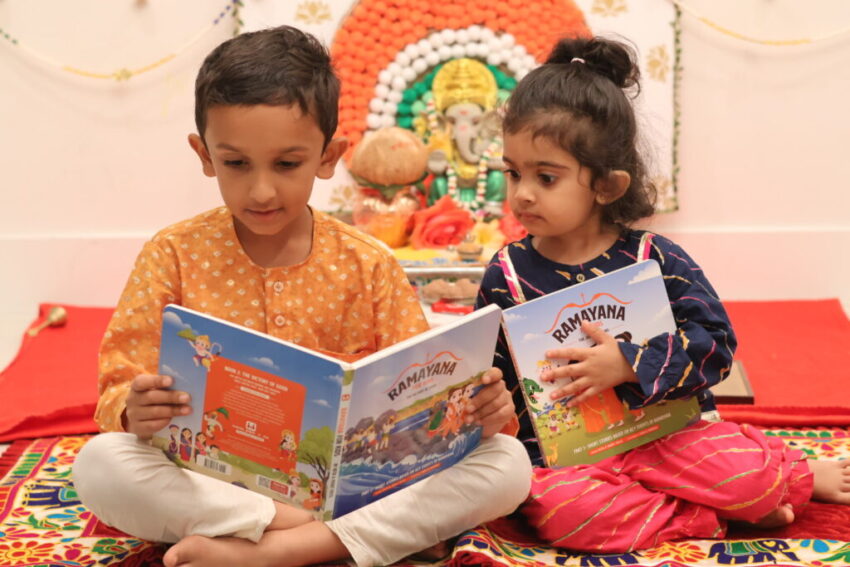
For many Indian families raising children in the United States, Diwali comes with a familiar mix of excitement and responsibility. We want our children to enjoy the lights, colorful clothes, family gatherings and sweets. But we also hope they will understand why the festival matters and carry some part of it into their lives long after the decorations come down. That second goal can be harder when children are growing up far from the extended families, languages and everyday traditions that shaped our own childhoods.

As parents, we have learned that cultural connection rarely begins with a formal lesson. It begins with a child’s question: Why do we light diyas? Who is Rama? Why do we visit family? Why do we share food? These questions are invitations, not interruptions. Diwali gives us a chance to answer them in small, age-appropriate ways and to make a tradition feel like something children belong to, rather than something they are expected to memorize.
There is no single way to celebrate Diwali. Hindu, Jain, Sikh and other families observe the season through different stories, rituals and regional customs. Even within Hindu households, the celebrations and the stories emphasized can vary widely. Many families connect Diwali with Rama’s return to Ayodhya after exile and his victory over Ravana; others place particular emphasis on Lakshmi Puja, Krishna’s victory over Narakasura, or their own regional traditions. A meaningful introduction starts with the practices and stories a family actually lives, while leaving room for children to appreciate the diversity around them.
For young children, the most effective introduction is usually tangible. A child who helps place a diya, chooses flowers for a decoration or arranges a small family gathering has an active part in the occasion. Ask what they notice, what they enjoyed and whom they would like to include. These conversations help children build memories associated with warmth and participation. They also create natural openings to explain ideas such as welcoming others, sharing with neighbors and showing gratitude.
ADVERTISEMENT

Stories offer another opening. When we tell children about Rama, Sita, Lakshmana and Hanuman, we can move beyond asking them to remember characters and events. We can ask what they think a character felt, why someone made a difficult choice or how a similar situation might arise at school. Hanuman’s devotion and courage, for example, can lead to a conversation about helping a friend. Rama’s commitment to duty can introduce the idea that doing the right thing is not always easy. Children do not need to master a long epic to begin exploring the human questions within it.
The key is to resist turning every story into a test. A four-year-old may be captivated by the image of Hanuman leaping across the ocean. A seven-year-old may ask more complicated questions about justice or responsibility. Both responses are valuable. Let children return to the same tale over time and understand more as they grow. Invite questions, including the ones adults may not know how to answer immediately. Looking for answers together models curiosity and respect for the tradition.
Language is often another source of anxiety for diaspora parents. We may worry that if our children are not fluent in Gujarati, Hindi, Telugu, Tamil or another family language, they will lose their connection to their heritage. Language matters, but perfection should not be a prerequisite for participation. Teach a short greeting, a festive phrase, a song or a familiar prayer. Ask grandparents to explain a word they love. Tell a story in English when that helps a child follow along, and weave in words from the family’s language where they fit naturally.
Grandparents and other relatives can become especially important cultural bridges. A video call in which a grandparent tells a childhood Diwali story may leave a stronger impression than a polished presentation. Ask them what their celebrations looked like, what foods were prepared, what they did with friends and what has changed. Children hear that traditions are not frozen objects: they are living practices, carried forward by people who adapt them to different places and circumstances.
Diwali can also become a lesson in generosity that children can practice. Invite them to help assemble a small gift for a neighbor, write a greeting for a teacher, choose a book to share or contribute to a community effort. Rather than insisting that they be generous, let them experience the preparation, anticipation and joy of giving. A family conversation about gratitude after the celebration may make the lesson even more durable.
In a world full of screens and competing schedules, it is tempting to search for one perfect activity or one elaborate celebration. But cultural learning often grows from repetition: ten minutes of reading together, a familiar song during a car ride, a festival dish prepared as a family or a puzzle completed with a sibling. Books and hands-on activities can help, especially when they give parents an easy way to begin a conversation. Their value comes from the connection they support, not from replacing the presence of a parent or grandparent.
This belief is part of why we created Mama Papa ’N Me, a children’s cultural learning brand. Like many parents raising children abroad, we wanted approachable ways to introduce stories and traditions without making the experience feel like homework. In developing Ramayana and cultural learning materials for young children, we kept returning to the same question: Will this give families something to do together and something meaningful to talk about afterward? The goal has never been to recreate our own childhoods exactly, but to make room for our children to develop a relationship with the heritage they inherit.

It is equally important to let that relationship become their own. A child may remember a festival because of a favorite story, a grandparent’s voice or a shared act of kindness. Another may feel most connected through music, food, language or community service. We can provide opportunities without prescribing a single correct emotional response. What matters is that children experience their culture as welcoming, relevant and open to their questions.
This Diwali, families do not need an elaborate plan to make the celebration meaningful. Choose one story to tell, one tradition to explain, one activity to do together and one generous action in which children can participate. If a child asks why another household celebrates differently, welcome that question too. It is an opportunity to teach that shared cultural roots can include many beautiful forms of expression, and that respecting those differences is itself an important family value. Ask what they thought, listen to their answers and revisit the conversation another day. Lights may illuminate our homes for a few evenings, but the memories, values and sense of belonging we build together can stay with our children far longer.
—-

Mohit and Keta Patel are co-founders of Mama Papa ‘N Me, an initiative “to bring timeless Indian stories, everyday values and Hindu culture to life through beautiful books, hands-on play and meaningful family conversations — without another screen.”