CHICAGO — August 29, 2026: India’s Union Minister for Finance and Corporate Affairs, Nirmala Sitharaman, made a landmark visit to Chicago as part of her six-day official tour of the United States, presenting India as a trusted, dynamic and long-term strategic destination for global investment, manufacturing, innovation and economic partnership.
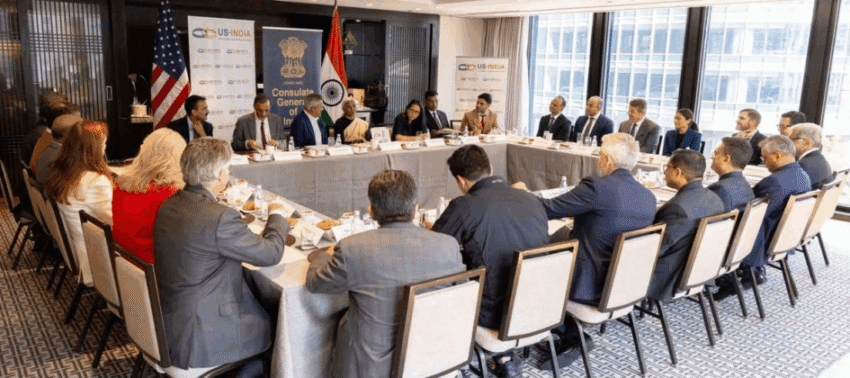
Business Roundtable: Nirmala Sitharaman, Minister of Finance and Corporate Affairs of India, Addressed addressed a business roundtable, urging global investors to manufacture, innovate, and build in India for worldwide markets. She highlighted India’s robust economic reforms, technology ecosystem, and talent pool. PHOTOS: Courtesy Organizers
During her official visit to Chicago, the Finance Minister held high-level discussions with prominent American business leaders, addressed an influential business roundtable and interacted with members of the vibrant Indian-American community. Her engagements emphasized India’s broad-based economic growth, continuing reform momentum, expanding infrastructure and rapidly developing opportunities across advanced and emerging sectors.
India’s Minister of Finance & Corporate Affairs, Govt of India Nirmala Sitharaman addresses the Indian diaspora in Chicago, USA, August 29, 2026
Sitharaman’s United States visit, scheduled from August 28 through September 2, included Chicago, Asheville and New York. The broader program featured participation in G20 meetings as well as meetings with investors, corporate leaders, policy experts and members of the Indian diaspora.
“Manufacture in India—for India and for the World”. A major highlight of the Chicago visit was a high-level business roundtable hosted by the U.S.-India Strategic Partnership Forum in partnership with the Consulate General of India in Chicago.
Nirmala Sitharaman interacted with the local Indian community at the Consulate General’s office, praising the diaspora’s role in amplifying India’s soft power, economic ties, and global reputation.
Addressing leading investors and business executives, Sitharaman presented a compelling case for “Why India, Why Now.” She urged international companies to view India not only as one of the world’s largest and fastest-growing consumer markets, but also as a powerful global platform for manufacturing, technology, innovation and long-term infrastructure development.
The Finance Minister’s central message—“Manufacture in India—for India and for the world”—reflected the country’s ambition to deepen its integration into global value chains while creating partnerships founded on co-development, co-production, research and innovation.
She invited global companies to build in India for international markets by taking advantage of the country’s large pool of engineering and technology talent, competitive manufacturing capabilities, growing domestic demand, expanding physical and digital infrastructure and strong entrepreneurial ecosystem.
The discussions highlighted opportunities in manufacturing, artificial intelligence and digital technologies, financial services, infrastructure, food processing, defence and other advanced technologies. These sectors offer substantial possibilities for companies seeking scale, skilled talent and durable growth.
Her message was clear: India should not be regarded merely as a market to be served, but as a strategic base from which companies can design, develop, manufacture and deliver products and services to the world.
During her Chicago engagements, Sitharaman met individually with senior executives representing major sectors of the American economy.
She met Monish Patolawala, Executive Vice President and Chief Financial Officer of ADM, for discussions concerning greater collaboration in food processing, nutrition, sustainable supply chains and related areas. These sectors are especially important as India works to improve agricultural value addition, strengthen food security and connect farmers and producers with modern domestic and global supply networks.
The Finance Minister also met Brandon Tseng, co-founder and president of Shield AI, and discussed opportunities related to defense innovation and advanced autonomous systems. India’s expanding defense manufacturing sector, engineering expertise and commitment to indigenous production offer growing opportunities for technology partnerships, testing, development and manufacturing.
Her meeting with Sachin Lawande, president and chief executive officer of Visteon Corporation, focused attention on India’s strength in automotive technology, electronics, software and advanced mobility. As the global automobile industry undergoes a major transformation, India is emerging as an important location for research, engineering, digital solutions and next-generation vehicle technologies.
Sitharaman also met Luca Zaramella, Executive Vice President and Chief Financial Officer of Mondelēz International. The engagement reflected the significant potential of India’s consumer market, food-processing sector, supply chains and manufacturing ecosystem.
Together, these meetings demonstrated the wide scope of India–United States economic cooperation—from agriculture and food processing to automotive technology, digital innovation and defense.
The Finance Minister highlighted India’s sustained reform process and the role of technology in making economic growth more inclusive, transparent and efficient. India’s expanding Digital Public Infrastructure has transformed access to financial and government services while supporting entrepreneurship and innovation on an unprecedented scale.
Platforms and initiatives such as Aadhaar, the Unified Payments Interface, DigiLocker and the Open Network for Digital Commerce have helped create an interconnected digital ecosystem serving citizens, businesses and institutions.
India’s experience demonstrates how technology, when developed at population scale, can promote financial inclusion, improve public-service delivery and open new opportunities for small businesses.
The country’s progress in digital services, advanced manufacturing and financial innovation—together with institutions such as Gujarat International Finance Tec-City—offers global investors multiple pathways to participate in India’s next phase of development.
Warm Interaction with Chicago’s Indian Diaspora. Another important feature of the visit was Sitharaman’s interaction with members of the Indian diaspora at the Consulate General of India in Chicago.
Raja Krishnamoorthi the U.S. Representative for Illinois’s 8th congressional district speaking at the event headlined by Indian Finance Minister Nirmala Sitharaman, August 29, 2026, in Chicago.
Addressing the gathering, she recognized the Indian-American community’s valuable contributions to the United States and its important role in strengthening the relationship between the world’s two largest democracies.
ADVERTISEMENT
Through their achievements in business, medicine, technology, education, public service and community leadership, Indian Americans have enhanced India’s global reputation and helped build enduring people-to-people connections.
The Finance Minister underscored the diaspora’s ability to amplify India’s soft power, share the country’s achievements and create meaningful bridges in trade, investment, knowledge and culture. The interaction offered community members an opportunity to hear directly about India’s macroeconomic landscape, development priorities and future outlook.
Sitharaman’s full address to the Indian diaspora in Chicago is available online.
Sitharaman’s Chicago visit carried significance beyond the individual meetings. It reaffirmed the growing importance of the American Midwest in India–United States economic engagement.
Chicago’s position as a center of finance, manufacturing, agriculture, transportation, food production, technology and higher education makes it a natural partner in India’s development journey.
The visit also demonstrated the increasingly multidimensional character of the bilateral relationship. Cooperation between India and the United States now extends across investment, resilient supply chains, clean energy, digital technology, defense, food security, advanced manufacturing and innovation.
By combining high-level business outreach with a warm community interaction, the Finance Minister presented a confident vision of an India that is reform-oriented, digitally empowered, globally connected and ready to build enduring partnerships.
Her message from Chicago was both an invitation and a statement of purpose: global partners are welcome to invest, innovate, co-develop and manufacture in India—not only for India’s vast domestic market, but for the entire world.