

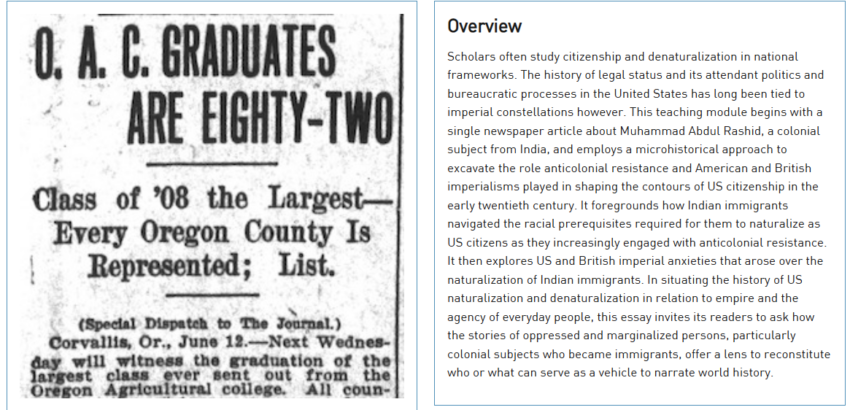

In 1905, twenty-three-year-old Muhammad Abdul Rashid deboarded the Empress of Japan at the port of Vancouver before making his way to Portland, Oregon. Rashid had enrolled at Oregon Agricultural College (now Oregon State University) and was part of a growing cohort of students from colonial India at leading agricultural colleges in the United States. Thanks to newspapers, we know about the experiences of these students, or how US and other officials responded to their presence in the US. These young adults hoped to gain knowledge in the US before returning to colonial India to develop its economy. They believed the future of India lay in the hands of foreign-educated students whose expertise could help build India’s economy and educational institutions in the wake of British colonialism.
Rashid, born the same year that the United States barred most Chinese immigrants (1882), entered the country at a historical conjuncture when white nativists insisted Asian laborers presented an immigration and health crisis for the nation. Federal and state authorities and local white residents policed Asian laborers but granted greater agency to more elite immigrants like Rashid. Asian students, diplomats, businessmen, and religious figures benefited from federal immigration law, which targeted Asian laborers but carved out exemptions for more well-to-do Asian immigrants. When the deportation of Indian immigrants peaked in 1908, Rashed marked a milestone of his own. He submitted a seventeen-page thesis entitled “Composition and Food Value of Some Cattle Foods” to the Department of Chemistry and graduated alongside the largest class to date at Oregon Agricultural College with a bachelor’s in science in June 1908. The local press heralded Indian graduates, noting their “excellent progress.”

The same month that Rashid graduated, he applied to the Benton County Circuit Court in Oregon to naturalize as a US citizen. At the time, federal immigration law required all immigrants to be a “free white person . . . of good character” to successfully naturalize. Congress had enacted this racial prerequisite in the nation’s first federal naturalization law in 1790, underscoring the founding legislators’ efforts to make whiteness a matter of law and maintain white supremacy through the law. How Rashid proved he was white is unknown, but the Benton County Circuit Court naturalized him as a U.S. citizen, despite insistence from the head of the Bureau of Naturalization, Richard K. Campbell, and the Attorney General of the US, Charles J. Bonaparte, that Indian immigrants were not white. At the time, federal judges held discretion over the naturalization cases of applicants such as Rashid. They relied on the academic writing of prominent anthropologists, philologists, and ethnologists to adjudicate race and held varying interpretations of whether Asian immigrants like Rashid constituted white persons or not.
Rashid was among the first Indian immigrants naturalized in the United States. By 1908, Bellal Houssein and Abdul Hamid, Bengali peddlers with strong connections to New Orleans’ Creole community, naturalized on the other side of the country in the District Court for the Eastern District of Louisiana. Federal judges across courts in San Francisco, New Orleans, Galveston, Detroit, Portland, Boxelder County (UT), Pittsburgh, and Los Angeles naturalized approximately seventy well-to-do Sikh, Hindu, Parsee, and Hindu immigrants from colonial India under existing racial and residency requirements in the early twentieth century. Most Indian laborers were denied naturalization.
ADVERTISEMENT

And yet Rashid’s case reflected major concerns about the naturalization of Indian immigrants in the United States. Shortly after Rashid naturalized as a US citizen, he returned to India where he advocated for the overthrow of the British government. In December 1908, The Corvallis Gazette reported that British authorities had convinced the Bureau of Naturalization and the United States District Attorney at Seattle to annul Rashid’s status as a U.S. citizen because he was actively encouraging Indian sepoys to revolt against the British colonial government. British officials were frustrated that they could not punish Rashid as harshly as other Indians or restrict his ability to migrate more freely due to his status as a U.S. citizen.
Efforts by the Government of India and the Colonial Office to foil a range of antiimperialist movements led by immigrant activists emboldened the security apparatuses of both the British and American states, and American processes of naturalization and denaturalization. In the late nineteenth century, British concerns over Irish American freedom fighters called Fenians sparked an international conflict over the rights of Irish immigrants to renounce British subjecthood and naturalize as US citizens. In the early twentieth century, British subjects arriving in the United States, including those from colonial India, continued to raise concerns over naturalization in the United States. Agents of the Government of India, India Office, and colonial India’s provincial governments feared that immigrants, including students like Rashid, would smuggle arms from abroad into India to lead a rebellion, plot the assassination of prominent British officials, and bomb strategic imperial sites.

Imperial officials considered it a high priority to thwart the political movements of Indian immigrants in the United States. Most Indian immigrants in the United States originated from colonial Punjab, which served as the primary recruiting base for the British Indian Army. Michael Francis O’Dwyer, the Lieutenant Governor of Punjab, feared Punjabi immigrants abroad could encourage seditious activities within Punjab and infiltrate the ranks of Punjabi service officers who helped sustain British imperialism across Asia and Africa. American complicity with foreign governments was not uncommon. State and federal government officials had long been complicit in prohibiting newly colonialized populations from acquiring U.S. citizenship across the Caribbean and Pacific, and in stifling anticolonial movements led by Irish, Mexican, Puerto Rican, and other immigrants within their national borders.
In the early twentieth century, as historians Moon-Ho Jung and Seema Sohi have shown, British and American authorities developed an expanding security state apparatus as a result of anti-imperial politics led by Indian immigrants and pan-Asian political solidarities. Imperial officers leveraged discourses of national security and patriotism during World War I to draw renewed attention to the naturalization of politically active immigrants who challenged the imperial world order. After Rashid’s case, British officials advocated for the denaturalization of Indian immigrants who secured U.S. citizenship if they participated in anticolonial movements from abroad. In 1917, U.S. and British officials collaborated but failed to denaturalize Taraknath Das, a Bengal-born activist and one of the founders of the Hindustani Association, over his involvement with German enemies of war and communists. During World War I, Das was convicted of violating the Neutrality Act during the Hindu-German Conspiracy Trial and sentenced to twenty-two months in the federal penitentiary in Leavenworth, Kansas. The Hindu-German Conspiracy Trial also drew renewed attention to British and American authorities who grew increasingly concerned about the risk the naturalization of colonial subjects posed to empire. The trial revealed that Indian immigrants had developed vast networks across imperial borders and spanning nearly every continent to overthrow the colonial government.
British officials also colluded with American officials to restrict Indian immigrants from naturalizing as U.S. citizens during the war. In 1917, V.W. Tomlinson, the regional naturalization examiner in Oregon employed by the Bureau of Naturalization, opposed Bhagat Singh Thind’s third attempt to naturalize as a U.S. citizen in Oregon. The Bureau submitted evidence retrieved from the Director of Military Intelligence linking Thind to political activities, activists, and wartime labor strikes, and questioned Thind’s loyalty to the United States. Thind, an Indian laborer and part-time student at the University of California-Berkeley, and his lawyer contested the Bureau of Naturalization. The two men submitted a letter from the U.S. Army proving Thind’s service during the war and his interest in becoming a Signal Reserve Corps officer, a position that required naturalization. They also submitted Thind’s Loyal Legion of Loggers and Lumbermen (Four L) membership card to the court. The organization, founded by the U.S. War Department in the Pacific Northwest, countered labor organizations such as the International Workers of the World. Every member swore loyalty to the United States and committed to the production of logs and lumber to build airplanes and ships for the U.S. armed forces. The District Court for the District of Oregon naturalized Thind as a US citizen, but the Bureau of Naturalization and Department of Justice appealed Thind’s case to the US Supreme Court, insisting that Indian immigrants were not white. The US Supreme Court declared Indian immigrants were of “Asiatic stock”—not white—and unanimously denied Thind citizenship in 1923. The Department of Justice then pursued the first denaturalization of an entire immigrant community when it targeted Indian immigrants in 1924. British authorities refused to intervene in the denaturalization proceedings, which impacted Indian men and their families, and largely ignored the petitions of Indian subjects suffering from the loss of rights granted to them as U.S. citizens. This included the right to land ownership and entry into the United States.
In 1946, U.S. legislators voted to grant a limited number of Indian and other immigrants from East, South, and Southeast Asia the right to naturalize as U.S. citizens in light of new transimperial concerns during World War II and political organizing by Asian communities. At the time, British officials hoped to secure Indian support for the war effort and did not challenge Indian immigrants’ right to naturalize as U.S. citizens as they had in the early twentieth century. British officials were preoccupied with the growing nationalist movement within or near the borders of colonial India and were busy preparing plans on how and when to transition power to India’s nationalist leaders in the wake of independence. U.S. officials also privileged the geopolitical importance of India and Indian soldiers to their victory in the war, and potential access to India’s markets following independence. The motivations of both empires revealed how imperial interests continued to shape legal reforms to American naturalization processes through the twentieth century.

Hardeep Dhillon is a sociolegal historian specializing in the development of immigration and border controls. Dr. Dhillon is currently a postdoctoral fellow at the American Bar Foundation where she is completing a book manuscript that places Asian American history at the center of the legal development of twentieth century US immigration and border enforcement. She received her doctorate in History from Harvard with a secondary focus on Women, Gender, and Sexuality Studies. Dr. Dhillon will join the Department of History at the University of Pennsylvania in Fall 2023.
Source: “Short Teaching Module: Indian Immigrants and U.S. Citizenship in an Imperial Context ,” in World History Commons, https://worldhistorycommons.org/short-teaching-module-indian-immigrants-and-us-citizenship-imperial-context