

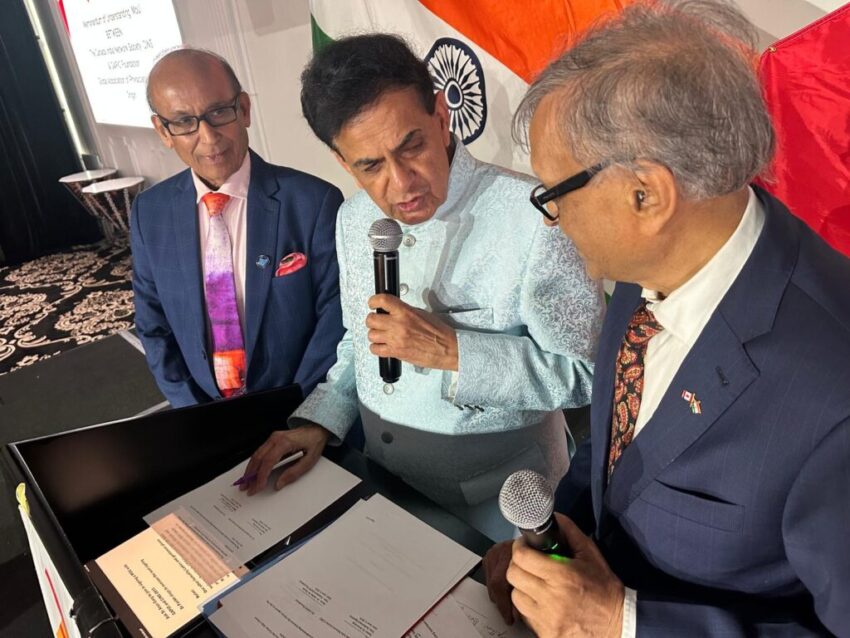
The Global Association of Physicians of Indian Origin (GAPIO) led by President Dr. Sudhir Parikh, and Canada India Network Initiative (CINI) under the Canada India Network Society (CINS) led by Dr. Arun Garg brought healthcare leaders, researchers, physicians, policymakers, and community advocates from US, Canada, and India to British Columbia, Canada in early June. They discussed integrative care and the impact of cultural and social factors on healthcare and advocated new approaches to preventive healthcare, chronic disease management, and community-based wellness.

The meeting was held in Surrey City Hall in the city of Surrey, British Columbia.
“By formalizing the Canada–India Bridge Accelerator and strengthening collaboration between CINS and the Global Association of Physicians of Indian Origin (GAPIO), the summit established a pathway toward a more integrated, culturally intelligent, and human-centered model of care,” organizers noted in a press release.

Padma Shri recipient Dr. Parikh, chairman of Parikh Worldwide Media/ITV Gold, among the largest Indian American media outlets in US, outlined the global reach of GAPIO, and urged Indian-origin physicians in Canada to join GAPIO in order to improve healthcare outcomes around the world. He emphasized how GAPIO was present in 60 countries and represented the interests of the 1.6 million or so Indian origin physicians around the world.
ADVERTISEMENT

CINS founder Dr. Arun Garg, emphasized culturally precise medicine, integrative thinking, and cross-sector collaboration to shift healthcare from a reactive system to a proactive creator of sustainable health.

The conference opened with municipal leaders, healthcare executives, and diplomatic representatives. Surrey Mayor Brenda Locke welcomed delegates, highlighting the role of local governments in shaping the social and cultural conditions that determine health outcomes.

Discussions centered around how modern medicine excels at diagnosing disease and measuring biological markers, but it often fails to account for the full human context in which those diseases develop.
The conference called for expanding the definition of ’clinical information’ to include questions around sleep, stress, diet, cultural practices, and spiritual beliefs as central determinants of disease expression and recovery, and that treatment and healing needed to go beyond prescriptions or procedures.
Connecting Biology, Culture, and Technology
Under the theme ‘Connecting the Dots, the conference advanced a model integrating biomedical science with cultural knowledge and emerging technologies. Traditional practices, whether breathwork, nutrition, or community rituals, offer both physiological and psychosocial benefits. When validated and responsibly integrated, they enhance rather than compete with conventional care, the conference concluded.
At the same time as wearable devices, home diagnostics, and AI-driven platforms enable real-time tracking of the dynamic relationship between behavior, environment, and biology, aspects such as art, storytelling, and movement are therapeutic tools that support and influence recovery and long-term outcomes.

The conference called for steps to be taken such as translating health resources into Punjabi, Hindi, Urdu, and Bengali, and expanding screening into trusted spaces such as gurdwaras, temples, and community centers.
Dr. Victoria Lee, Former President and CEO of Fraser Health, noted that embedding care within these ecosystems supports a shift from reactive emergency care to proactive, prevention-focused systems.
Several institutions including Apollo Hospitals in India whose Chairman Dr. Prathap C. Reddy had founded GAPIO in 2011, had been adopting the integrative approach, a press release from CINS said.

“Health is not created in clinics alone. It is shaped in kitchens, workplaces, places of worship, and everyday interactions,” organizers noted in the press release.