

Abstract art has traditionally been dominated by men, but female abstractionists have often been the trailblazers, as a new show at the National Museum of Women in the Arts makes abundantly clear.

What stands out most about “Making Their Mark: Works From the Shah Garg Collection,” an exhibition of eight decades of abstract art by women, is the variety and scope of the roughly 80 pieces by nearly 70 artists. On display are paintings, sculpture, ceramics, textiles and more figural compositions that might not typically be categorized as “abstract.”
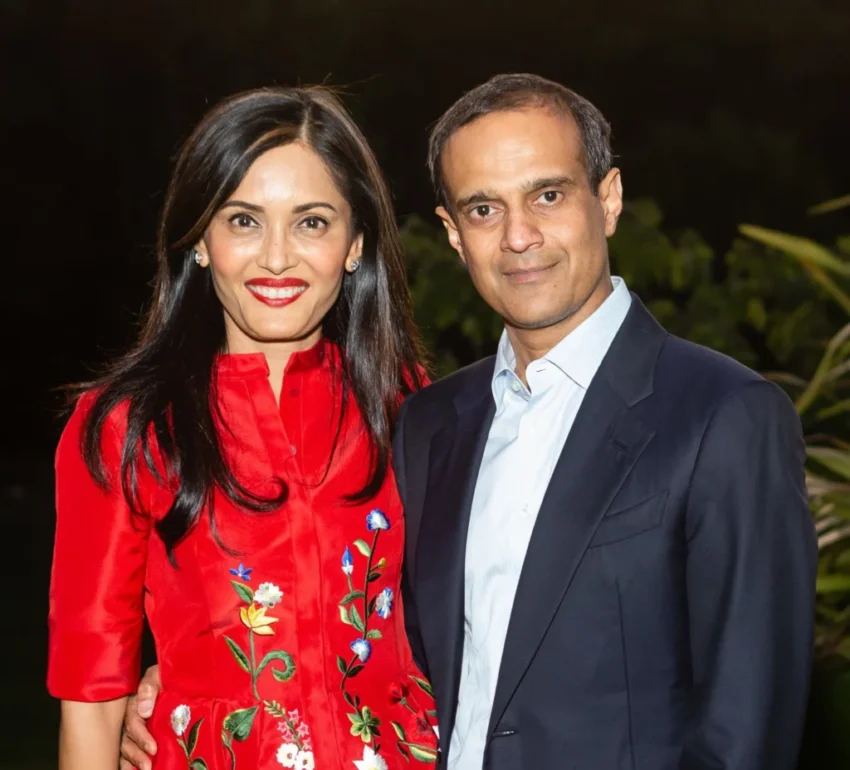
The traveling exhibition, drawn from the private collection of Komal Shah, a veteran of Silicon Valley, and her husband, venture capitalist Gaurav Garg, opened in 2023 in New York, followed by stops in California and Missouri. Its D.C. incarnation is the first time it is being shown at a women-focused venue.
With works spanning 1946 to 2024, “Making Their Mark” features significant female figures in 20th-century art as well as emerging artists. Indeed, it is as if the old guard is passing the baton, as several artists have died since the show was launched – including Faith Ringgold in 2024, Jaune Quick-to-See Smith last year and Pat Steir this spring. Other pioneers born in the 1930s and ’40s include Judy Chicago, Barbara Chase-Riboud, Howardena Pindell and Kay WalkingStick.
ADVERTISEMENT

Some pieces carry extra political resonance, while others highlight the abstract potential of textiles and fiber – materials often characterized somewhat derisively as “craft,” particularly when employed by female artists. Here are six noteworthy works in the show, which runs through July 26.
Julie Mehretu: ‘Among the Multitude VI’
Part of a series, Julie Mehretu’s “Among the Multitude VI” takes on the charged issue of immigration, but there is nothing recognizably representational about it. The Ethiopian American artist here used digital techniques, as in much of her recent work, to manipulate and blur photographs taken from media of migrant detention centers and anti-immigrant demonstrations. She then projected the imagery onto a canvas and worked it over with ink and acrylic until the colorful composition reached a style resembling gestural abstraction. The vigorous strokes feel at once aesthetically captivating and full of righteous anger.
Jenny Holzer: ‘Top Secret Endgame’
Conceptual artist Jenny Holzer, who had a show at Glenstone last year, is best known for her text-based light projections, but in this abstract painting, the text is minimal. The luminous work, made with oil paint, moon gold leaf and palladium leaf on linen, appears as if its surface is gleaming metal. On closer inspection, the words “top secret” and “endgame” and a couple of numbers reveal what the painting is really about: Each metallic swath represents a redacted paragraph from U.S. government documents on the wars in Iraq and Afghanistan.
Joyce J. Scott: ‘Harriet’s Quilt’
An homage to Harriet Tubman, Baltimore artist Joyce J. Scott’s “Harriet’s Quilt” is made of plastic and glass beads held together with yarn, resulting in a highly tactile assemblage that is draped on the wall like a quilt and loosely evokes the shape of Africa. Created between 2016 and 2022, it uses materials that feel of the moment while also honoring older African American quilting traditions. The work incorporates fabric knotted by the artist’s late mother, quiltmaker Elizabeth Talford Scott (1916-2011), who also has a piece in the show: “Save the Babies,” a 1992 mixed-media patchwork quilt in the shape of a shield.
Firelei Báez: ‘For Améthyste and Athénaire (Exiled Muses Beyond Jean Luc Nancy’s Canon),
Anaconas’
Firelei Báez created these two elaborately framed paintings as part of a larger site-specific installation at the Museum of Modern Art in New York from 2018 to 2019, but they are enthralling even without their original backdrop. The New York-based artist, who is of Dominican and Haitian descent, envisioned portraits of Améthyste and Athénaire Christophe, the daughters of Haiti’s first king and queen, of whom no images had been thought to exist. The women wear tignon head coverings decorated with symbolic patterns, and their eyes are especially haunting: Báez, seeking to push against racial stereotyping, rendered their faces without noses or mouths.
Melissa Cody: ‘The Three Rivers’
This vibrant wool rug by fourth-generation Navajo weaver Melissa Cody is centered in her own history as well as that of her people. Cody works in what is known as the Germantown Revival style, with roots going back to the 1860s. That’s when Navajo artisans, who used only natural dyes, were introduced to synthetically dyed yarn in extremely bright colors that had been manufactured in the mills of Germantown, Pennsylvania. Cody applies this Technicolor-like palette in geometric patterns inspired by traditional forms and the pixelated video games of her 1980s childhood.
Françoise Grossen: ‘Contact III’
Dating to 1977, this enormous hanging fiber sculpture by Swiss-born, New York-based Françoise Grossen consists of a long line of reddish ropes made with Manila hemp, a material often used in fishing nets and on ships for its durability. Knotted and tied in a repeating pattern accented by fuzzy tufts, the dangling cords have an anthropomorphic quality. Grossen’s piece acts as a sort of curtain between sections of the exhibition, offering a meditative ambiance while leaving its meaning open-ended.
ADDON FROM NEWS INDIA TIMES
About Komal Shah and Gaurav Garg (Makingtheirmark.org)
Originally from Ahmedabad, India, Komal Shah migrated to the US in 1991 to study computer science in California. After completing her Masters at Stanford, she obtained an MBA from the Haas School of Business at Berkeley, eventually holding positions in the executive suites of Oracle, Netscape, and Yahoo. In 2008, Shah left the tech industry to focus on philanthropic pursuits. She then began developing the Shah Garg Collection with her husband and tech entrepreneur Gaurav Garg, solidifying a vision for the collection’s emphasis on women artists in 2014.
Today, they are focused on amplifying the voices of women artists through the Making Their Mark Foundation.
Formerly known as the Shah Garg Foundation, the Making Their Mark Foundation supports scholarship and public engagement highlighting the achievements and innovations of women artists. Through a wide range of projects and partnerships with educational institutions, arts organizations, and arts leaders, the Foundation works to bring greater recognition to art by women and to rectify the underrepresentation of women in public collections, exhibitions, and art historical narratives.